PHOTO
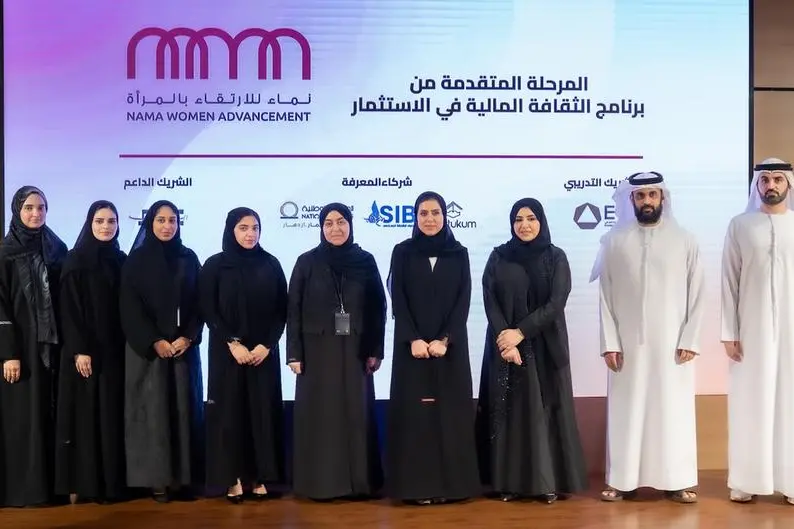
Sharjah: NAMA Women Advancement concluded the second edition of the Advanced Financial Literacy in Investment Programme, enabling 32 women to strengthen their financial and investment capabilities and make more informed and independent financial decisions. The programme was delivered in collaboration with the Emirates Institute of Finance, with the participation of Sharjah Islamic Bank, National Bonds, Baitukum and Alef Group.
Delivered over three weeks, the programme combined interactive learning, practical applications and one-to-one mentoring sessions, providing participants with practical tools to assess their financial standing, define financial goals, compare investment options and make decisions that balance returns, risk, liquidity and long-term objectives.
Through interactive workshops, case studies and expert-led guidance, participants developed a deeper understanding of financial planning, investment decision-making and wealth-building principles, while applying key concepts to real-life financial scenarios.
Knowledge-based financial decision-making
H.E. Mariam Al Hammadi, Director General of NAMA Women Advancement, said: "The programme gave participants a broader and more practical understanding of investment by helping them recognise how day-to-day financial decisions relate to investment opportunities, digital investing platforms, Sharia-compliant financial products and long-term financial planning. This integrated approach enables women to assess financial decisions with greater confidence, compare the options available to them and choose the path that best aligns with their goals, circumstances and long-term aspirations."
She added: “The real value of programmes such as this lies in transforming financial knowledge into more informed, confident and independent decision-making. Financial literacy becomes meaningful when it equips individuals with the ability to ask questions, analyse information and compare alternatives before making decisions. At its advanced level, the programme takes participants beyond the foundations of financial literacy towards a deeper understanding of how investment decisions are developed and evaluated at every stage.”
Investment Tools and Islamic Finance Principles
The programme progressed from personal financial management to introducing participants to a range of investment instruments, including deposits and savings accounts, bonds and sukuk, equities, mutual funds, exchange-traded funds (ETFs), and lower-risk real estate investment options.
Participants explored how returns are generated through different investment vehicles, the levels of risk and liquidity associated with each, and the importance of building diversified portfolios. The training also highlighted the long-term impact of fees and trading commissions on investment performance.
Islamic Finance Principles
The programme also introduced participants to the principles of Islamic finance and the key distinctions between Islamic and conventional financial systems. Participants were familiarised with concepts such as murabaha, mudaraba and musharaka. They gained an understanding of how returns in Islamic finance are linked to trade, leasing arrangements, assets and genuine economic activity.
Digital Investing and Market Participation
As part of the programme’s digital investment component, participants gained an understanding of the regulatory environment governing financial markets and investment platforms in the UAE. They were introduced to the process of obtaining an investor number, opening and securing investment accounts, and using trading simulation tools before entering live markets.
The programme also included practical training on using digital and mobile investment platforms, helping participants understand the fees associated with trading, withdrawals, and account management, as well as how these can affect investment outcomes.
Long-Term Financial Planning
The programme also explored Long-Term Financial Planning and retirement options, introducing participants to the concept of financial independence as the stage at which income generated through investments and assets is sufficient to cover living expenses, reducing reliance on employment as the sole source of income.
Following the completion of the training programme, participants attended one-to-one mentoring sessions to discuss their individual financial priorities and investment-related questions directly with experts.