PHOTO
We are mere hours away from the end of Ramadan. As Muslims across the globe get ready to bid adieu to the holy month that has been filled with blessings and kindness, there is a sense of jubilation.
After all, at the end of it is Eid Al Fitr - a day of happiness and festivities. Fasting on this day is not allowed, as it must be dedicated to a feast and a declaration of the greatness of Allah.
Eid is the first day of the Islamic month of Shawwal, which comes after the holy month of Ramadan.
Giving a brief history of the festival, Islamic scholar Shaikh Zafarul Hasan Madni said:
"Eid began from the time Prophet Muhammad (Peace Be Upon Him) migrated to Madinah from the holy city of Makkah, when he found people celebrating two specific days as Eid. They had carnivals and festivities to mark their New Year and another to celebrate the date from when days became shorter and nights longer. Prophet Muhammad (Peace Be Upon Him) told them: that instead of those two days, Allah has appointed two other days which are better, the days of Eid Al Fitr and Eid Al Adha. From that day onwards, Muslims worldwide celebrate these two days."
Eid is celebrated to give thanks for the strength that carried Muslims through the month, Madni said.
"We celebrate Eid to show our gratitude to our Creator Allah for giving us the strength, health, and a chance to fulfil our obligation to fast and do good deeds during the holy month. Also, this is our way of thanking Allah for giving us an opportunity to get all our sins forgiven as our dear Prophet Muhammad (Peace Be Upon Him) said that whoever fasts during Ramadan out of sincere faith, hoping to attain Allah's rewards - all his past sins will be forgiven."
As soon as the crescent of the month of Shawwal is sighted, mosques, markets, streets and houses echo with cries of the takbeerat (Allahu Akbar, which means 'God is great').
Muslims praise God in a loud voice (by saying Allahu Akbar, Allahu Akbar, Allahu Akbar. La ilaha illà l-Lah wal-Lahu akbar, Allahu akbar walil-Lahi l-Hamd) as they go to the Eid prayer site. And the recitation stops once the prayer starts.
General rituals
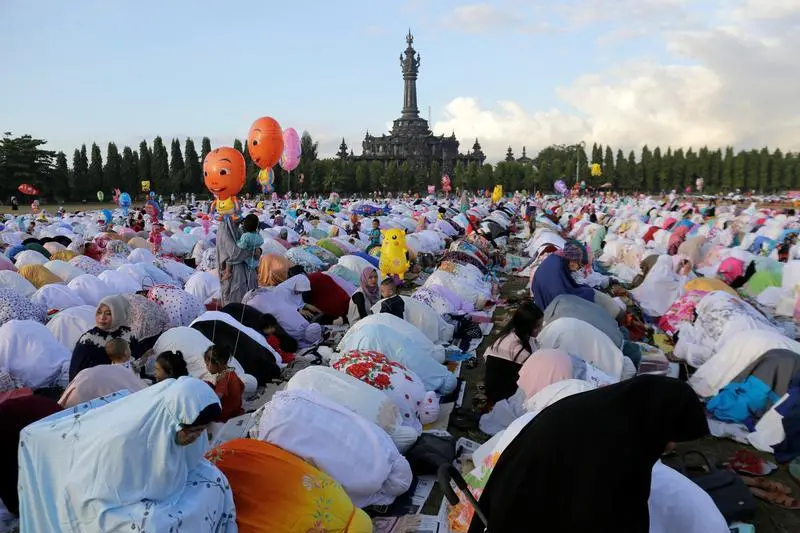
Eid Al Fitr is celebrated for one, two or three days, and a specific prayer for this Eid takes place at a special place - and in a special way.
But before offering the Eid prayer, Muslims must ensure that they have paid the Fitr charity, which is mandatory regardless of whether the person observed the Ramadan fast or not. It's an obligatory act of charity, where a stipulated amount is paid to the poor and the needy (known as Zakat Al Fitr) before performing the Eid prayer.
Reminding Muslims of some important traditions, Madni said: "The way of our dear Prophet Muhammad (Peace Be Upon Him) was that he would take a bath, brush his teeth, wear good clothes, and apply perfume and then proceed to the Eid grounds for the Eid prayers. He would eat something sweet (preferably dates), before proceeding with the prayers."
Madni added that it was the way of the Prophet to urge all women - young and old - to come and pray at the open-air Eid grounds.
"Also, it is Sunnah (way of the Prophet) to take different routes when going to and coming back from the Eid prayers," he said.
Eid, Madni said, is a feast of bringing people together and uniting everyone for the love of Allah.
"It strengthens the ties of love among the Muslims of the world. The message that Eid conveys to the world is that of unity, love, peace and brotherhood. This is evident with the way the Eid day starts, which is with a prayer in congregation in an open ground, so that a number of Muslims (men, women, children and the elderly) can meet, greet each other, and pray together behind one imam.
"Eid is a peaceful festival where Muslims show their gratitude to God by coming together to glorify and thank Him," he said.
Copyright © 2019 Khaleej Times. All Rights Reserved. Provided by SyndiGate Media Inc. (Syndigate.info).