PHOTO
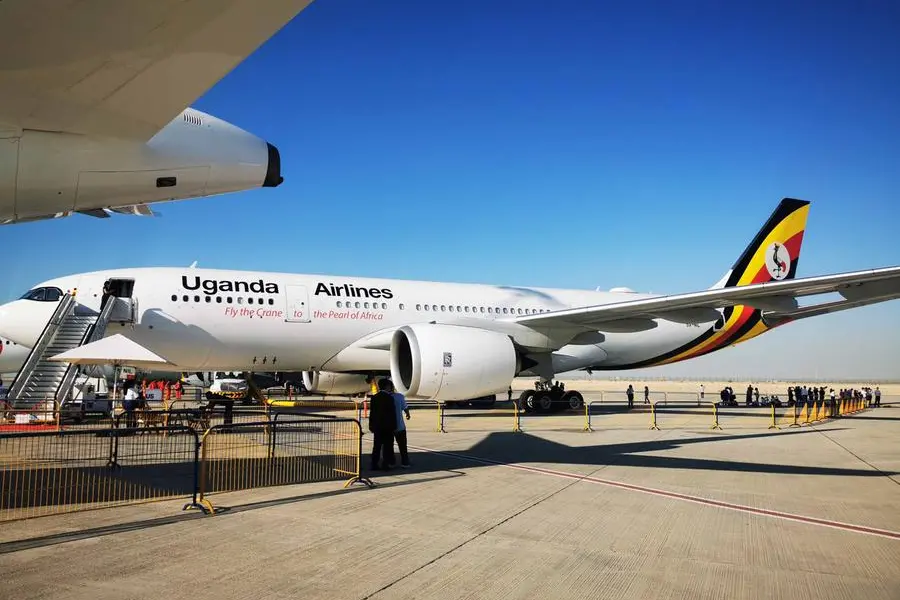
Uganda Airlines and British aerospace giant Rolls-Royce are engaged in delicate negotiations whose outcome could shape the future of the airline’s long-haul ambitions and determine whether the Airbus A330neo remains central to the carrier’s fleet strategy.
For interim chief executive Girma Wake, the talks represent an early and politically sensitive leadership test as he walks the tight rope of restoring operational stability after months of disruption.
Mr Girma must now navigate a commercially sensitive relationship with one of aviation industry’s most influential suppliers while safeguarding the airline’s long-term international expansion plans.
The outcome could ultimately determine whether Uganda Airlines’ future wide-body operations remain anchored around the Airbus A330-800 or pivot decisively toward Boeing aircraft instead.
The negotiations follow a turbulent period that repeatedly forced the grounding of the airline’s two A330neos, disrupting key international services to London, Dubai and Mumbai.
But this has exposed the difficult economics of running an airline in Africa’s highly expensive operating environment, where smaller carriers often struggle to balance contractual obligations against high operating, maintenance and financing costs.
At the centre of the dispute are the aircraft’s Rolls-Royce Trent 7000 engines and the increasingly expensive TotalCare maintenance programme attached to them.
The Trent 7000 powers the A330neo family and is typically sold alongside Rolls-Royce’s TotalCare support package, under which operators make monthly payments in exchange for guaranteed access to maintenance services, spare parts and replacement engines when required.
For Uganda Airlines, the arrangement initially proved advantageous. During the post-pandemic supply chain crisis, when airlines globally struggled to secure spare parts and maintenance slots, TotalCare helped the carrier maintain relatively stable technical support and avoid prolonged aircraft downtime.
But as the aircraft matured and maintenance requirements intensified, the economics reportedly became harder for the airline to sustain. Sources familiar with the negotiations say tensions escalated after accumulated arrears under the agreement prompted Rolls-Royce to suspend elements of its support services, leaving Uganda Airlines exposed because there are no independent third-party maintenance providers certified for the engine type.
The situation became acute from December 2025, when both A330neos were grounded in quick succession after reaching mandatory inspection thresholds tied to engine cycles and time-limited components.
Industry sources say the Trent 7000 requires high pressure turbine blade inspections roughly every 1,000 flight cycles — thresholds that can be reached much faster when aircraft are deployed on shorter routes.
While the strategy helped preserve network coverage and accumulate flying hours, it also accelerated engine cycle depletion while generating lower yields.“The aircraft works technically, but the economics are becoming difficult,” one industry source familiar with the negotiations said.
Reached for comment, Uganda Airlines board chair Priscilla Mirembe Serukka and LCH Consultancy for Rolls-Royce said they would make their plans public “soon”According to industry insiders, a growing feeling within the airline is that the maintenance arrangement increasingly favours the manufacturer over the operator as monthly costs continue to escalate.
Payments that reportedly started at about $400,000 per month had risen to approximately $1.1 million by January 2026. That perception was reinforced after the airline wet-leased a Boeing 787-800 from Ethiopian Airlines and found that operating the leased aircraft was costing less than deploying its own A330neos.
The comparison deepened concerns within sections of the airline that the economics of the fleet model may no longer be sustainable without significant restructuring of maintenance terms, improved aircraft utilisation or expansion of the route network.
Analysts further say Uganda Airlines’ difficulties also reflect deeper structural challenges within its fleet strategy.
The airline currently operates only two Rolls-Royce-powered A330neos, limiting its ability to spread maintenance and operational costs across scale. In the airline industry, wide-body economics generally improve when operators run larger fleets, allowing maintenance costs, spare parts inventories, crew utilisation and technical expertise to be distributed across multiple aircraft.
Uganda Airlines, by contrast, operates a relatively small and fragmented fleet structure. Its regional operations are primarily handled by 76-seat Bombardier CRJ900 aircraft, creating a sharp capacity mismatch with the 258-seat A330neos.
That imbalance has complicated efforts to consistently fill long-haul flights while also creating onward connectivity bottlenecks for passengers arriving from intercontinental routes.
In operational terms, the airline often faces situations where passenger flows arriving on an A330 exceed the carrying capacity of connecting regional aircraft.
Conversely, feeding enough passengers from regional routes into long-haul departures has also proven difficult. The result is lower-than-optimal utilisation across the network.
Although the London Gatwick Airport route reportedly gained early traction and captured a significant share of Uganda-UK traffic, sustaining high load factors consistently across the broader long-haul network has remained challenging.
Under the TotalCare arrangement, utilisation matters enormously. Industry sources say the agreement effectively assumes minimum monthly operating thresholds — estimated at around 400 block hours per aircraft— below which the airline may still be required to pay for unused hours.
That model works well for large airlines operating dense global networks and consistently high aircraft utilisation. But for smaller African carriers operating fewer long-haul routes and facing volatile demand, the economics can quickly become strained when aircraft fail to achieve expected flying hours.
The challenge is compounded by the broader cost structure of African aviation. Airlines across the continent routinely face some of the world’s highest fuel costs, heavy taxation, expensive financing and fragmented markets.
Those pressures leave many operators with thin margins and limited room to absorb unexpected technical or maintenance expenses. Sources familiar with the situation say despite the tensions, the manufacturer remains committed to Uganda Airlines and views the relationship as strategically important.
Rolls-Royce has continued supporting the airline during the negotiations, including facilitating temporary engine swaps that allowed one aircraft to return to service and helping the carrier avoid a complete operational shutdown.
Analysts say TotalCare is designed to protect airlines from catastrophic one-off maintenance costs by spreading payments gradually over time.
From the manufacturer’s perspective, the model allows airlines to avoid sudden multimillion-dollar maintenance bills while guaranteeing technical support and operational predictability.
But critics within the industry argue that the economics can become difficult for smaller operators when utilisation assumptions fail to materialise. Some aviation insiders also believe Uganda Airlines’ current predicament may accelerate a broader reassessment of the carrier’s fleet strategy.
The airline has announced plans to acquire four Boeing 787s, four Airbus A320neos and two Boeing freighters.as part of its next growth phase.
Industry sources say two of the planned 787s are expected to replace the existing A330neos rather than simply complement them.
There is also growing speculation that Boeing Commercial Airplanes could eventually persuade Uganda Airlines to transition toward an all-Boeing fleet centred around the 787 and Boeing 737 MAX families.
Such a shift would simplify fleet commonality and potentially reduce operational complexity, although it would also represent a major strategic pivot only a few years after Uganda Airlines invested heavily in the Airbus platform.
For now, much depends on whether the current negotiations can restore stability between the airline and Rolls-Royce.
A collapse in relations would carry significant implications not only for Uganda Airlines but also for Rolls-Royce and Airbus, both of which have an interest in preserving confidence in the A330neo programme among African carriers.
Industry observers say the dispute ultimately illustrates the difficult balancing act confronting many African airlines: the desire to operate globally competitive fleets while contending with thin traffic volumes, fragmented regional connectivity and some of the harshest operating economics in global aviation.
© Copyright 2026 Nation Media Group. All Rights Reserved. Provided by SyndiGate Media Inc. (Syndigate.info).