PHOTO
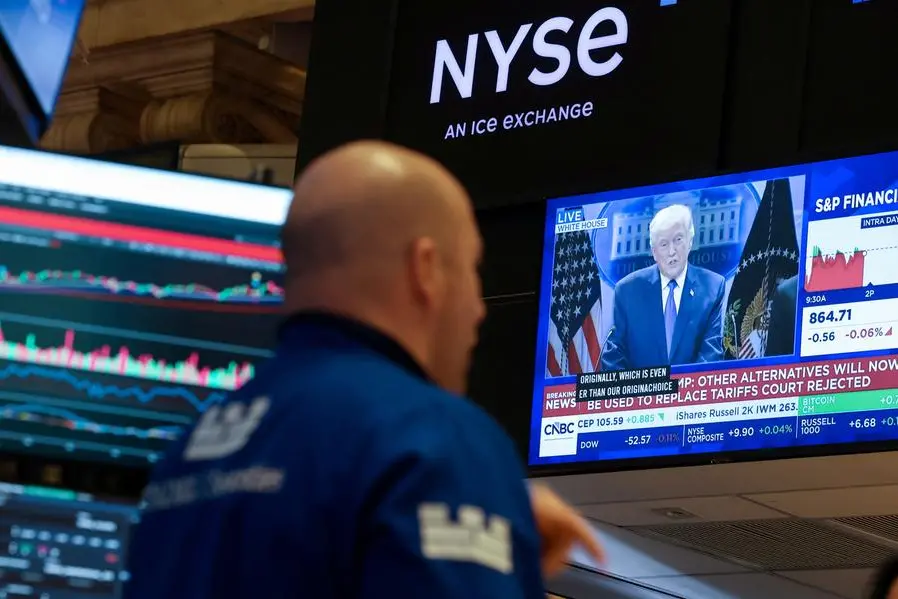
Wall Street futures and the dollar dropped on Monday as confusion over U.S. trade policy revived the "sell America" trade, after President Donald Trump imposed a new 15% tariff following the Supreme Court's ruling against his global levies.
Gold gained along with safe-haven currencies such as the Japanese yen and Swiss franc. European stock futures slipped as investors tried to work out the implications for the world's major economies, while shares in Hong Kong jumped on the assessment that U.S. tariffs on China could fall.
The U.S. Supreme Court struck down Trump's emergency tariffs on Friday, leading the president to quickly announce a new 10% rate on the rest of the world, only to then lift it to 15% on Saturday.
"The tariff landscape is now more uncertain than before, uncertainty is not good news for any economy or market," said Rodrigo Catril, a senior FX strategist at NAB.
"Unless common sense prevails, we could be entering a circular process where new tariffs are announced, then potentially overturned, only for new tariffs to be announced, and we do the dance again."
S&P 500 futures fell 0.2% and Nasdaq futures were down 0.4%, after earlier dropping as much as 1%.
U.S. stock markets are also set to be tested later this week by earnings from Nvidia, which are sure to cause waves given the chip designer makes up almost 8% of the S&P 500 index.
The dollar fell 0.14% versus the yen to 154.82, while the euro rose 0.16% to $1.1799.
The dollar also slid 0.22% on the Swiss franc while gold climbed 1% to $5,153 an ounce and silver rose 2.8% to $86.96 per ounce.
AVERAGE TARIFF RATE DROPS
It was unclear when the new tariffs would be imposed, what might be excluded and whether every country would be slapped with 15%. Some, including the UK and Australia, had 10% tariff rates under the former rules, while many countries in Asia had higher rates.
The Yale Budget Lab said the overall average effective tariff rate would stand at 13.7% after Trump's announcement on Saturday, down from 16% - the highest since 1936 - before the Supreme Court's ruling.
It added that it expected the 15% tariffs would expire after 150 days, following the 1974 Trade Act under which they were invoked. If so, the average rate would fall to 9.1%.
Europe's STOXX 600 index fell 0.3%, with Germany's DAX down 0.5% and Britain's FTSE 100 roughly flat.
"Trump is Trump - he won’t abandon his America first mantra and will keep pushing the limits as long as he’s in power," said Tomas Hildebrandt, senior portfolio manager at Evli in Helsinki.
"(There) may be some relief for some European exporters, but the tough anti-Europe attitude of the Trump administration isn’t fading away."
Asian markets were mixed but stocks broadly rose, with the MSCI Asia index which excludes Japan up 0.86%.
Hong Kong's Hang Seng index rallied 2.53% partly due to expectations that China will face lower tariffs after the ruling. Goldman Sachs analysts noted China could enjoy a 6.6 percentage point fall in its tariff rate.
Japan's Nikkei was shut for a holiday but futures fell 0.24%.
Brent crude oil prices slipped 0.6% to $71.31 a barrel, unwinding some of the gains made last week when Trump said the U.S. could strike Iran amid a large-scale build up of forces in the region. Further U.S.-Iran talks are scheduled for Thursday.
Government bonds rose very slightly in the United States and Europe, with the 10-year U.S. Treasury yield down just under a basis point to 4.078%. Yields move inversely to prices.
(Reporting by Harry Robertson in London and Wayne Cole in Sydney; Additional reporting by Danilo Masoni; Editing by Lincoln Feast and Susan Fenton)