PHOTO
SINGAPORE: Markets got off to an uneven start in Asian trading on Wednesday as worries about the Iran conflict and health of the AI sector dominated ahead of the Federal Reserve's decision and earnings from tech megacap stocks later in the session.
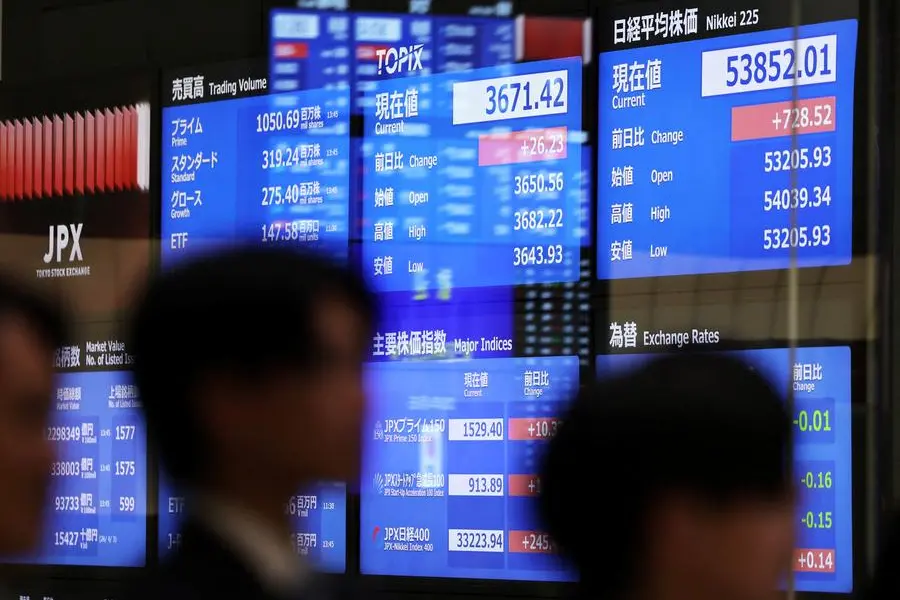
MSCI's broadest index of Asia-Pacific shares outside Japan eased 0.2%, retreating for a second day from record highs set on Monday, led by declines for Taiwanese chipmakers. Japanese markets were closed for a holiday.
S&P 500 e-mini futures nudged up 0.1%, while Brent crude rose 0.4% to $111.71 per barrel as efforts to end the Iran conflict hit an impasse.
"Markets remained cautious overnight as peace talks continued to stall, with Iran seeking the lifting of the U.S. naval blockade of the Strait of Hormuz and mediators expecting a revised Iranian proposal in coming days," analysts from Westpac wrote in a research note.
U.S. President Donald Trump is unhappy with the latest proposal from Tehran as he wants nuclear issues dealt with from the outset, a U.S. official said.
The Wall Street Journal reported on Tuesday, citing U.S. officials, that Trump has instructed aides to prepare for an extended blockade of Iran.
Stocks on Wall Street sold off on Tuesday, with the S&P 500 sliding 0.5% and the Nasdaq Composite falling 0.9% as investors assessed the stalemate in Iran.
Tech shares also took a hit after the Journal reported that AI heavyweight OpenAI had missed internal targets for weekly users and revenue, raising concerns over the ChatGPT parent's ability to support its massive spending on data centres. The report weighed on shares of Oracle and CoreWeave.
Earnings from U.S. tech giants Microsoft, Alphabet , Amazon and Meta Platforms, due later on Wednesday, will further test the AI-driven rally.
Corporate America has shown resilience in the face of the Iran conflict: with slightly more than one-third of S&P 500 sectors having already reported profits, 81% of companies have beaten estimates.
Market attention will turn to the outcome of the Federal Reserve's April meeting later on Wednesday, which will be Jerome Powell's last as Fed chair.
Traders believe a hold is a certainty. Fed funds futures are pricing an implied 100% probability the U.S. central bank will stand pat, with no policy changes expected until late in 2027, according to the CME Group's FedWatch tool.
"Given the challenging war-impacted inflation environment, it won't cost much for the Fed to adopt a hawkish tilt; while remaining in a wait-and-see mode," analysts from ING wrote in a research report. "There will also be questions on the incoming Kevin Warsh and Powell's intention to stay or go."
The yield on the U.S. 10-year Treasury bond was up 0.6 basis point at 4.346%, while the U.S. dollar index, which measures the greenback's strength against a basket of six currencies, edged up 0.1% to 98.67, rising for a second consecutive day.
Markets also digested the surprise exit of the United Arab Emirates from OPEC, though expectations are that the rest of the oil producer alliance will likely stick together.
"On any other given day, this news may have seen the Brent price move down $5 to $6 off the bat, given the UAE accounts for around 10% of OPEC output," said Chris Weston, head of research at Pepperstone Group Ltd in Melbourne.
"However, with the UAE's production facilities currently close to capacity, it is perhaps no surprise that Brent front-month futures quickly erased the initial drop."
Gold was down 0.3% at $4,581.40. In cryptocurrency markets, bitcoin was flat at $76,471.21 while ether was 0.3% lower at $2,289.16. (Reporting by Gregor Stuart Hunter; Editing by Jacqueline Wong)