PHOTO
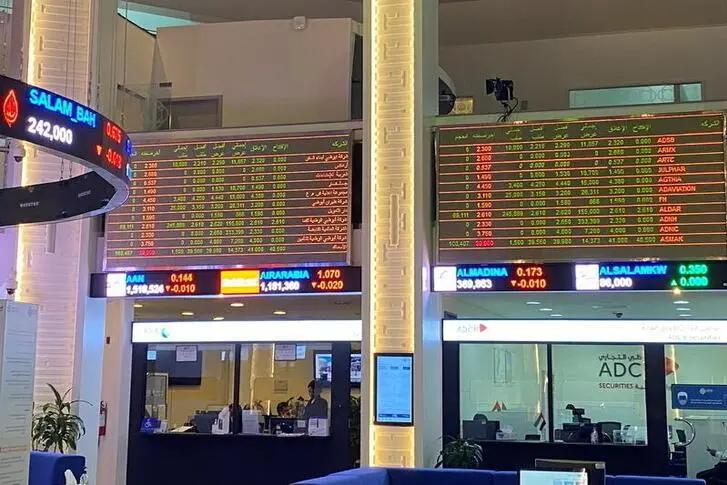
Stock markets in the United Arab Emirates ended lower on Friday, extending losses as investors grappled with mounting uncertainty over a potential escalation in the Middle East conflict. Israel launched heavy airstrikes on Hezbollah-held southern suburbs of Beirut and began what it called a "broad-scale" wave of attacks on infrastructure in Tehran on Friday. Iran said it responded by firing missiles at central Tel Aviv.
Overnight, Iranian drones attacked the U.S. Al Udeid airbase in Qatar, the biggest U.S. base in the Middle East, Qatari officials said. There were no reported casualties.
UAE bourses reopened on Wednesday after a two-day halt following Iran's unprecedented wave of missile and drone attacks on the Gulf nation over the weekend.
Dubai's main share index slid 3.2%, with blue-chip developer Emaar Properties retreating 4.8% and budget airliner Air Arabia losing 4.9%. Emirates and Etihad Airways resumed limited services to major global cities from their UAE hubs on Friday, even as the threat of missile strikes added pressure on airlines scrambling to accommodate passengers.
The escalating Middle East conflict has exposed how dependent global air travel is on a few major hubs, particularly Dubai — the world’s busiest international airport — as the closure of Gulf airspace disrupted airline networks worldwide.
Despite a two-day halt, the market recorded its worst week in nearly six years, down about 9%.
The UAE stock market is likely to stage a stronger-than-expected rebound once the initial shock fades and investors reassess the attractive entry points created by recent price discovery, said Samer Hasn, senior market analyst at XS.com.
As geopolitical sentiment stabilizes, investors may rotate into undervalued blue-chip names, partly unwinding the recent selloff as fear-driven selling eases and fundamentals regain prominence, supported by the UAE's long-term growth outlook.
In Abu Dhabi, the index finished 1.4% lower, with Aldar Properties shedding 4.9% and Abu Dhabi Commercial Bank falling 2.9%.
In telecoms, Emirates Telecommunications Group declined 3.8%.
The index recorded a weekly loss of more than 5%.
The Dubai and Abu Dhabi exchanges temporarily set a 5% lower price limit on securities to try to reduce volatility. Meanwhile, the UAE is considering freezing billions of dollars in Iranian assets held in the country, a move that could restrict Tehran’s access to foreign currency and international trade as the U.S.-Israeli military conflict intensifies, the Wall Street Journal reported on Thursday.
(Reporting by Ateeq Shariff in Bengaluru; Editing by Sumana Nandy and Shilpi Majumdar)