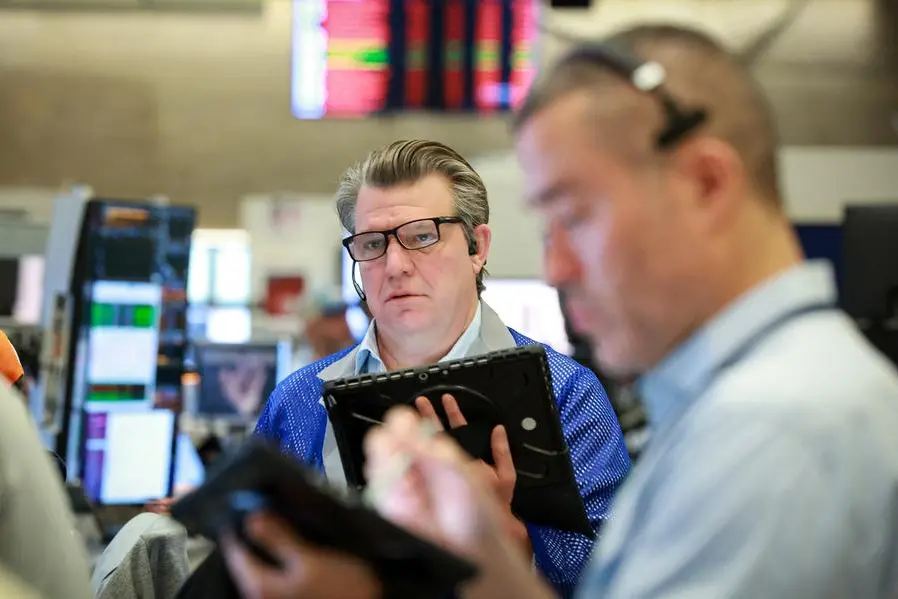
PHOTO
U.S. stock index futures fell on Thursday as oil prices surged past $100 a barrel, fanning inflation worries and forcing traders to dial back expectations of U.S. interest rate cuts.
Crude prices jumped after two tankers were set ablaze in Iraqi waters in apparent Iranian strikes, as part of wider attacks on oil and transport facilities across the Middle East. Iran warned prices could surge as high as $200 a barrel.
S&P 500 airline stocks, highly sensitive to fuel costs, are on track for their biggest monthly losses in a year. American Airlines and United were down over 2% each in premarket trading on Thursday, along with cruise stocks Norwegian and Royal Caribbean.
Energy companies Occidental and ConocoPhillips rose 1.8% and 1%, respectively.
Goldman Sachs has pushed back its forecast for the Federal Reserve's next rate cut to September, from an earlier expectation of June. Money market futures show traders now fully price in only one quarter-point cut by December, down from two cuts expected before the conflict.
"The problem is that investors are increasingly pricing in a more protracted conflict that causes extensive economic damage," said a group of strategists led by Deutsche Bank's Jim Reid.
"After all, with no concrete signs of de-escalation yet, that’s keeping oil prices elevated, and raising the risk of a broader stagflationary shock."
Global markets have been roiled this month as the U.S.-Israel war with Iran has disrupted oil and gas supplies and sent crude prices sharply higher, complicating global central banks' plans to ease monetary policy.
The International Energy Agency said that the world is facing the biggest oil supply disruption in history, with global supply is expected to drop by 8 million barrels per day in March.
At 7:21 a.m. ET, Dow E-minis were down 293 points, or 0.62%, and S&P 500 E-minis were down 32 points, or 0.47%. Nasdaq 100 E-minis were down 110 points, or 0.44%.
The CBOE volatility index, Wall Street's fear gauge, was up 1.08 points at 25.31, while futures tied to the rate-sensitive Russell small-caps index lost 1%.
Investors are also scrutinizing the roughly $2 trillion private credit market following a string of credit issues that have surfaced in recent months, raising concerns over loan performance and borrowers' ability to manage elevated interest rates.
Swiss private equity firm Partners Group warned private credit default rates could double in the next few years, and Glendon Capital Management said private credit lenders such as Blue Owl are obscuring weaknesses in their portfolios, according to reports.
Morgan Stanley slipped 2% after limiting redemptions at one of its private credit funds after similar actions by Blackstone and Blackrock earlier this month. JPMorgan Chase reduced the value of some loans to private credit funds on Thursday.
Shares of Blackstone dropped 1.4%, while Blue Owl lost 3%. Additionally, Washington said it was launching two new trade investigations into excess industrial capacity in 16 major trading partners and into forced labor, in a long-telegraphed move, to rebuild tariff pressure, after the Supreme Court tore down much of President Donald Trump's tariff program last month.
Bumble jumped 25% on Thursday after the dating app operator reported fourth-quarter revenue above estimates.
Dollar General fell 3.3% after the discount retailer forecast annual comparable sales below estimates.
Later in the day, investors will gauge jobless claims and comments from Fed Vice Chair for Supervision Michelle Bowman, ahead of Friday's personal consumption expenditure data - the central bank's preferred inflation gauge.
(Reporting by Medha Singh, Johann M Cherian and Utkarsh Hathi in Bengaluru; Editing by Sherry Jacob-Phillips and Maju Samuel)