Friday, May 10, 2013
By Costas Paris
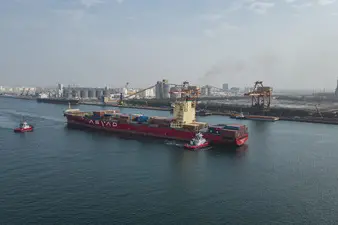
LONDON--Cash-rich United Arab Shipping Co. is considering buying five of the world's largest container ships for around $700 million, people with direct knowledge of the deal said Friday, in a move that underlines its ambition to become a significant player in an industry already awash with excess tonnage.
UASC's Triple-E mega container ships will form the basis of a new Europe to Asia service, jointly run with China Shipping Container Lines Co. (2866.HK), which earlier this week confirmed its own order for five Triple-Es, adding extra capacity on previously lucrative trade routes between Europe and Asia.
A record amount of vessels were ordered in 2007 just before the start of the financial crisis triggered a plunge in global trade. Tighter credit and uncertainty prompted a temporary lull in new shipbuilding, but stubbornly high fuel prices have since increased demand for bigger and more fuel-efficient designs even though the industry is groaning with excess capacity.
Five years on and routes between Europe and Asia are showing little or no growth in demand while industry analysts estimate oversupply at 10%, resulting in rock-bottom freight rates, which make it tough for companies to cover the industry's heavy fixed costs and operating expenses. All but seven of the world's 30 biggest shipping companies lost money last year, according to shipping analysts Alphaliner.
"All 20 big major container players will have to choose to either order similar ships or find themselves out of the Europe-Asia trade as smaller, less fuel-efficient vessels won't be able to compete," said Lars Jensen, chief executive of Denmark-based SeaIntel Maritime Analysis. He estimates that accumulated losses for the industry ran to about $7 billion over the last four years.
Market leader Maersk Line was first to order the mammoth ships, which can carry more than 18,000 20-foot containers, 2,000 more than CMA-CGM's Marco Polo, its nearest rival and currently the world's largest container ship. Maersk has 20 Triple-Es on order from DSME with the first ship scheduled to be delivered next month.
Compounding the problem for the industry, container-ship orders in the first quarter were up six-fold from last year, according to analysis by London-based Braemar Seascope Ltd., keeping rates in the future under pressure unless demand improves. Freight rates from China to northern Europe are down 30% since the start of the year at $796 per container, according to the latest Shanghai Containerized Freight Index.
"The minimum freight rate in the Europe-Asia route should be around $1,400 per box," Mr. Jensen estimates. "Lower rates for a significant period of time will lead to the industry being unsustainable."
Despite the obvious need to take tonnage out of the market, smaller ships are unlikely to be scrapped. "Instead they will be re-deployed to other trade routes adding to the overcapacity which will take years to be absorbed," Mr. Jensen said.
Maersk Line Chief Executive Soren Skou warned in April that the industry is on the verge of another price war unless excess vessels are taken out of service, especially in the Europe-Asia route, which accounts for about 40% of total container trade for the shipper and 15% of global container trade.
Shipping analyst Drewry said in its weekly container insight that current freight rates are "seriously lossmaking" and about 20,000 containers a week, or 6% of capacity, in the Europe-Asia route must be removed to halt the decline.
Hyundai Heavy Industries Co. (009540.SE) is building the Triple-E ships for CSCL and the South Korean shipyard is also in the running for the UASC order, along with Daewoo Shipbuilding & Marine Engineering Co. (042660.SE) and Samsung Heavy Industries Co. (010140.SE).
"The South Korean yards have been initially shortlisted for the UASC order," one of the people involved in the deal said. "There will be further shortlisting this month followed by talks with the yards on the price. We expect the order to be announced by August."
UASC didn't respond to written requests for comment.
Maersk Line says the Triple-Es will consume approximately 35% less fuel per container than the standard 13,100-capacity container vessels being delivered to other shipping lines in the next few years.
Bunker fuel prices have risen 16% a year on average over the past decade.
Write to Costas Paris at costas.paris@wsj.com
(END) Dow Jones Newswires
10-05-13 1514GMT