The net income of major UAE banks exceeded analyst expectations in the second quarter as the country's economy continues to fuel growth in the sector, but Shuaa Capital expected loan growth to become more challenging going forward and interest margins to come under pressure.
Net income was 9% above consensus on aggregate for the eight major banks covered by Shuaa Capital.
"Bottom line growth accelerated to 23% YoY (vs 19% YoY in Q1 14 and 18% in FY 13) on the back of decent loan book expansion, resilient net interest margins, robust non-funded income generation and lower provisions," Shuaa Capital said in a note.
Dubai banks outperformed their Abu Dhabi counterparts. Dubai Islamic Bank posted a 60% jump in net income year-on-year, while Emirates NBD recorded 35% year-on-year growth.
While a 14% growth in fee income contributed to the improvement in ENBD's performance, capital gain from property sales during the quarter reached AED 180 million (USD 49 million), a jump of 100%, year on year.
"The top-line remained robust with the improvement attributable to a favourable shift in the asset mix on account of retail and Islamic business, growth in CASA [current account and saving accounts] deposits and a contribution from Egypt," Global Investment House said of Emirates NBD's results.
However, it was Dubai Islamic Bank that saw the biggest jump in loan growth among major UAE banks, rising 10% in the second quarter. Total assets rose 9% to AED 123.2 billion in the first half, while non-performing loans continued their downward trajectory as impairment losses fell to AED 355 million in the first half compared to AED 545 million in the same period of 2013.
Abu Dhabi banks' performances in the second quarter were solid. National Bank of Abu Dhabi reported 17.5% year-on-year bottom-line growth, mainly due to strong growth in non-interest income and a huge decline in provisions.
"Notably, the bank's net interest income growth remained muted during the quarter due to subdued growth in loan book and decline in NIMs," Global said.
Abu Dhabi Commercial Bank reported a 22% growth in net profits while First Gulf Bank saw net income grow 16%.
COMPETITION INTENSIFYING
"We expected credit growth to become more challenging during 2014 as banks emerge from a period of deleveraging and competition intensifies; this has materialized this quarter with aggregate loan book adding 2% quarter-on-quarter for our coverage," said Shuaa Capital.
"Overall, the loan growth picture is becoming more challenging and banks have revealed this reality with both FGB [First Gulf Bank] and ENBD trimming full-year expectations post-Q2 2014 numbers."
Net interest margins are also under pressure and present a "key downside risk" for UAE banks going forward.
Still, asset quality continues to improve and non-performing loans (NPL) are receding.
Provisions fell 5% year-on-year in the second quarter with average NPL ratio standing at 5.5%, compared to 6.2% in the first quarter.
Deposit growth has strengthened, boosting liquidity in the banking system.
"Banks remain amply capitalized, and nonperforming loans (NPLs) have begun declining from their post-crisis peak, though they remain high, especially among Dubai banks," the International Monetary Fund noted.
MACROECOMIC GROWTH
UAE banks are benefiting from strong growth in the economy. Average corporate earnings in the first quarter alone grew 18.6% on a year-on-year basis, with real estate companies registering a growth of 82.4%.
The International Monetary Fund expects the country's GDP to grow 4.75% this year and on average 4.5% in coming years.
Dubai has been steadily reducing its debt pile and Abu Dhabi's economic fundamentals remain strong with crude oil prices above USD 100 per barrel for the fourth year running.
Despite the strong economic performance, the IMF warns that Dubai's total government and government-related entity debt stands at USD 142 billion (or 141% of GDP), with around USD 92 billion due over the next five years.
In addition, volatility in global financial markets could also erase gains made by Dubai.
"Renewed phases of financial market volatility could trigger a sustained reversal of capital flows, an increase in risk premiums and tighter liquidity conditions for the Dubai government and its GREs [government-related entities]," the IMF said. "GREs' potential financial problems could spill over to the domestic banking system, given their strong interconnectedness."
These challenges are somewhat offset by the UAE's status as a regional hub and a safe haven in times of regional tensions.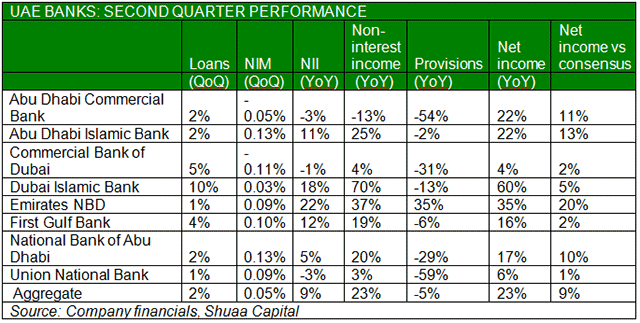
The feature was produced by alifarabia.com exclusively for zawya.com.
© Zawya 2014