Kazakhstan's Kashagan giant offshore field may have opened on July 2, but there are still a few doubts about the field's production timelines.
The massive oil field - touted as one of the world's biggest finds when it was discovered in 2000 with 35 billion barrels of oil in place - is set to catapult Kazakhstan to the status of one of the biggest non-OPEC producers in the world.
Indeed, Kazakhstan is expected to register the fourth largest growth in oil production over the next 20 years after Iraq, Brazil and Canada, according to the International Energy Agency (IEA).
The project has attracted some of the world's biggest heavyweight players:
Italian giant Eni (16.81%), European behemoth Royal Dutch Shell (16.81%), French company Total S.A. (16.81%), United States' ExxonMobil (16.81%) and ConocoPhillips (8.4%), Kazakhstan's KazMunayGas (16.81%) and Japan's Inpex (7.56%) were the original investors.
But Conoco will soon be out of the picture. The company wanted to sell its entire stake to India's ONGC Videsh for USD 5 billion last October, but the Kazakh government exercised its rights to purchase COP's 8.4% interest in the North Caspian Sea project.
However, India's loss is China's gain, as China National Petroleum Corp. (CNPC) is set to buy Conoco's stake in the project.
From Kazakhstan and other shareholders's viewpoint, CNPC's entry into Kashagan entails certain significant advantages to the project.
"The purchase price paid to KazMunayGas in this three-way transaction can translate into an infusion of capital into the Kashagan project."
Another key advantage of including China in the Kashagan project is the ready-to-use transport infrastructure. An onshore pipeline close to the offshore field means that the first oil will probably end up in China.
"The Indian company, had it won the contest, seemed likely to ship its share of oil from Kazakhstan via Russia," said Socor.
"By contrast, Chinese oil companies in Kazakhstan (CNPC's subsidiaries) are using the Atyrau-Alashankou pipeline from Kazakhstan to China. Launched in 2006, built and operated by a CNPC-KazMunayGaz joint venture, this pipeline goes from the source of supply to the consumer country directly, without having to cross any transit country."
The Chinese deal also allows Kazakhstan to move away from its dependence on Russian infrastructure, especially as the two countries are planning to raise pipeline capacity from the current 240,000 bpd to 400,000 bpd by 2015.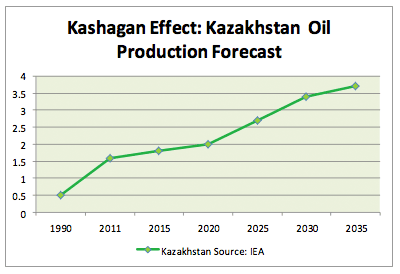
KASHAGAN IS CRUCIAL
The IEA believes the Kashagan project is crucial to Kazakhstan's aspirations of becoming a major crude producer.
"Production growth, especially in the medium term, comes primarily from the Kashagan and Tengiz fields, pushing total supply up from 1.6 million bpd in 2011 to 3.7 million bpd in 2035," said the IEA in its global outlook report.
"..There are significant uncertainties over the prospects and timing for the larger second phase that could take overall production from the field beyond the 1- million bpd mark."
Indeed, despite the formal start-up for Kashagan on July 2, media reports suggests the consortium may produce only nominal volumes before shutting down the field until a more practical start-up in warmer weather in April/May.
The managing director of North Caspian Operating Company (NCOC) highlighted the "start-up" as a "very important milestone", but also noted that the consortium would now begin a long sequence of complex processes in preparation for the production launch.
"Operator Eni has previously indicated (ahead of earlier plans) that start-up during the winter in Kazakhstan was challenging," said Peter Hutton, analyst at RBC Energy Capital Markets.
"Technically, if the October deadline is missed, the government is entitled to stop reimbursing the consortium's capital costs which have now risen to USD 45 billion."
Main production will be from eight wells linked to an artificial island in the shallow Caspian, then pumped to another island for treatment and then to the Bolashak plant near Atyrau for export. NCOC has begun testing Bolashak with sweet gas from nearly Makat oilfield. Once producing, the field is planned to ramp up to 180,000 bpd and a midterm plateau of 370,000 bpd.
GEOLOGICAL ISSUES
However, the project is beset with geological problems and cost overruns. The IEA estimates the operating cost of the Kashagan is one of the highest in the world at USD 20,000 per barrel, compared to USD 2,000 per barrel for many Iraqi and Saudi oil fields.
The NCPOC notes that the project involves a combination of technical complexity and environmental challenges, calling it "one of the greatest challenges of the petroleum industry worldwide."
"The field is heavily over-pressured, which presents a significant drilling challenge," the company said. "Offshore operations are conducted in extreme continental weather conditions. Winters are harsh and temperatures can drop to -40ºC (-40ºF), while summer temperatures can reach +40ºC (+104ºF)."
Despite the technical challenges and cost overruns, the Kashagan is set to emerge as one of the world's most important oil fields, and the government will
persist even if other oil majors sell their share.
With China backing the project financially and becoming an immediate customer -- that too in close proximity -- Kashagan is set to emerge as a strategic project for Kazakhstan.
© alifarabia.com 2013