The suspension of Nigeria's central bank chief has raised uncertainty for the economy as investors worry about its long-term impact.
In February, Nigerian president Goodluck Jonathan suspended Central Bank governor Lamido Sanusi after he made allegations that as much as USD 20 billion of the country's oil wealth was missing.
The governor had accused the country's state-owned oil company, Nigerian National Petroleum Corporation (NNPC), of misappropriating around USD 50 billion of oil revenues that should have accrued to the federal government.
NNPC refuted the allegations, suggesting that the governor "did not understand" how oil revenues are managed.
Analysts allege that the president acted swiftly as Sanusi's investigations into the missing billions would have led him straight to some of the most powerful people in the country.
The suspension of governor Sanusi coincides with rising investor concern over a decrease in foreign exchange (FX) reserves, which has partly caused a rise in fixed income yields, warns Ecobank, a pan-African national bank. FX reserves have fallen 15% to USD 41 billion compared to one year ago, reflecting continued robust American dollar demand to pay for imports and weaker than expected oil revenue performance owing to below target oil production and despite still high global oil prices.
With the unexpected suspension of a key policy maker, concerns will have risen over the direction and content of economic policy in the months ahead.
"While the position of the minister of finance is thought to be secure as she is a strong, technocratic leader with good connections throughout government (and beyond), nonetheless, the decision to suspend the CBN governor does increase uncertainty, which in turn will likely make foreign investors more cautious towards NGN-denominated assets," noted EcoBank, a pan-African regional bank based out of Togo.
News of Sanusi's suspension saw investor sentiment deteriorate sharply. The naira weakened to a record low of close to NGN 169/ USD 1 at one point, before the central bank's intervention pulled the currency back to close to NGN 163/ USD 1.
In a bid to soothe market fears, the president nominated Zenith Bank CEO Godwin Emefiele as the new central bank governor, who would start his term in July.
ELECTION TIME
The scandal of the missing billions of oil wealth comes at an unfortunate time for president Goodluck who is gearing up for elections on February 2015.
While the country's economy is set to grow by 7.3% this year, compared to the 6.4% in 2013, economic vulnerabilities persist. The external current account surplus had fallen to 3.1% of GDP last year from 7.8% at end-2012.
"The non-oil primary deficit of the consolidated government is projected to narrow from expenditure restraint, but a shortfall in oil revenues resulted in a drawdown of the Excess Crude Account (ECA), a key fiscal buffer," the International Monetary Fund warned in its March 7 report on the country.
Key threats to the economy include uncertainty about the pace of global recovery, unwinding of the unconventional monetary policy and lower oil prices.
In a nod to recent events, the IMF called for strong action to address oil theft and production losses.
"They advised the authorities to strengthen the regulatory framework by passing a sound Petroleum Industry Bill with enhanced oversight and transparency provisions," the IMF noted. "The framework for anti-money laundering and combating the financing of terrorism could support these efforts."
Oil production had fallen to 1.92 million barrels per day in February 2014, from a high of 2.07 million bpd in 2012.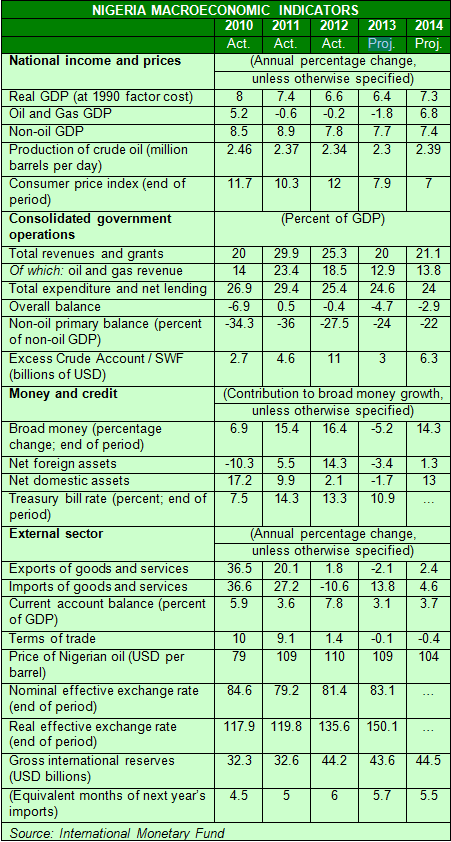
BANKING SECTOR SAFE
Despite the tensions with the suspended Central Bank chief, the country's banking sector remains robust, according to Fitch ratings.
"Despite the market volatility and uncertainty created by the suspension of the governor of the Central Bank of Nigeria, the agency does not believe there is any weakening in support for the Fitch-rated banks (which together form 70% of banking sector assets)."
The authorities had stepped in to support Nigerian banks during the global financial crisis of 2008/09, and analysts believe the banks can continue to expect government backing if the need arises.
Rapid consolidation over the years has also seen the number of Nigerian banks contract from 89 to 21 within a decade, and Investec Asset Management expects further consolidation.
"We see further consolidation and have invested in banks that we believe will be long-term winners in the process," Joseph Rohm, portfolio manager of the Africa fund at Investec Asset Management, said in a note to clients.
"Banks are still cautious on consumer credit but are open to offering mobile, Internet and other non-branch based-banking."
The Central Bank also granted licenses to seven mortgage institutions in February, taking the total number to 40, in a bid to spur housing loans in the country.
Other key areas of focus for the banks include power, energy and infrastructure. However, the banks remain reluctant on consumer credit.
"Continued weaknesses in labor markets, access to electricity, cost of doing business, and small and medium enterprises' access to finance have prevented a transition to a more robust and inclusive growth path," the IMF noted.
More crucially, the issue of transparency remains unaddressed.
Nigeria is notorious for rampant corruption and the authorities' suspension of a key respected official who had highlighted misappropriation of funds in the country's most vital sector, sends the wrong signal to would-be investors.
The feature was produced by www.alifarabia.com exclusively for www.zawya.com.
© Zawya 2014