Uzbekistan, Kazakhstan and Turkmenistan have some of the highest energy usage rates in the world, according to latest data.
Uzbekistan has by far the highest energy intensity at 0.73 kilogram of oil equivalent (kgoe) per US dollar, followed by Kazakhstan (0.49 kgoe per US dollar), among 45 emerging European and Central Asian states, according to data from the World Bank. Turkmenistan has the sixth highest usage rate, after Serbia, Russia and Ukraine.
"The region remains the most energy-intensive in the world - using 50% more energy per unit of output than the global average," the bank said in a three-report series on the region's climate change challenge. "Fossil fuels comprise 88% of the energy supply in Europe and Central Asia."
While the rates may be high they have come down from a decade ago as Central Asian states make concerted effort to bring their energy consumption rates closer to that of their peers.
CARBON-EMISSION CONTRIBUTORS
Curbing energy usage is important to raise productivity and economic efficiency in many Central Asia states.
The region is not immune to the challenges of global climate change, and the issue is demanding immediate and urgent changes in economic and social policies from the authorities.
"In recent years, some countries in the Europe and Central Asia region have been slow to respond to this challenge," said the World Bank in a three-report series, tackling the subject of climate change in the region.
In addition, chronic issues of power shortages in many parts of Central Asia, means governments will have to be proactive in diversifying the mix of energy sources to ensure that rising population and economic growth do not translate into greater carbon emissions.
DELICATE BALANCE
But it is a careful balance between ensuring economic growth without destroying the environment.
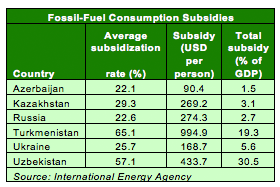
In much of Central Asia, residential energy subsidies are straining government budgets. But these are politically sensitive issues especially for many autocratic regimes, which leverage lower energy bills to ensure citizens remain compliant.
"By raising the cost of energy, climate action can affect employment and household welfare," the bank said. "Greater energy efficiency and effective social protection systems can soften those impacts. Labor market reforms and active labor market policies can facilitate job transitions, and social safety nets can help those unable to find adequate new work. Similarly, rising energy bills would hit the budgets of the poorest households the most."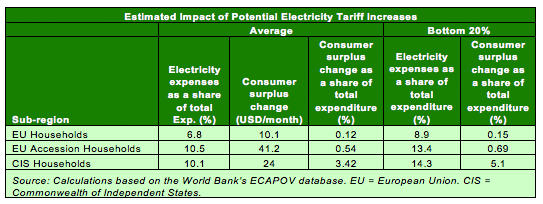
JOB-CREATING GREEN ENGINE
One study notes that Kazakhstan could double its agriculture productivity if it focuses on energy usage and efficiency. The World Energy Council estimates Kazakhstan alone can save up to 12 exajoules of energy by implementing a series of practical energy efficiency policies.
However, many Central Asian states continue to use outdated machinery, processes and technologies that contribute to energy wastage and - worse - degrade the environment.
Renewable energy presents unique job creating opportunities for the regional economies.
"More than 1 billion ha of forests in ECA should therefore be able to sustain around 1 million jobs in the forestry sector, and if wood and timber processing is further developed to reach Western European standards, 4.4 million people could be employed in wood processing. Hence, more than 3 million additional jobs could potentially be sustainably created in ECA's forestry sector.
The International Energy Agency notes that Eurasian nations are expected to raise their demand for renewable energy from 43 million tons of oil equivalent (mtoe) in 20120 to 103 mtoe by 2030 - an increase of 3.2% each year.
The Central Asian states have taken some tentative steps towards renewable energy. Armenia has been working on hydropower, while Azerbaijan and Kazakhstan has been experimenting with wind projects.
And there is a lot more potential that Central Asian can tap into. Analysts believe
Kazakhstan, Tajikistan, Turkmenistan and Uzbekistan are ripe for large-scale wind power projects. Meanwhile, Georgia, Kyrgyz Republic and Tajikistan have the potential to develop hydropower projects.
"Lowering climate change risks in ECA [Europe and Central Asia] will involve many different actions that fall broadly into three areas: Some, like energy efficiency improvements, are often economically beneficial regardless of climate concerns," said the World Bank.
Other improvements include creating a good business environment for green enterprises. Finally, while expanding wind and solar energy investment may be higher than investment in fossil fuels, they are essential in tackling climate change.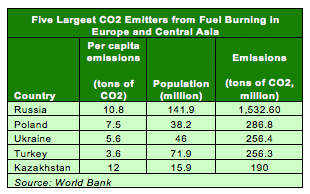
MIDDLE EAST LESSONS
Oil and gas exporting Central Asian states such as Kazakhstan, Azerbaijan and Turkmenistan can learn lesson from Middle East oil exporters.
Despite sitting on the second largest oil reserves in the world, Saudi Arabia is investing heavily in solar power. Meanwhile, the UAE is also developing solar and nuclear power capabilities, as both realize they need to diversify their energy mix away from crude oil.
Over the past decade, Middle East consumption of oil has grown at a fast clip, which has raised concerns that many Gulf states could lose their influence over global energy markets as they consume much of their own production.
Central Asian states are on the same growth trajectory. Rising populations and economic growth means fossil fuel energy subsidies are becoming difficult to justify for many countries.
Central Asian government need to develop green-friendly policies to encourage investment in the renewable sector which could serve as a major investment engine for the economies, the World Bank recommends.
Total FDI in ECA countries stood at USD 87 billion in 2010, of which perhaps less than 5% was dedicated to green energy sectors, the bank estimates.
"Countries can consider incentives for green FDI and remove barriers that prevent it, the bank said. "Incentives for green FDI do not differ significantly from those for other types of investment. However, they can be more targeted to capture a share of a fast-growing market."
alifarabia.com 2013