While Egypt's transition is heartening, there are 11 key challenges and issues it needs to address to ensure the country's enormous potential is harnessed.
Are Egypt's historic political changes as revolutionary as we think?
"We should not go looking at Egypt as a successful revolution? It's not. It's a managed transition," says Ian Bremmer, president and founder of Eurasia Group, a global political risk research and consulting firm.
"Mubarak is gone, but the army is still there and will be the most powerful player in the country for a long time. There will be democratically elected government, which is a good thing, but it will be a weak government and it will have weak coalitions and it will probably have a very hard time actually getting meaningful political, economic reform done," he says.
Some analysts note that if the new government takes populist stances, instead of taking the hard, tough decision that need to be taken, it could hurt Egypt in the long run.
And this is an important point to be made, especially as many think that the removal of Hosni Mubarak and his regime will open the golden gates of prosperity for Egypt.
The trouble with successful revolutions - or transitions - is that it is the victors that have to clear the mess before they can start rebuilding. The losers have either fled or are being prosecuted and languishing in jail.
That's exactly the situation in Egypt. As many former political and business elites languish in Torah, the notorious prison where Mubarak sent many of his own enemies packing, it is those outside prison that have a challenge on their hands.
Egyptians may be euphoric that they managed to overthrow a tyrannical government, but life post-revolution has not changed as quickly as they would have thought.
As Egyptians stood at Tahrir Square and rejoiced at their new-found freedoms, the political revolution has taken the wind out of its economy.
Now many painful decisions need to be made before the country can return to its path of being one of the most dynamic and open economies in the Middle East, and fulfill its role as one of the promising economies in the world (Read Egypt's Rise).
The Supreme Council of the Armed Forces (SCAF) has a massive challenge on its hands as it tries to balance public expectations and ensure that the economy is back on its feet without increased burden on fragile government resources.
Here are the key developments and challenges facing Egypt:
1 While political revolutions make great TV and are a cathartic exercise, the images of people on the streets strike terror in the hearts of investors.
Even after the successful overthrow, protestors have returned to the famous Tahrir square and as long as that continues to happen - for what may be very legitimate reasons - investors will continue to avoid the market on perceived instability.
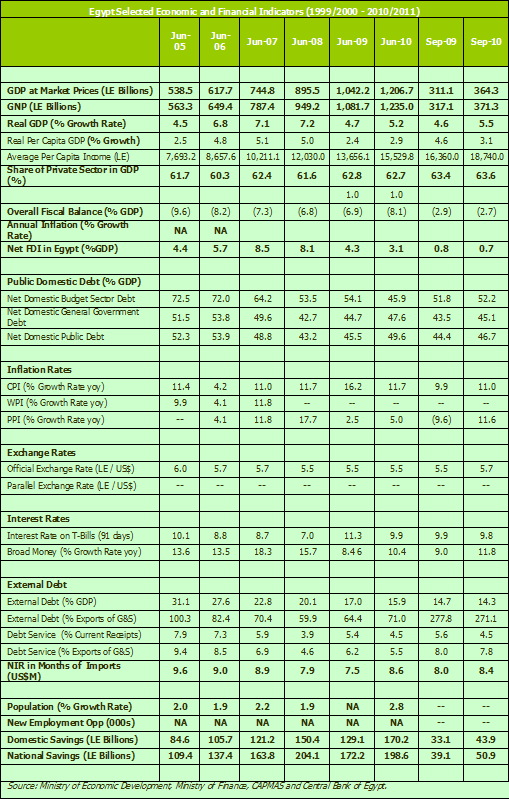
2 Not surprisingly, the first quarter of the year was not great for the economy. "The drop in private spending, investments and exports is expected to contract GDP by 2.6%QoQ, and reduce the YoY growth from 5.6% in 4Q10 to 2% in 1Q11. Slow GDP growth coupled with high inflationary pressure places Egypt in a stagflation phase," says CI Capital Research in a note.
3 Food inflation, one of the key reasons for Egyptians coming out on the streets, is actually a global problem, not a Mubarak-induced one.
In fact, events in EgyptMiddle East and North Africa are contributing to commodity uncertainty and price volatility. Inflation in Egypt hit 11.8% in March, compared to 10.8% in February as food prices continued to mirror high oil prices. IMF estimates show Egypt's inflation to hover around 11.5% in 2011 and 12% in 2012.
High food costs will continue to put pressure on government accounts. "Unfortunately, rising commodities and oil prices will increase subsidies, which represent 28% of total expenditure. However, we expect some savings as manufacturing facilities were not operating in full force," the IMF noted in its recent report on the global economy.
The new Egyptian cabinet has allocated an additional $1.7 billion in the next three months in a bid to ease pressure from high food prices, which places more burden on the government.
Inflation in urban food and beverage prices, which account for 44% of the weighting of the basket Egypt uses to measure inflation, soared to 20.5% in the year to March, up from 18.2% in February.
4 Egypt's new Finance Minister Samir Radwan expects the economy to rise to 2.5-3% in 2011, decreasing his earlier forecast from 4%.
The International Monetary Fund is much more pessimistic, forecasting a 1% growth in 2011, and 4% next year.
"Egypt's GDP growth will fall significantly below the 5% registered in the second half of 2010," the IMF says. "This assumes a modest dampening effect on economic activity from the political turmoil: disruptions to tourism, capital flows, and financial markets are expected to be temporary."
5 Foreign investments will take more time to return, with Prime Holding predicting both domestic and foreign investors will stay away for much of the year.
"We expect both domestic and foreign investors to show extreme risk aversion over FY11, to be reflected in 12% decline in investments. A 4% growth in investment is expected in FY12 assuming a stable political system is intact."
6 Cancellation of deals with foreign investors will also dissuade new investments. While it is important for the country to flush out 'illegal' deals or contracts that were contrary to the country's wider interests, the authorities also need to balance this need to appease citizens with ensuring that investment deals under review are thoroughly investigated and findings made public why they are being scrapped, to ensure a transparent process is in place.
Of course, investors' rights and interests need to be protected as well.
Some recent cases of deals being cancelled:
- Egypt's General Authority For Tourism Development scrapped a land deal with Egyptian Resorts for a project on the Red Sea. The company says it has already paid $7.3-million, or a little over a quarter of the land, and spent a further $5.3-million, and it will contest the decision.
- Egyptian Resorts' 41-million square metre Sahl Hasheesh is also being disputed after a lawsuit was filed arguing the government broke the law when it sold the land to the firm.
- Renowned Saudi entrepreneur Prince Waleed Bin Talal was embarrassed when prosecutors seized a land he owned in Egypt, citing that the government included terms that violated the law and entitled Prince Waleed to unfair benefits. Since then, the Prince has been negotiating with authorities.
7 The Egyptian economy benefits greatly from foreign direct investment (FDI). The country attracted $6.75 billion in FDI last year, according to the Egyptian Ministry of Finance but 2011 may be very different, especially as the biggest investors are from within the region.
CI Capital Research expects FDI to drop to $0.5-billion in the first quarter of the year.
However, foreigners continue to eye Egypt. For example, chip giant Intel, via its entity Intel Mobile Communication, announced its purchase of most of the assets of SySDSoft, a privately held software company.
"A group of Saudi investors have decided to establish a new investment and development bank in Egypt to finance foreign direct investment (FDI) amounting to $ 17-billion,' says CI. "Moreover, after putting the acquisition on hold, Electrolux AB announced it will resume negotiations with Olympic Group to acquire up to 100% of Olympic Group's shares. The deal is expected to be finalized in 2Q11."
8 Egypt's tourism sector could decline as much as 25%, according to the Minister of Tourism.
Media reports suggest 210,000 tourists left the country in the aftermath of the political crisis in Egypt, which led to a drop of $178 million in tourism spending.
"Moreover, the cancellation of February reservations created losses of $825-milion. We expect tourism revenues to fall 44% year-on-year to $1.5-billion in 1Q11," CI Capital notes.
Some tour operators estimate that summer bookings for Egyptian holidays are down 22%.
The sector employs one in seven Egyptians and makes up 11.5% of the country's GDP. The tourism sector also helps in painting a very positive image of the country internationally, and seen as a bellwether of the economy. A return of normality in the tourism sector is crucial for Egypt's economic recovery and international image.
However, 2011 will be the year of transition with many political developments taking place which could result in more upheaval in hiccups, disrupting business life. We can be certain that TV images of protestors in Tahrir Square in Cairo will keep tourists away.
9 Egypt's political transition and reform is heartening, but that also means the country will not be able to focus entirely on the economy. Here is what's ahead on the political front:
A recent referendum on the constitutional amendment was approved by 77% of the votes, giving Egyptians a first taste of democratic systems. Parliamentary elections are expected to take place in September. Soon after, elected members are expected to form a commission to draft a new constitution.
While the country navigates its way through this political exercise, expect economic issues to take a backseat.
10 Egyptians are watching the army's every move against former Egyptian President Hosni Mubarak, his family and political and business colleagues. The Eurasia Group notes there could be trouble ahead if the average citizen does not see the former president being held accountable by the new government.
"How the supreme military council handles senior figures in Hosni Mubarak's regime will shape its relationship with the anti-Mubarak activists and could impact the cohesiveness of the military itself," the risk management research house notes.
The armed forces are much more conscious about their international and domestic image and are likely to take a populist stance.
"These factors will likely compel the military to move against senior Mubarak-era officials, including his son Gamal, in the coming days. But how the council handles Mubarak himself, until recently their benefactor, is one of the keys to stability in the short term," says Eurasia.
© alifarabia.com 2011