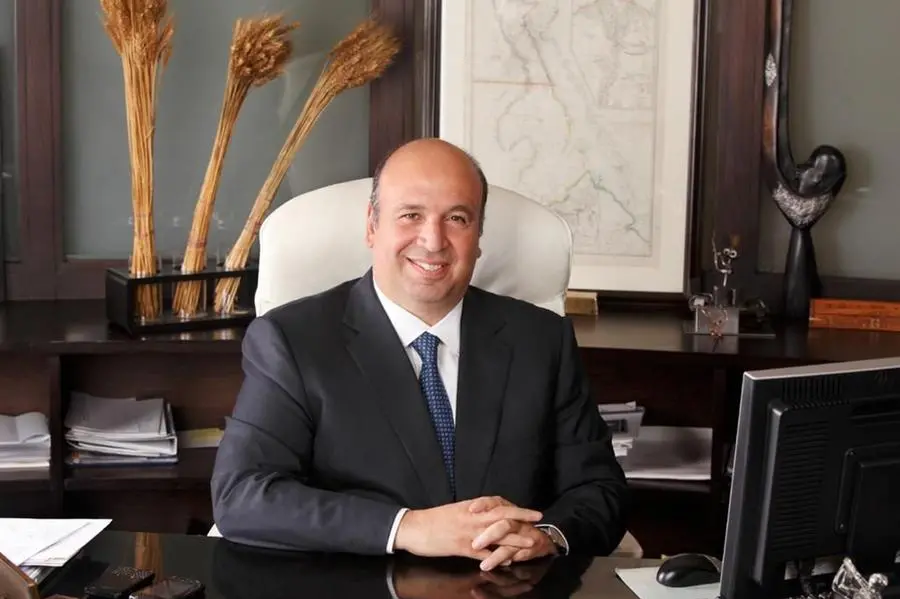
Taking over a company with bad debt and bad history is a gamble. But for Mohammad Abu-Ghazaleh, it was a golden opportunity. Ghadeer Taher and Joumana Jallad Shanshal talk to the chairman and CEO about how he turned Fresh Del Monte Produce Company around.
They say the apple does not fall far from the tree, and for Mohammad Abu-Ghazaleh this couldn't be more true. His father, Ahmed, was the first to bring bananas from Central America and introduce bitter lemons to the Middle East in the 1960s, considered a mission impossible at the time. Still, it took guts for his group to be the only bidding entity to take over the failed Del Monte from the hands of the Mexican government and assume $300 million of its debts. And it took more than guts to turn it around in only one year and convince investors that the company was a viable buy.
Asked why he went for the deal, Mr. Abu-Ghazaleh said, "I have always dreamt about [owning] a brand, and Del Monte was one of those brands. Knowing the business, we were more capable of evaluating the company and still saw the potential despite its bad shape."
So how did Del Monte, a famed fruit packer and producer find itself in receivership? With roots going back to the California Gold Rush, Del Monte grew to become one of the largest food producers and distributors. In 1979, the company was acquired by R. J. Reynolds Industries (later RJR Nabisco) and in the late 1980s split into two divisions a fresh fruit division and a canned fruit and vegetables one. In 1989 RJR Nabisco sold Del Monte Foods to a Merrill Lynch investor group, which was subsequently acquired in 1997 by the Texas Pacific Group (TPG). TPG then took the company public again in 1999.
The fresh fruit portion of Del Monte, now known as Fresh Del Monte Produce, came under the control of the Polly Peck family. The company's chairman, Asil Nader, a Cypriot businessman, fled Britain in 1993 to Cyprus following the collapse of the company. Financial troubles led to Polly Peck's downfall and the fruit company was taken over by Mexican businessman, Carlos Cabal, who had stakes in banks, insurance and hotels.
Within two years of taking the reins, Mr. Cabal became a fugitive of the Mexican government, accused of embezzling $700 million from his own banks. It was he who changed the company name to Fresh Del Monte Produce.
When Mr. Abu-Ghazaleh's Chile-based IAT Group, a fruit importer, came to acquire Del Monte, his business had grown to a $250 million venture (with an initial investment of $1 million, IAT's revenues surpassed $250 million the fifth year of operation). Negotiations with the Mexican government took one full year, but the group stood firm with its offer. So, in 1996, IAT acquired Del Monte for $425 million ($125million purchase price and $300 million in debt).
Shortly thereafter, in 1997, Mr. Abu-Ghazaleh successfully listed Fresh Del Monte Produce on the New York Stock Exchange (NYSE) selling 35% of the company in an IPO, raising $321 million. Commenting on the turnaround, Mr. Abu-Ghazaleh, who still holds 56% of Fresh Del Monte Produce, stated modestly, "We had one year of due diligence when we were looking at the company. So we had a check list of 30 to 40 items which we implemented immediately when we took over."
Today, Fresh Del Monte Produce is a vertically integrated company with a market capitalization of $1.2 billion as of March 31 2006. Its most recent acquisition of Del Monte Foods Europe in 2004 for $340 million gave it a more diversified and global reach, with sales of $3.3 billion. With 37,000 employees and customers in approximately 100 countries, the company farms over one million dunums (100,000 acres) in 12 countries, including Chile, Costa Rica, Hawaii, the Philippines, South Africa, Kenya, and New Zealand. It is one of the leading producers, marketers and distributors of high quality fresh fruits and vegetables, juices, beverages, snacks and desserts in Europe, the Middle East and Africa. The company is also a top marketer of branded melons in the United States and the United Kingdom, and is the world's third largest marketer of bananas and the leading year-round marketer of branded grapes in North America.
But this is a tough, competitive business, and reaching and maintaining these rankings is not easy when the company's competitors are fruit giants Chiquita and Dole. (Dole recently went private when it was bought out by David Murdoch, who paid $1.4 billion at $33.50 per share.)
"It's a very small club but it is very competitive. You have to be creative about how you package and market your items. It is definitely a challenge. With our experience over the years, the systems we have in place and with the vertical integration we have developed, I think it makes us much more capable than our competition."
Part of Mr. Abu-Ghazaleh's forte was his focus on diversifying Del Monte by growing the business organically and through acquisitions. Commenting on his diversification strategy, the chairman and CEO told Jordan Business, "If we find the right acquisition we will not hesitate. If you look at our revenue, a lot of it has been through organic growth. I prefer to do that rather than to spend so much money on an acquisition."
In the last 10 years, the company has grown considerably in terms of products and markets. "We started with a few items and now have a wide range," said Mr. Abu-Ghazaleh. "I think we have achieved a part of it [our diversification strategy], but the market is so huge, so we have a lot to do. The fresh cut and fresh salads market is huge. We are at the tip of the iceberg."
But in a business that relies so heavily on freshness, ensuring that the right product is at the right place at the right time is no easy task. "We cannot compromise the brand. Our brand only gets stamped on the perfect piece of vegetable or fruit. This is why we have to make sure everything is going according to our specs and policies."
To compete, Mr. Abu-Ghazaleh took control of his supply chain, managing it from the fields to the store shelves. The company has its own shipping fleet and North American inland transportation network, as well as 45 global distribution centers and 14 fresh cut facilities worldwide (see timeline below).
"In our business, the margins are very small and narrow," he said. "The only way to really sustain and keep the operation viable is by integrating vertically, which means from field to consumer. If you are just a producer, the chances of survival are small. The same goes for being an exporter or importer. All these roles, by themselves, are quite risky."
But it is not all gold at Del Monte Fresh Produce. The company's stock is trading at a year low, 32% down from the previous year. Additionally, the company has had a tough fourth quarter in 2005, posting a net loss of $3.5 million compared to a net income of $19.1 million in the fourth quarter of 2004. Higher operation costs fueled by increasing oil prices, stiff competition, and lower banana pricing in Asia had a knock-on effect on the results Del Monte saw last year: the company's net income stood at $106.6 million in 2005 compared to $139.2 in 2004. Commenting on the quarter's poor performance, Mr. Abu-Ghazaleh said, "You cannot predict what will happen four quarters ahead... prices change, weather changes, ships are delayed... there are so many variables you cannot control. In 2003, we posted great growth, and people asked us how the company was making all this money. I said it was the perfect storm, everything was in our favor. Now it is not as good as it used to be, but we just have to overcome it."
Indeed, Del Monte has proven to have thick skin. Several lawsuits, from allegations of employees being exposed to chemicals to violations of the European Union's competition laws, have been slapped on the company. But this seems to go along with the territory of doing business in corporate, litigious America.
A lingering thorn in Del Monte's side is an ongoing lawsuit filed in 2002 on behalf of seven Mexican shareholders. They are accusing Mr. Abu-Ghazaleh and his Coral Gables-based firm of purchasing the company for less than half its value by bribing Eduardo Bours, the Mexican official then in charge of the sale and now governor of Mexico's second largest city. (Lehman Brothers, which was advising the Mexican government at the time, originally valued the company at $275 million, but there was no interest. IAT was the only bidder at $125 million). Several shareholders, part of the former ownership, were enticed to file the lawsuit, says Mr. Abu-Ghazaleh. "Someone had a grudge and wanted to make money so he financed the whole suit... there was probably a belief that the head of the company, being an Arab after the September 11th attacks, could be intimidated."
But Mr. Abu-Ghazaleh filed a countersuit against Eastbrook companies in 2002, seeking damages in excess of $620 million, in addition to punitive damages against firms tied to Carlos Cabal, charging a conspiracy to extort money. The state Supreme Court in New York ruled in favor of Mr. Abu-Ghazaleh and awarded him an undisclosed amount in damages. Shortly after the 2002 lawsuit was filed, Marvin Bush, the brother of President George W. Bush, resigned from the company board which he served on since 1998.
Still pending is a similar case in Florida brought forth by shareholders, which is set to be heard in Miami Dade county next month.
Meanwhile, Mr. Abu-Ghazaleh and his team at Del Monte are busy making sure the company stays ahead of the game. "We are expanding our fresh-cut business. It is a rapidly growing industry due to rising worldwide demand from consumers seeking convenient, ready-to-eat products that reflect active lifestyles."
Regionally, Del Monte is said to be building a juice plant in Jordan as well as a state of the art, multi-faceted facility in Dubai, slated to open in late 2006. Facilities in Algeria and other countries in the Middle East are also in the pipeline.
Asked about his management philosophy, the CEO, who reads 60 reports a day and spends a big chunk of his time travelling, added, "I believe you have to lead by example. You cannot tell your employees to work hard when you are not working hard. In our business, you have to be involved in all operations. This is not a business that gets run sitting behind a desk in an office. You have to be present [on site]. We have hands on management."
So what brought back Jerusalem-born Abu-Ghazaleh to Jordan from a road that took him from the Gulf, to faraway Chile, to later acquire a Mexico-based company and list it on the NYSE? Simply, he said, "I did not want my children to live outside of the Arab world. And I thought Jordan was the best place to set my family up. During my trips [here] I realized the business climate was more suitable than other countries in the Middle East and opportunities were more abundant. And being Jordanian gives me the freedom to operate and conduct my business."
Asked if doing business in Jordan has changed for the better over the last 10 years, he was quick to answer "no". Yet he made major investments in the country.
National Poultry, which he founded 12 years ago, made $9.6 million in net profits last year. Royal Jordanian Air Academy, acquired three years ago, had 300 students and now has grown to almost 1,600 students.
Another acquisition, Arab Wings, taken over last year, had almost no assets, but within a year has three fully operational planes. The company is looking to expand by introducing a fourth aircraft. "The value of the company has appreciated. We just raised the capital by $150 million and hopefully Arab Wings will merge with the Royal Jordanian Air Academy soon. So it will take us to the next level."
Most recently, Mr. Abu-Ghazaleh started Amwal Invest, an investment bank that he recently took public and was heavily oversubscribed. However, some investors were disappointed with the share price, which they expected to be much higher. (On March 31 2006, the stock traded at JD2.60). Apart from poor market dynamics, some attributed the low share price to the expensive acquisition of Arab Financial Investment Company (AFIN). But Amwal Invest's management believes giving AFIN shareholders 6.5 shares in Amwal Invest translates to about three times price/earnings (P/E) ratio, a fair valuation compared to the overvalued brokerage companies. AFIN had posted one of the highest returns on equity among its peers. "I would like to see the Amwal Invest stock trade at JD5 in the market. But the stock does not drive the business. If we do well then the stock will reflect the value," he said.
"In the end, I am interested in building companies," said Mr. Abu-Ghazaleh. And Jordan seems to be fertile ground.
© Jordan Business 2006