With Qatar at political odds with Saudi Arabia, the UAE and Bahrain, the Gulf Co-operation Council's initiative to bring their economies closer has taken a major setback.
Oman is already lukewarm to the idea of developing closer ties and with a whole host of regional issues flaring up, the concept of a stronger GCC 2.0 seems like a distant dream, at least for now.
The inability of Gulf governments to form a unified political stance on events in Egypt, Syria, Iraq and Palestine will have long drawn-out issues on economic co-operation. This was most evident during the recent dispute between Saudi Arabia, Bahrain, the United Arab Emirates with Qatar that resulted in the former three states withdrawing their ambassadors from Doha. Analysts believe it was the greatest signal that Gulf authorities strongly disagree on key issues.
"There are clear fault lines within the GCC, which will prove challenging to overcome through greater union," according to a Chatham House report. "Varying priorities and interests between Gulf states, and indeed between communities within them, represent undeniable obstacles."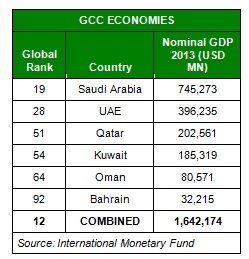
FORMIDABLE ECONOMY
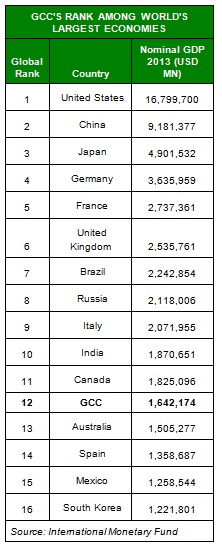
The economic bloc of less than 50 million people has an oversized economy. Together, the Gulf states would be the world's 12th largest economy, ahead of Australia, Spain, Mexico and South Korea. Although Saudi Arabia is the dominant economy, the UAE and Qatar are also growing at a fast clip and considered formidable among regional and international players in the global economy.
In addition, the region's massive hydrocarbon reserves mean the GCC has the world's largest conventional crude oil reserves in the world, apart from the third largest natural gas deposits. Together, the Gulf states are the largest producers of crude oil anywhere in the world.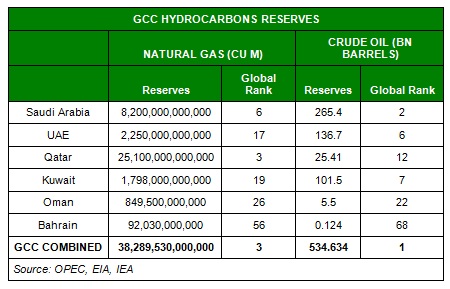
If the region can leverage these strengths, it can emerge as a strong economic power in the world and form the basis of a future larger economic bloc comprising Egypt, Jordan, Lebanon and other North African states.
But the inability of the six nations to agree on a common economic and political future does not bode well for the initiative.
A common power grid and Gulf railway networks are positive developments, but the lack of progress in forging a monetary union highlights structural weaknesses, even though the majority of the currencies are pegged to the American dollar.
"Current domestic issues within GCC countries, moreover, are in need of attention and are in danger of being exacerbated by the merging of national policies," according to Chatham House. "Some of these include education, healthcare, employment and the general imperative of social responsibility, as well as the vital issue of migrant labour rights. Some of the major concerns facing the GCC entail sustainability issues: resource limitations and climate change are key areas of concern, which cannot be overstated."
A REGIONAL ROLE
Despite its challenges, the Gulf Cooperation Council had emerged as a strong entity that could play a major regional and global role. From the Kuwait war in 1990 to pooling resources to offer financial aid to fellow members Bahrain and Oman, the GCC states have demonstrated that it can be a unifying force especially in times of crisis.
"The significance of the role played by the Gulf states has increased in recent years, and they now comprise a central part in Arab politics as a result of the absence of the pivotal states--Syria, Iraq and Egypt--particularly following the Arab Spring revolutions and the profound changes they provoked," according to a background paper for the third annual conference of Arab Research Centers in December.
"This begs the question of whether the GCC is capable of leading the Arab regional order and joint Arab action, and whether it can succeed in activating Arab economic agreements, particularly the Greater Arab Free Trade Area (GAFTA)," ARC said in the report titled 'The GCC Countries: Politics and Economics in Light of the Regional and International Shifts and Changes.'
"These questions have gained further legitimacy after the deep impact of the Arab Spring revolutions on bilateral relations within the GCC system and the subsequent disclosure of tensions and divisions among the foreign policy positions of the Gulf countries."
The ARC paper notes that there are now shadows of doubt over the future of the Gulf system that was, until recently, the most harmonious, cohesive, and successful Arab regional grouping. In addition, political differences and the disagreements over the Gulf currency, the single market, the central bank, and other issues have started to push members within the GCC to seek external economic options.
"These challenges, such as bilateral free trade agreements, only add to the existing doubts about the future of the GCC, without even mentioning the matter of assuming the leadership role in joint Arab action," ARC paper warned.
"Rather than achieving greater integration, such as the Gulf Union proposed by Saudi Arabia in 2012, the Gulf states appear to be heading for more fragmentation and division."
The feature was produced by www.alifarabia.com exclusively for www.zawya.com.
© Zawya 2014