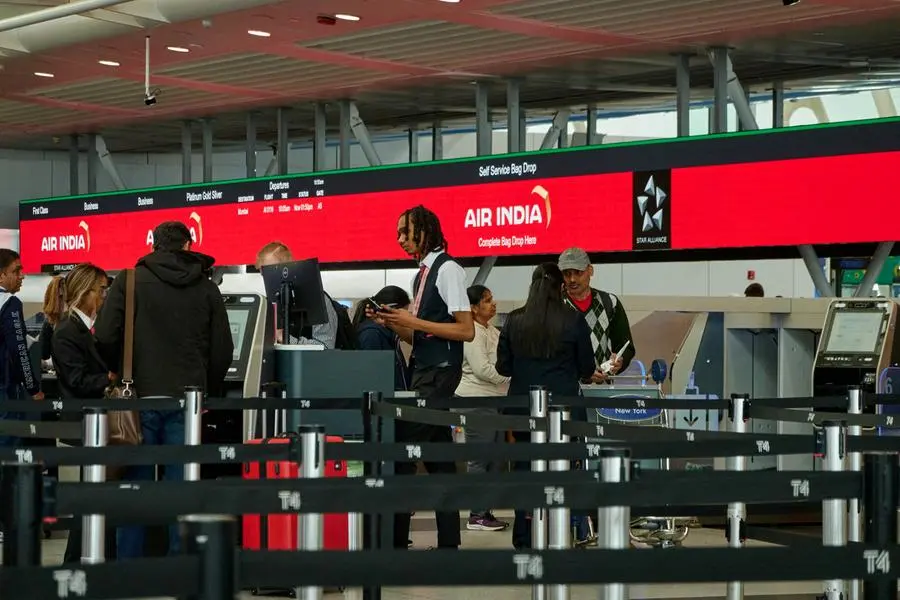
PHOTO
Airspace restrictions in the Middle East amid the Iran war have dealt another blow to Indian airlines, which count the region as a crucial corridor for flights to Europe and the U.S. since Pakistan banned Indian carriers from its airspace last year.
As war in the Middle East forces flight rescheduling and re-routing, Indian airlines have limited options because they can't fly over Pakistan either.
The country's biggest international carriers Air India and IndiGo did not operate 64% of their 1,230 scheduled flights to the Middle East, Europe and North America in the last 10 days, Cirium data shows.
"It is a double whammy for Indian airlines which fly international routes," said Amit Mittal, an independent aviation expert.
Pakistan has banned Indian carriers from its airspace since last April following military tensions between the two neighbours.
Last week, HSBC said that current geopolitical tensions in the Middle East will lead to a "significant burden" on the cost and profitability of Indian airlines. HSBC estimated that seven days of cancellations to the affected regions could shave 1.2% off its estimate for the airline's annual profit-before-tax.
While the two airlines resumed some affected routes in recent days, IndiGo is facing unique problems.
It relies heavily on six Boeing long-range aircraft it has leased from Norse Atlantic Airways to fly to Europe. Given the registration of those planes remains Norwegian, they have to abide by a European Union Aviation Safety Agency advisory that has asked airlines to avoid airspaces of Iran, Iraq, Israel, Kuwait, Lebanon, Qatar, the United Arab Emirates and Saudi Arabia.
That has forced IndiGo to take longer routes via Africa, increasing flight times by up to two hours in some cases, according to Flightradar24.
Even then, the routes face challenges. An IndiGo Delhi-Manchester flight was forced to return to Delhi on Sunday after air traffic control in the African nation of Eritrea declined airspace use due to confusion over how a Norse-registered plane was being used by IndiGo, a source familiar with the matter said.
IndiGo said the incident, which saw the plane return to Delhi after being in the air for 13 hours, was due to "last-minute airspace restrictions."
Another IndiGo Boeing aircraft flying from London to Mumbai faced the same issue with Eritrea and had to divert to Cairo on Monday, the source added.
Flight disruptions due to the Middle East conflict add to problems at IndiGo whose CEO Pieter Elbers stepped down on Tuesday, in the aftermath of an operational crisis that drew scrutiny from the public and the government in December.
IndiGo and Air India did not respond to Reuters queries. Norse referred Reuters' questions to IndiGo.
AIR INDIA WOES
Air India said on Monday that it would operate 78 additional flights on routes between India and Europe and the U.S. over the next week in response to high demand during the Iran conflict.
But its flight times to some destinations are becoming much longer as it is forced to add a stopover, giving an edge to rivals like Lufthansa and American Airlines on routes to and from India.
Air India's Delhi to New York flight on Monday made a stopover in Rome, extending the journey time to nearly 22 hours, according to Flightradar24. Before the Iran war, Air India could fly via Iraq and Turkey and reach the U.S. in about 17 hours with no stops.
In comparison, an American Airlines flight on Sunday took about 16 hours on the same route, via Pakistan.
Air India, owned by Tata Group and Singapore Airlines , has forecast a hit of $600 million a year due to the Pakistan airspace ban, Reuters has reported. The airline, which was sold by the Indian government in 2022, has been reporting losses which amounted to $433 million last year.
Longer flight times will only add to the airline's costs as they mean more fuel usage, further pushing up energy costs on top of the spike in oil prices since the U.S.-Israeli war with Iran began.
(Reporting by Abhijith Ganapavaram; Editing by Aditya Kalra and Susan Fenton)