PHOTO
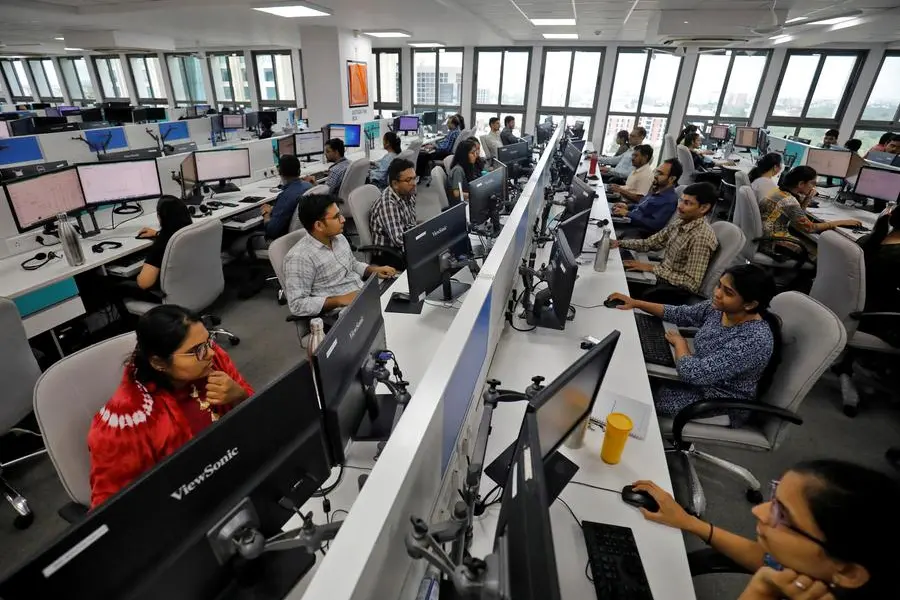
India's office market posted record leasing in the first half of 2026 as multinational companies expanded global capability centres and flexible workspace operators signed larger deals despite geopolitical uncertainty, property consultant CBRE said.
India's office sector absorbed 45.5 million square feet of space — equivalent to nearly 400 football pitches — in the first half of 2026, the highest ever for any six-month period, up 9.6% from a year earlier, the CBRE report said on Monday.
The data underscores how India remains a key destination for multinational companies expanding global capability centres (GCCs) and technology operations, even as geopolitical tensions and economic uncertainty weigh on business sentiment elsewhere.
"Multinational companies are continuing to expand existing India operations, with decisions driven by long-term business priorities rather than short-term geopolitical events," CBRE India's Managing Director-Leasing Ram Chandnani told Reuters.
"They see the advantage of the talent, the cost arbitrage, the cost of real estate and the availability of talent."
GCCs accounted for 43% of all leasing in the first half, with the number of GCC deals jumping 30% year-on-year.
GCCs also drove 53% of all transactions above 100,000 sq. ft., reinforcing India's position as a global hub for technology, engineering and business support functions.
Industry estimates expect India to host more than 2,100 centres by the end of fiscal 2026.
Fortune 500 companies leased about 6.8 million sq. ft. in the second quarter, accounting for a 28% share, with the number of deals rising roughly 34% from the previous quarter.
Last month, India Ratings and Research said Middle East-related volatility was unlikely to materially affect office demand, although higher crude prices and currency volatility could delay some capital deployment.
CBRE expects office demand to remain resilient through the rest of 2026.
India's flexible workspace market has gained prominence as one of the fastest-growing globally, with occupiers increasingly viewing flex as a core component of their expansion strategies, using a "core+flex" model to balance scalability, risk and cost.
(Reporting by Surbhi Misra in Bengaluru; Editing by Shreya Biswas)