PHOTO
Even if overall inflation slows next year as the U.S. Federal Reserve anticipates, President Donald Trump will still face political headwinds over the cost of living with home mortgage rates expected to remain comparatively high, tariff-related price increases on goods seen persisting through the first part of the year, and cost pressures building around items like beef and electricity that can have an outsized influence on consumer perceptions.
Fed economic projections issued on Wednesday held good news for the administration, with policymakers expecting inflation to cool over the coming year, while economic growth accelerates.
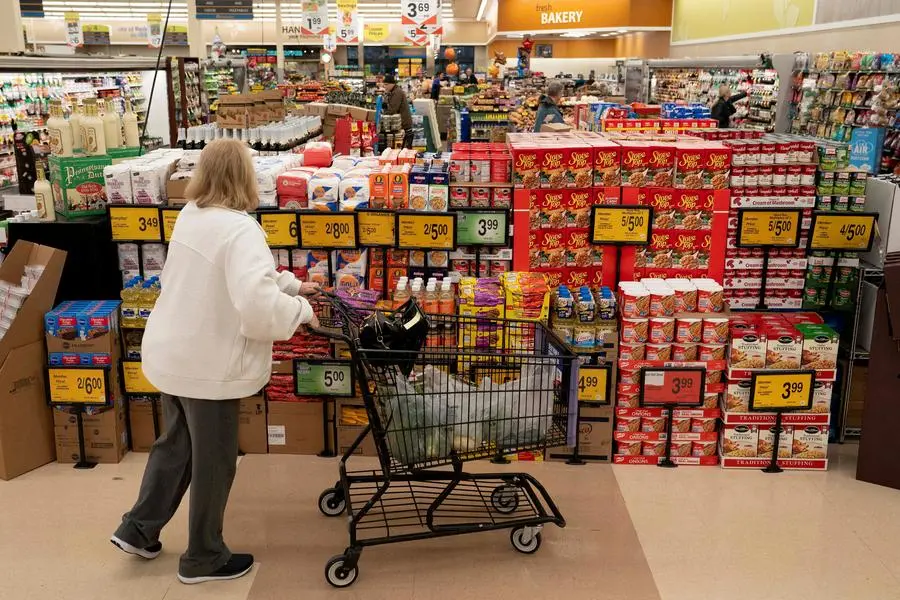
Across the broad array of services that account for most economic activity, "disinflation appears to be continuing," Fed Chair Jerome Powell said, while goods inflation should "come down in the back half" of 2026 as firms finish dividing tariff costs among consumers, their suppliers and their own operating margins. But in a midterm election year Trump and Republicans face a problem all politicians share. Consumers - voters - focus far less on the macroeconomic generalities analyzed by economists, for whom inflation is a carefully weighted average rate of price changes across all goods and services, and more on what their local grocery charges for milk, how much the utility bill has risen, and what insurers charge to renew their homeowners policy.
Trump, whose administration has become concerned about low poll numbers particularly on the economy, with affordability a central issue, can rightfully note that overall inflation has been pretty modest on his watch so far. The Consumer Price Index from his inauguration through September is up about 1.6%, equivalent to a roughly 2.4% annual pace and not far off of the central bank's 2% target, though that is measured slightly differently. Food at home, the rough equivalent of grocery prices, is up even less at 1.4%.
But prices haven't fallen as Trump promised during his election campaign and early on in his administration, with consumers still struggling through what has now become a nearly five-year case of rolling sticker shock.
Some prominent CPI line items have in fact spiked sharply in recent months, a fact that may turn hamburger into the same sort of political cudgel for Democrats that egg prices were for Trump last year.
In September, ground beef was 14% more expensive than when Trump resumed office; electricity prices were up over 4%, or around 6% on an annualized basis, and expected by many forecasters to go higher; and homeowners insurance was rising at a roughly 10% annual pace.
There were also cautionary notes in Powell's commentary to indicate the affordability fight will persist.
Powell singled out the housing market as one part of the economy that continues to struggle, with likely little respite coming from the Fed's recent rate cuts. While its benchmark interest rate does influence long-term mortgage rates, government debt and other securities, Powell said the housing problem is one of chronic undersupply.
Mortgage rates have moderated since nearing 8% a little over two years ago, but they've remained around 6.2% since September, after investors began pricing in what became quarter-point Fed rate cuts in September, October and December. With the Fed on hold for now and other factors holding up longer-term interest rates, they may not move much further.
Real estate firm Redfin this week reported both sellers and buyers pulling back, with sales prices rising nonetheless and mortgage rates likely to "remain largely unchanged in the near term."
Mortgage rates remain far above the ultra-low rates seen in the roughly 15 years following the 2007-to-2009 financial crisis, when Fed policy aimed specifically at holding down long-term borrowing costs.
Absent a serious recession or financial swoon, sub-3% mortgages are unlikely to reappear. The collapse of the housing industry during that crisis still echoes through what Powell said was years of underbuilding.
"We just haven't built enough housing for a long time...We can raise and lower interest rates, but we don't really have the tools to address a secular housing shortage," he said.
Home affordability remains a key issue for younger workers and families who've delayed homebuying and the increase in household wealth that typically accompanies it.
The Census Bureau's latest homebuilding data is from August, with reports still delayed by the government shutdown, but at that point new building permits were down 11% from the year before while new housing starts were off 6% from a year earlier.
Construction jobs, which hit a new high in mid-2022 during the rebound from the COVID-19 pandemic and kept growing until this year, have mostly flatlined at around 8.3 million since January.
There's been a general stall, in fact, in the blue-collar jobs Trump said he would revive. The manufacturing sector lost about 50,000 jobs from January through September; the much smaller mining and logging sector shed about 15,000.
To the upside: Workers' average hourly earnings have been growing faster than inflation, and some important costs, like rent, are now increasing at rates more in line with pre-pandemic norms.
But that hasn't made the public happy.
After tending to stay steady or even fall during the years of increasing globalization, goods prices in general are now rising following the imposition of tariffs, and even if that does not persist much longer it has meant higher costs for consumers during the holiday shopping season.
Opinion surveys have responded.
The New York Fed's latest household poll showed a declining share of people who felt they were better off than a year ago and who felt they would be better off a year from now - with both measures now comparable to those seen during former President Joe Biden's term.
After bumping higher in the wake of Trump's election, the University of Michigan's Consumer Sentiment Index has also turned sour, and despite a small rise in December, survey Director Joanne Hsu said "the overall tenor of views is broadly somber, as consumers continue to cite the burden of high prices."
(Reporting by Howard Schneider; Editing by Dan Burns and Andrea Ricci)