PHOTO
(The opinions expressed here are those of the author, a columnist for Reuters)
ORLANDO, Florida - While the U.S. CPI inflation report on Tuesday showed a slightly softer-than-expected annual increase in core prices, there's little reason for consumers or policymakers to cheer.
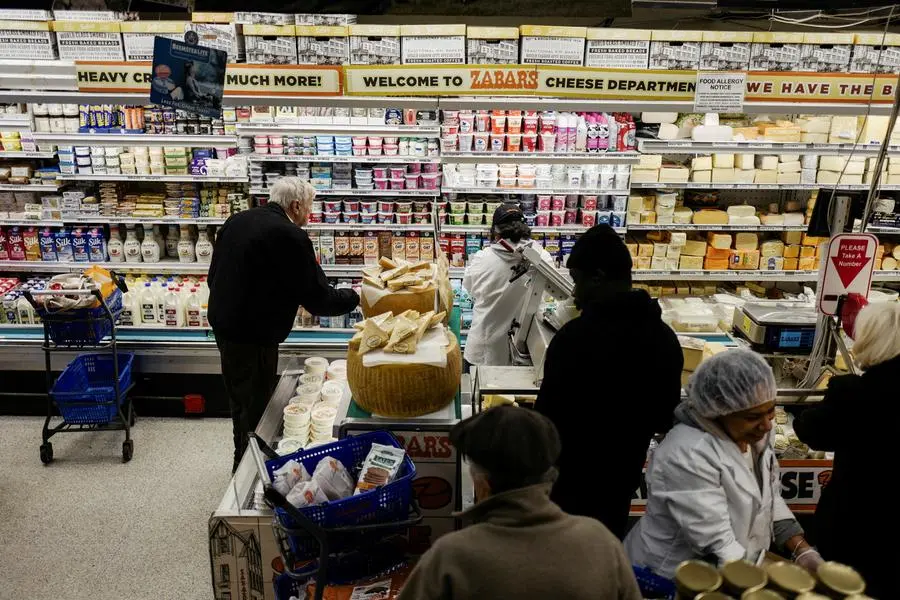
For consumers, the sharp spike in food prices is a reminder - as if one were needed - of the ongoing affordability crisis. Meanwhile, underlying numbers pointing to upside risks for the Federal Reserve's favored Personal Consumption Expenditures (PCE) inflation gauge will make uncomfortable reading for policymakers.
Figures showed that the consumer price index (CPI) rose at an annual rate of 2.7% in December, as expected, while core prices excluding food and energy rose 2.6%, a tenth of a percentage point below forecasts.
On the face of it, this is reasonably welcome news. But food prices surged 0.7% on the month, the biggest rise since October 2022, lifting the annual rate of food inflation to 3.1%.
This comes just as oil prices have been starting to pick up again, with U.S. President Donald Trump's unpredictable and controversial foreign policy agenda raising geopolitical tensions. True, oil prices remain relatively low and may well be capped by a looming oversupply, but the recent uptick is still liable to worry U.S. households nonetheless.
GIVE PCE A CHANCE
Fed officials prefer to focus on inflation that excludes volatile food and energy prices, but consumers don't have that luxury, especially those at the lower end of the income spectrum.
Economists point out that the "wedge" between monthly CPI and PCE inflation is widening. December's PCE inflation could thus come in a bit hot, although we won't know for some time because the government shutdown has delayed its release until February 20.
Skanda Amarnath, co-founder and executive director of Employ America, notes that CPI, a fixed-weight basket of goods and services, "underweights" some areas where consumers spend meaningfully, like software and computer accessories. PCE inflation, meanwhile, better reflects consumers' actual spending habits.
"When you look at the goods where people actually allocate their dollars ... we're seeing some meaningful upside right now," he says.
Echoing this, economists at Barclays and Morgan Stanley upped their monthly December PCE forecasts to just under 0.5%, which would steer the annual rate up to 2.8% or 2.9%. And in a note titled "December CPI: Stronger than you may think," BNP Paribas's Andy Schneider said December's PCE inflation will be "significantly" higher than CPI.
3% IS THE NEW 2%, RIGHT?
Of course, Fed officials are aware of these dynamics too. New York Fed President John Williams said earlier this week that he expects inflation to peak close to 3% in the first half of this year, ease in the second half, and return to the central bank's 2% target next year.
None of that is particularly new. It broadly reflects the median projections in the Fed's Summary of Economic Projections in December. But the lack of urgency is notable nonetheless given how long inflation has been above the Fed's target and how far away that goal still is.
It has been nearly five years since annual inflation - whether measured by CPI or PCE, headline or core - was below the Fed's 2% target. If Williams is right in his outlook, it will end up being nearly six.
The PCE prints are higher and close to 3%, but the CPI readings aren't that much lower. Fed officials will never admit it publicly, of course, but they appear to have tacitly accepted that 3% is the new 2%.
And inflation may very well stay closer to that 3% level in the coming months due to multiple factors, such as companies passing on tariffs, tight housing supply, potential energy shocks, and growth-fueled demand driven by expected tax relief and fiscal stimulus.
Some of these risks may not materialize and other factors could weigh on prices, but, as it stands, consumers and policymakers will have to deal with above-target inflation for some time to come.
(The opinions expressed here are those of the author, a columnist for Reuters)
Enjoying this column? Check out Reuters Open Interest (ROI), your essential source for global financial commentary. ROI delivers thought-provoking, data-driven analysis of everything from swap rates to soybeans. Markets are moving faster than ever. ROI can help you keep up. Follow ROI on LinkedIn and X.
(By Jamie McGeever; Editing by Marguerita Choy)