PHOTO
U.S. lawmakers appearing on Sunday morning talk shows split sharply over a potential deal to end the Iran war, with Republicans mostly backing the publicly reported contours of an agreement being negotiated by President Donald Trump and Democrats dismissing it as accomplishing little.
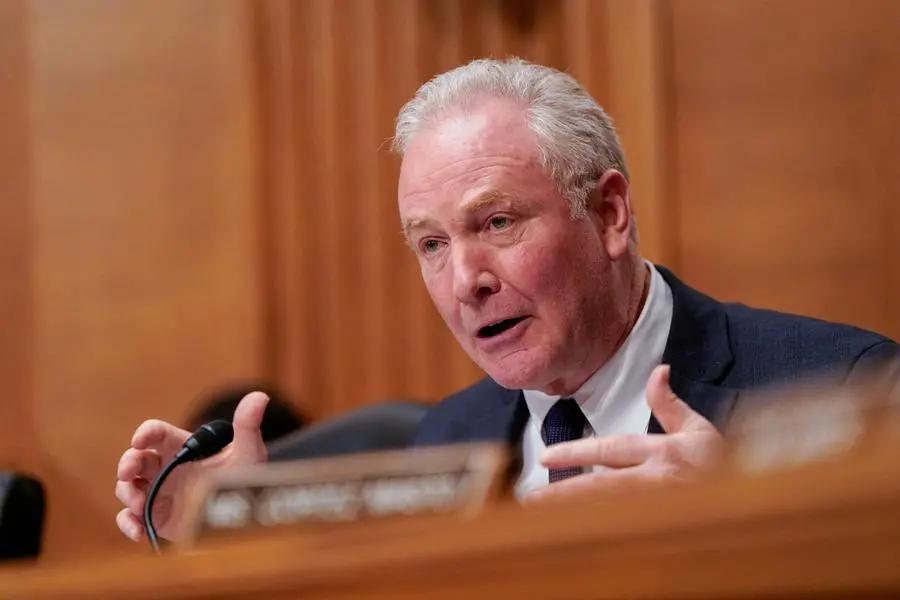
* Senator Chris Van Hollen, a Maryland Democrat and a member of the Senate Foreign Relations Committee, said the reported outlines of a deal sounded like little more than "the pre-war status quo" with Iran. "I think this was a blunder," Van Hollen said on the "Fox News Sunday" program. "When you're digging a hole, you should stop digging, and that sounds like maybe what we're doing finally."
* Representative Mike Lawler, a New York Republican who sits on the House Foreign Affairs Committee, praised Trump's approach to talks with Iran. "I think on the whole what the administration has been able to do for the first time in 47 years is force the remnants of this regime into a negotiation, a real negotiation," Lawler said on CBS' "Face the Nation."
* Senator Cory Booker, a New Jersey Democrat, said Trump was being "played as a fool" in negotiations. "He's got us in a situation that's worse than it was before, a more extreme regime," Booker told CNN's "State of the Union" show. "(The) Strait of Hormuz now is a leveraging point for them. This weak nation has put America in a stalemate.”
* Republican Senator Bill Hagerty of Tennessee said any deal will have "strict" terms to ensure that Iran has no path to a nuclear weapon. "I think they'll be very enforceable," Hagerty told "Sunday Briefing" on Fox News. "And remember … President Trump has used military force to basically annihilate the economic, technological, and military capacity of the Iranian regime. They're in a fundamentally different place."
* Republican Senator Thom Tillis of North Carolina, who often criticizes Trump, suggested on CNN's "State of the Union" that the reported details represent a shift in the administration's stance. "We were told about 11 weeks ago, by (U.S. Defense Secretary Pete) Hegseth and the Department of Defense, that they had obliterated Iran's defenses and it was just a matter of time before we had the nuclear material," Tillis said. "Now we're talking about a posture where we may accept the nuclear material remaining in Iran. How does that make sense at all?"
(Reporting by Nathan Layne in Wilton, Connecticut; Editing by Sergio Non and Deepa Babington)