PHOTO
Jordan has signed a tripartite agreement with Syria and Lebanon to export imported natural gas to the two countries to help fuel power plants damaged by years of conflict.
The agreement was signed in Amman by the energy ministers of the three countries following months of negotiations and rehabilitation works to repair and restore their gas infrastructure.
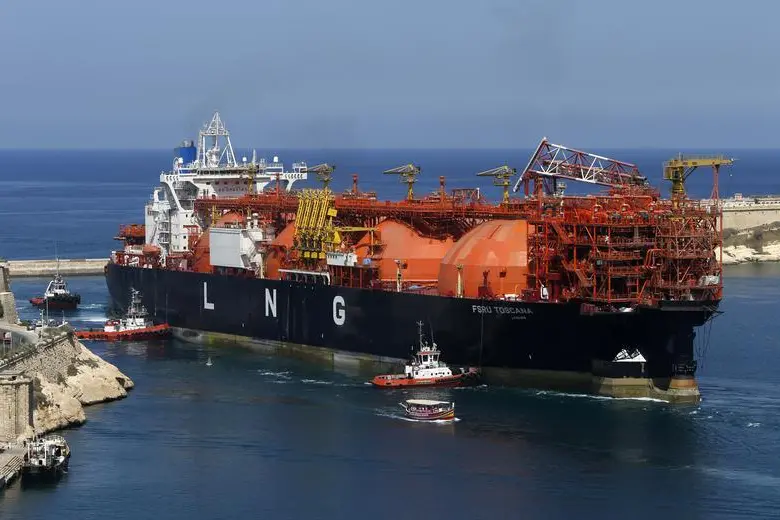
Jordan will import liquefied natural gas (LNG) and process it through its floating storage and regasification unit (FSRU) near Aqaba before transporting gas through the Arab Gas Pipeline.
Jordanian Energy and Mineral Resources Minister Saleh Kharabsheh said technical preparations and pipeline rehabilitation works had been completed.
The minister did not specify the LNG source. Jordan currently imports pipeline gas from Israel alongside LNG cargoes from international markets.
Arab Gas Pipeline
The 1,200 kilometre Arab Gas Pipeline was originally built more than two decades ago at a cost of $1.2 billion to transport Egyptian gas from Arish to Jordan, Syria and Lebanon. It includes underwater and overland pipelines to and from Israel, and is designed with an ultimate capacity of 10 billion cubic metres/year.
The 265km, 36-inch diameter first phase of the Arab Gas Pipeline from El Arish to Aqaba was completed and operationalised in 2003.It includes a 15km offshore segment portion under the Gulf of Aqaba.
The second phase within Jordan comprises of two stages – the 393km first stage from Aqaba to El Rehab in the North was completed in 2006 with completion certificate issued next year while the 30km second stage from Rehab to Jaber on Jordan-Syria border was completed in 2009 with completion certificate issued in 2009.
The third phase of the Arab Gas Pipeline inside the Syrian territory - the 334km section from Jaber to the city of Homs - was completed in 2008 and operationalised in 2009.
The 24-inch diameter, 101km Homs-Deir Ammar (Lebanon) section, which was completed in 2009 and the planned 240km Homs to Aleppo section have been lumped together as the fourth phase.
The 64km Aleppo-Kilis (Syria/Turkey border) section, completed in 2011, was originally envisaged as part of the Arab Gas Pipeline, but is now part of the Turkey-Syria Natural Gas Pipeline, supplying Azerbaijani gas to Syria via Turkey.
The Arab Gas Pipeline network has operated intermittently since 2011 following sabotage attacks and Egypt’s domestic gas shortages, which halted most exports by the mid-2010s.
Between 2015 and 2018, the pipeline was reversed to transport imported LNG from Jordan’s Aqaba terminal into Egypt.
Jordanian Egyptian FAJR for Natural Gas Transmission and Supply, owned by Egyptian FAJR for Natural Gas Company, is responsible for operating and maintaining second phase of Arab Gas Pipeline within Jordan under a Build-Own-Operate-Transfer (BOOT) scheme for 30 years extendable for 10 more years since 2003, according to its website.
Syria network rehabilitation
Syrian Energy Minister Mohammed Al-Bashir said Syria has completed repairs to its domestic gas transmission network, while Lebanon is continuing rehabilitation works on its own infrastructure.
Al-Bashir recently said Syria expects domestic gas production to nearly double to around 15 million cubic metres per day by end-2026.
Jordan energy strategy
Kharabsheh also confirmed plans to connect Jordan’s Risha Gas Field to the Arab Gas Pipeline to strengthen the domestic distribution system.
Jordan previously approved around 700 million Jordanian dinars ($980 million) for the 300-km pipeline project linking Risha to the regional network, partly financed through an Abu Dhabi government loan.
Under Jordan’s 2025–2035 energy strategy, the country aims to increase the share of renewables in the energy mix to more than 30 percent by 2030, while expanding domestic gas production and developing hydrogen projects.
Jordan targets boosting Risha gas field output to 418 million cubic feet per day by 2029.
Lebanon gas infrastructure repair deal
On Wednesday, the Egyptian Ministry of Petroleum and Mineral Resources announced that Jordan-based Technical Company for Gas Pipeline Operation Services (TGS) will undertake the repair and rehabilitation work of 24-inch diameter gas pipe lines in Lebanon spanning 30 km. The scope includes raising efficiency of Pressure Reduction and Metering Stations (PRMS), mechanical works, generator works, upgrade of automation and control systems, and installation and commissioning of Cathodic Protection (CP) systems.
TGS a joint venture owned 51 percent by Jordanian Egyptian FAJR for Natural Gas Transmission and Supply, 40 percent by Egyptian Natural Gas Company (GASCO) and 9 percent by Egyptian FAJR for Natural Gas Company. It was established in 2018 and is chaired by Egypt's Minister of Petroleum and Mineral Resources Karim Badawi. TGS started to operate and maintain the Arab Gas Pipeline and its facilities in Jordan from 1 March 2019.
(Reporting by N Saeed; Editing by Anoop Menon)
(anoop.menon@lseg.com)
Subscribe to our Projects' PULSE newsletter that brings you trustworthy news, updates and insights on project activities, developments, and partnerships across sectors in the Middle East and Africa.