PHOTO
The UAE's ADNOC Gas, which reported a record full-year profit of $5.2 billion on Monday, said capital expenditure will be $4–4.5 billion this year, up from $3.6 billion in 2025 - a figure that had itself nearly doubled from the previous year.
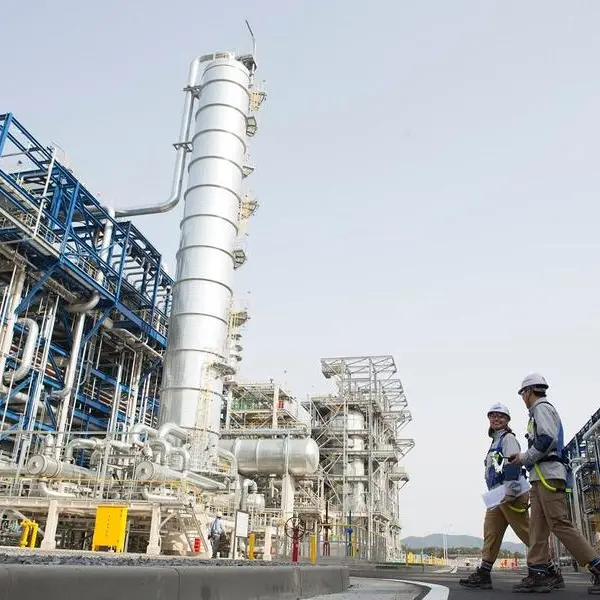
Peter van Driel, Chief Financial Officer of the Abu Dhabi–based state-owned gas company, told reporters on earnings call that capex could increase once Final Investment Decision (FID) is taken in the first quarter on Phases 2 and 3 of the Rich Gas Development (RGD), the $5 billion strategic project to expand gas processing at Habshan, Das Island, Asab and Buhasa.
“We guided the market to $20 billion of committed spending, which excludes capex required for Phases 2 and 3 of the Rich Gas Development. If we were to take FID on those phases, the $20 billion will go up… Also, another project for which we need to take FID is the Bab Gas Cap (BGC) project later in the year; that’s also not part of the $20 billion.”
In December 2024, ADNOC Gas had announced the award of Front End Engineering and Design (FEED) contract for new gas processing facilities at BGC project to Australia’s Worley, with FID expected in 2026.
The committed capex of $20 billion supports more than 40 percent EBITDA growth between 2023 and 2029, Van Driel added. The company plans to issue updated guidance in the first quarter.
Van Driel said once approved, Phases 2 and 3 of RGD would add roughly $8 billion to the currently committed capex programme — at an indicative cost of $4 billion per train for the two trains. That spending would be distributed over 2–3 years.
Meanwhile, capex for 2025 nearly doubled to $3.6 billion, ADNOC Gas’ financials showed. The CFO attributed this to scheduled payments for the IGD-E2 (Integrated Gas Development Expansion Phase II) project and spending linked to Phase 1 of the RGD and debottlenecking works.
The three phases of the RGD together will increase processing capacity by about 30 percent — from 10 billion cubic feet (bcf) to 13 bcf by 2029, he said, emphasising that part of the uplift also comes from debottlenecking existing infrastructure.
Once the 30 percent capacity increase is reached, van Driel said, “we believe we will be able to accommodate future upstream growth within our outlook,” as the only pending FID is the BGC project, which will further enhance production capacity.
The company had previously announced that the BGC would boost processing capacity by over 1.8 billion standard cubic feet per day (scfd).
Petrofac impact
ADNOC Gas had awarded part of a $1.2 billion contract for the Das Island liquefaction facility and a $1.1 billion contract for the Asab and Buhasa facilities to the UK’s Petrofac last June. Petrofac’s holding company entered administration in October 2025 following a liquidity crisis. However, van Driel said Petrofac’s on-site performance continues according to plan.
Ruwais LNG ahead of schedule
On the Ruwais LNG project, of which ADNOC Gas is set to acquire a 60 percent stake from its parent company ADNOC in the second half of 2028 for an estimated $5 billion, the executive said that despite the project currently running slightly ahead of schedule, commissioning dates for the two trains - one for processing and the other for fractionation - remain unchanged: Train 1 is planned for the second half of 2026 and Train 2 for first half of 2029.
Ruwais LNG, a low‑carbon‑intensity project with 9.6 million tonnes per annum (mtpa) capacity, already has 87 percent of its volumes sold under Sales and Purchase Agreements (SPAs), he said. Domestic market sales were optimised in 2024 in anticipation of a softer LNG market in 2028–2029.
While Ruwais LNG is currently being funded by ADNOC, some infrastructure spending now sits with ADNOC Gas. The major financial impact of Ruwais on ADNOC Gas will begin in 2028 after the transfer, he noted.
ADNOC Gas expects 4–5 percent annual growth in gas demand, broadly tracking GDP and population/industrialisation increases. This forecast does not include demand related to data centres, which is not yet material, according to the CFO. The scale of AI-driven demand will depend on the number of new data centres and their cooling energy mix, he said.
Van Driel said that while gas will remain part of the mix, solar is expected to play a major role. The company will benefit from incremental demand, but the share attributable to gas will depend on the evolving energy mix, he added.
(Reporting by Brinda Darasha; editing by Anoop Menon)