PHOTO
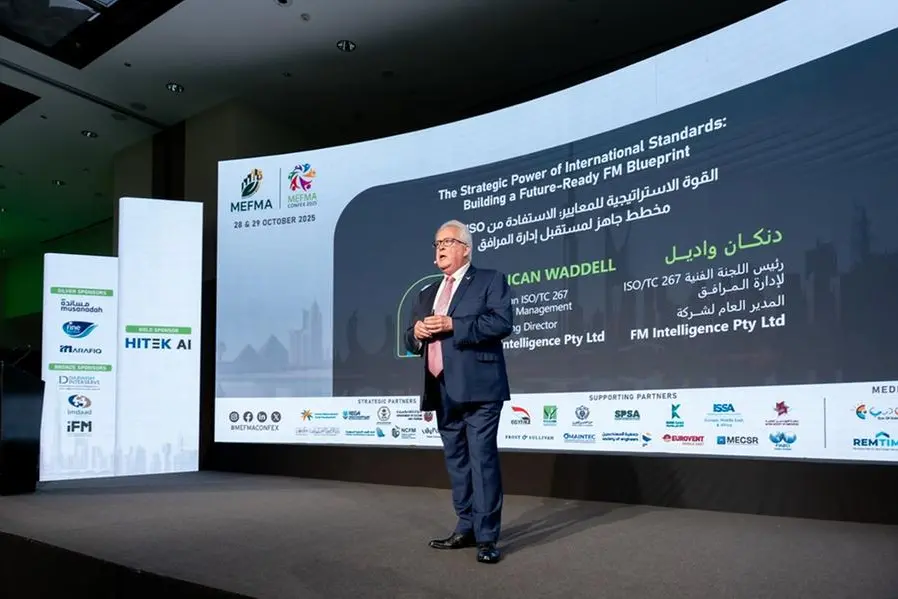
The global facilities management (FM) industry must shift from traditional, reactive maintenance models to integrated, data-driven management frameworks if it is to meet the needs of modern organisations, according to Duncan Waddell, Chairman of ISO/TC 267 Facilities Management.
Presenting at the MEFMA Confex 2025 in Dubai last month, Waddell, who is also Managing Director of Melbourne-based FM Intelligence, said facility management remains fragmented in many markets, with hard and soft services still delivered in silos despite the operational efficiencies of unified management approach.
"What’s often missing is the collective view - what if all these services were brought together under a single management system, sharing data, processes, and workflows that are truly fit for purpose?” he said. “Herein lies the distinction between facilities management and management of facilities.”
He pointed out that traditionally, facility managers were defined by urgency - rushing to fix problems.
“That role must evolve,” he said. “FM companies need to adopt a culture of curiosity and questioning, question the status quo: Why am I doing this? Can it be done better? Why not approach this differently?”
He said not all issues require immediate action, noting that FM teams should reassess whether certain assets or even buildings remain essential to organisational needs in terms of space and resources, and this applies to asset lifecycle as well.
“Maintenance isn’t just about keeping equipment or buildings operational; it should also consider how the asset lifecycle aligns with the organisation’s goals and priorities and how the asset supports both the people and the mission of the organisation,” he said.
Waddell urged asset owners and developers to challenge long-standing assumptions when defining FM scopes, instead of restricting providers to rigid task lists.
He noted that Developers or asset managers typically define strict scopes for FM providers, who are expected to operate only within those boundaries. Even when FM firms can add value beyond the brief, they are often told to “stick to their competency.” Limited early stakeholder engagement further restricts their ability to influence project outcomes.
“Too often, the default position is: ‘This is how we’ve always done it. That’s what I want.’ While I understand that certain areas require strict compliance, operating this way is, frankly, lazy. If I were an asset manager defining the scope, I’d ask: Can we push service providers to deliver better results, greater efficiency and effectiveness, by doing things differently?
He added that FM firms, too, must demonstrate initiative: “This isn’t about over-servicing. It’s about finding smarter, more effective ways of delivering within the agreed scope, and proving that things can be done differently.”
“If FM companies want to prove they can do more, worthy of future opportunities, or differentiate themselves within existing cost constraints, why not go the extra mile?
Waddell stressed that continuous improvement doesn’t have to cost more.
“Incentives can take many forms, and drive better performance overall. What matters is creating scopes that allow service providers to innovate and deliver differently,” he said. “More service isn’t always better; it can be unnecessary and costly. The goal is deliver smarter.”
Standards as a framework for transformation
Waddell recommended using standards as a framework to provide context and guidance beyond the traditional siloed way of working.
“Standards don’t dictate rigid step-by-step instructions on how to run facilities; they provide a management framework,” he said. “They help facility managers think strategically, encourage them to engage with other stakeholders rather than focusing only on isolated tasks.”
He pointed out beyond the core standard, there are many others that serve as reference points.
“They allow practitioners to look at examples and ask: If I applied this approach, it could make a significant improvement to how I operate.? Not every example will apply to every area of asset management or ownership, but many are highly relevant and practical.”
He emphasised the need for FM professionals to develop skills in areas such as communication and change management - disciplines not typically included in traditional FM training.
“For instance, how does a facility manager learn to motivate and communicate with people? This is relevant because most facility managers haven’t been formally trained in these skills.”
Waddell also promoted self-certification to standards such as ISO 41001 as a credible entry point for FM companies, given that accredited FM certification does not yet exist globally.
“A single-service provider can’t be fully certified to ISO 41001, for example, because of the nature of their business. However, they can pursue self-compliance with ISO 41001 and declare themselves self-certified. That is a valuable opportunity,” he noted.
He explained that self-certification under ISO 41001, or other standards in the 41000 series, can also serve as a marketing differentiator.
“Anyone familiar with the standards will recognise that the organisation is thinking holistically. The process helps FM companies align their teams to work in a structured way, without incurring the cost of full certification across a broad range of services. It also opens new markets, strengthens their roles as stakeholders in projects.”
Waddell emphasised that while self-certification is accepted in the industry, it still requires auditing.
“It’s a legitimate starting point and practical option, and it often lays the groundwork for moving into third-party certification later.” he said. “Whether self-certified or certified by a third-party, FM companies can provide credible evidence of how they operate.”
(Reporting by Dennis Daniel; Editing by Anoop Menon)
(anoop.menon@lseg.com)
Subscribe to our Projects' PULSE newsletter that brings you trustworthy news, updates and insights on project activities, developments, and partnerships across sectors in the Middle East and Africa.