Dubai, UAE - 11 January 2005: Hadeed has signed a contract with the Italian Danieli and the Saudi Dywidag Ltd. to supply and set up a new plant for the production of steel reinforcing bars and wire rods at an annual capacity of 500,000 tonnes beside the existing long product plants at Hadeed's complex in Al-Jubail Industrial City.
The new expansion is part of the company's strategy to complete plant expansion projects and raise production capacity, in a serious bid to meet local and international demand, and first and foremost to supply the local market with the high quality SABIC steel reinforcing bars.
Hadeed recently signed a deal in Dubai with Saudi Voest Alpine Company and another contract with the Austrian Voest Alpine Company and the US Midrex Technologies to establish a direct reduction plant at an annual capacity of 1.7 million tonnes of directly reduced iron. This ironwork will use modern technology to enable the company to produce hot reduced iron at temperatures as high as 600 centigrade, increasing the steel plant's production by 15 per cent.
Hadeed also signed an agreement with Saudi Voest Alpine, Saudi Siemens Ltd. and another agreement with a consortium incorporating the Austrian Voest Alpine and German Siemens to set up an steel plant with an electrical arc furnace, with an annual production capacity of 1.4 million tonnes of molten steel, and a continuous steel casting facility with an annual production capacity of 1.2 million tonnes of steel.
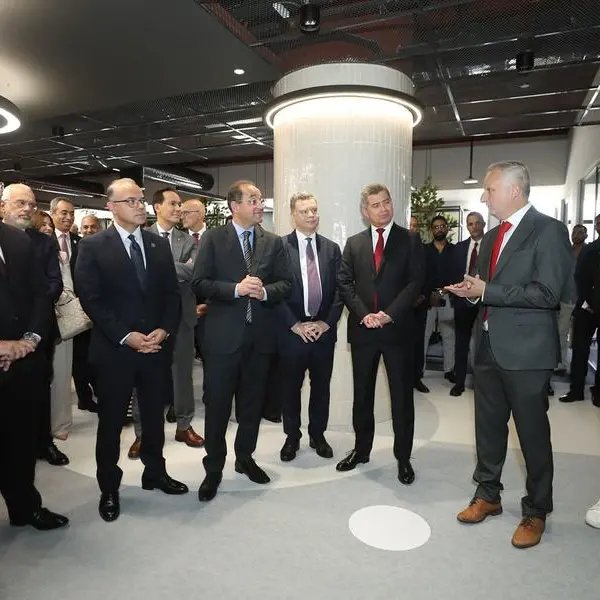
The signing ceremony was attended by Engineer Mutlak bin Hamad Al Morished, Chairman of the Board of Directors of Hadeed and Deputy Chairman of SABIC for Financial Affairs, Mr. Gerhard Falch, Board Chairman of Voest Alpine, and their Excellencies the ambassadors of Austria to Saudi Arabia and the UAE. The agreement was signed on behalf of Hadeed by Mr. Mohammed bin Saleh Al Jabr, Hadeed President and Vice President of SABIC's Metal Group.
Since its inception, Saudi Iron and Steel Company (Hadeed) has been seeking to increase the production capacity of its plants and to diversify its products. The annual production capacity in 2003 was 4 million tonnes of long and flat steel bars, compared with the annual design production capacity of 800,000 tonnes when production started in 1983.
When the expansion projects are completed by the end of 2006, Hadeed's annual iron production capacity will increase from 4 million tonnes to 5.5 million tonnes of long and flat steel products.
Hadeed is regarded as the Arab world's largest iron and steel producer. With the completion of the project, it will be the world's largest directly reduced iron production plant.
-Ends-
Saudi Iron and Steel Company (Hadeed) Background
Saudi Iron and Steel Company (Hadeed) is a company wholly-owned by SABIC.
In 1979, Hadeed was established on a 4.4 sq. km. plot of land in Al- Jubail Industrial City, becoming the first fully integrated iron and steel complex in the Kingdom of Saudi Arabia. When it started operations in 1983, its plant annual design capacity was 800,000 tonnes.
After successive technical improvements and expansions, the production capacity of Hadeed rose to 4 million tonnes of steel products.
Hadeed's Mission
To be the Provider of Comprehensive and Competitive Steel Products through Employees Empowerment with Safe and Environmentally Sound Practices
New Vision
To be the leading Producer and Marketer of Steel Product in the Middle East & North Africa.
Direct Reduction Plants
Directly reduced iron is produced at four direct reduction units, with an annual capacity of 3.4 million tonnes.
Directly reduced iron is the main feeding material for Hadeed's steel plants that produce steel billets and slabs which are later rolled into long and flat steel products.
Raw iron comes in the form of lumps or pellets, and is the principal feeding material for direct reduction modules.
Raw iron is imported. Lumps are often imported from Brazil, and pellets from Brazil, Sweden and Bahrain.
Current production level requires some 5 million tonnes of raw iron annually. Two ship unloaders handle the job at Al-Jubail Industrial Port.
A 13.6km long conveyor belt brings the iron ore to a storage area at Hadeed's complex with a storage capacity of 600,000 tonnes.
In 1982, the two direct reduction modules started operations at an annual capacity of 800,000 tonnes.
In 1992, the third direct reduction module started production with an annual production capacity of 650,000 tonnes. The three modules use the Midrex reduction technology.
In 2002, a fourth reduction module started production, using the HYL3 method, with a production capacity of 1.1 tonnes annually.
Long steel products plant:
It includes three electric arc furnaces, two ladle transfer cars, two ladle furnaces and three continuous casting machines that produce two types of steel billets: one is of a 130 mm square cross-section and 14 metres long; and the other is of a 100mm square cross-section and a length of 4.5 meters long, with an annual production capacity of 2.7 million tonnes.
Long product Rolling Mills:
Hadeed's long products rolling mills include three rolling mills:
1- Rebar Mill.
2- Wire Rod Mill.
3- Section and Bar Mill.
Rebar and Wire Rod Rolling Mills started production in January 1983.
In 1986, slit rolling was introduced to the Rebar Mill for sizes between 12mm and 20mm, raising production by more than 21 per cent.
In 1988, Hadeed introduced Bar Quenching to its Rebar Mill for sizes between 12mm and 32mm.
The Rebar Mill uses 130 X 130mm diameter and 14 meters long steel billets as raw material. These billets are also used in the other two rolling mills.
Steel billets are re-heated to the degree required by the rolling process. They are then rolled to reinforcing bars in a size range of 12 - 40 mm and 12 meter long. These bars can also be produced to the length required by customers from 12 to 18 meters with a standard weight of 2 tonnes for each bundle.
The annual production capacity of the Rebar Rolling Mill is around 1.2 million tonnes of reinforcing bars.
The Rod Mill rolls the steel billets into wire rods and rebar in coils in the 5.5 - 16mm size range.
The annual production capacity of the Rod Mill is around 700,000 tonnes. It can produce various grades used for drawing or wire mesh fabrication in accordance with customer requirements.
In 1993, the Section and Bar Mill started production. This flexible mill has an annual production capacity of 650,000 tonnes of light sections and reinforcing bars.
Reinforcing bars range in size between 10 - 32mm.
Light sections include angles of 30 X 3mm to 70 X 7 mm, and channels of 30 X 15 X 4 to 75 X 40 X 5 mm, and square bars of 10 - 25 mm diameter and flat bars of 25 X 5 to 100 X 6mm.
Why do Hadeed Rebars have superior quality?
In 1988, Hadeed introduced a new technology (bar quenching) to its rolling mills in Jubail to enable the manufacture of superior quality concrete reinforcing bars. This technology employs a state-of-the-art process that involves high pressure surface quenching followed by self-tempering.
As the bar emerges from the last rolling stand, high-pressure water jets rapidly reduce the surface temperature. This action causes change in the microstructure of the steel, making it harder and stronger. Subsequently, the heat retained in the core dissipates and heats the surface to around 620oC causing another change in the microstructure, which improves the ductility and toughness of the bar.
This process meets the ever-increasing demand of structural engineers for higher yield strength combined with good ductility and weldability in reinforcing steel, thus reducing construction costs.
SABIC Research and Technology Center, and the Research Institute of King Fahd University of Petroleum and Minerals carried out several studies on Hadeed's rebar produced by Bar Quenching Process, and the results confirmed the superiority of rebars produced by Hadeed compared with conventional hot rolled rebars.
Flat Products Rolling Mills:
Hadeed's Flat products rolling mills comprise a Hot Strip Mill, a Cold Mill Complex and finishing facilities.
The Hot Strip Mill:
It has an annual design production capacity of 850,000 tons of hot rolled coils of 1.5 mm in thickness and 900 - 1650 mm wide. The hot rolled coils meet the international standards including the construction and the high quality grades.
The Cold Mill Complex:
The Cold Mill Complex includes:
- A Push Pickling Line with an annual capacity of 456,000 tons. The Line is designed to process strip thickness ranging from 1.4 to 6.0 mm, whilst the width range is from 850 to 1650 mm.
- A Four High Reversing Mill with an annual capacity of 360,000 tons. This line produces strips with thickness range from 0.3 to 3.0 mm and a width range from 850 to 1650 mm.
- A Batch Annealing Facility with an annual capacity of 150,000 tons,
- A Temper Mill with an annual capacity of 411,000 tons
- A Continuous Hot Dip Galvanizing Line with an annual capacity of 200,000 tons. This line produces coils with thickness ranging from 0.3 to 2.0 mm and a width range of 850 to 1400 mm.
- A Cold Slitting and Recoiling Line with an annual capacity of 186,000 tons.
Mira Sadek,Senior Account Executive
Impact Porter Novelli
Tel: ++9714 330 4030 Ext 412
Fax: ++9714 330 4031
Mobile: ++97150 6443278
Email: m.sadek@ipn.ae
© Press Release 2005