PHOTO
GENEVA, Switzerland: Saudi Arabia concluded its participation in the 79th World Health Assembly (WHA79) in Geneva this week, where the Kingdom’s delegation set out the progress of its national health transformation and shared its experience in building resilient, digitally enabled health systems including the launch of a new Global Virtual Health Alliance.
The Kingdom’s delegation to WHA79 was led by His Excellency Eng. Abdulaziz bin Hamad Al-Rumaih, Vice Minister of Health.
A national health transformation
Delivering The Kingdom’s national statement to the Assembly, Dr Riyadh Alghamdi, Chief Executive Officer of the Public Health Authority, set out the success of the national transformation spanning the Ministerial Committee for Health in All Policies, the One Health unified national platform, the National Biosecurity Strategy, the expansion to 21 Healthy Cities recognised by the World Health Organization and a rise in life expectancy to approximately 80 years. It also conveyed the Kingdom’s positions on strengthening pharmaceutical supply chains, the International Health Regulations amendments and the Pandemic Agreement.
A tested model for resilient supply chains
The Ministry of Health and the National Unified Procurement Company (NUPCO) convened a high-level side event at the Kingdom’s Permanent Mission in Geneva, presenting Saudi Arabia’s national approach as a model for resilient health supply chains and an open invitation for partnership and shared learning.
The model unifies procurement, logistics and distribution within a single national framework, builds local manufacturing into procurement and uses real-time data to anticipate disruption rather than respond to it. Operated through NUPCO, it reaches 97% of Saudi Arabia within six hours.
Health supply chain resilience has been a priority for health systems worldwide since the COVID-19 pandemic, and more recent disruption to global shipping routes has kept it firmly on the global health agenda.
Speaking at the side event, His Excellency said: “Resilience is built before disruption, not declared during it. It is built quietly, over years, through hard governance and operational choices and consistent investment. It is built by aligning policy with practice and by holding both accountable to the same measure: did the patient receive what they needed, on time, every time? The Kingdom comes to Geneva this week not carrying promises but carrying results. The model behind those results is on the table today, and we share it in the spirit of partnership.”
Scaling virtual health worldwide
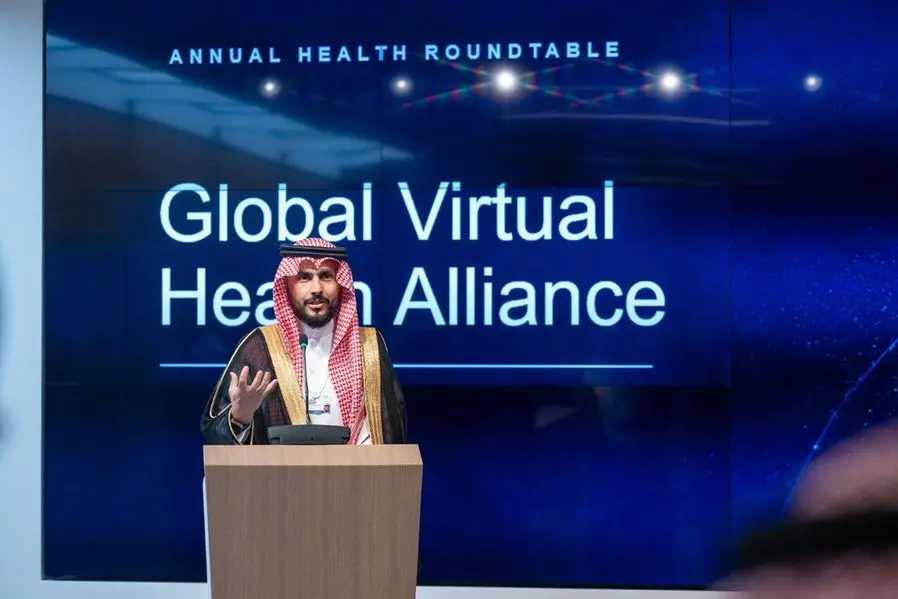
Saudi Arabia and the World Economic Forum also launched the Global Virtual Health Alliance, an initiative to accelerate the scaling of trusted virtual health systems across borders, at the Forum’s Annual Health Roundtable during the 79th World Health Assembly (WHA79), which closed on 23 May.
The Global Virtual Health Alliance, is a voluntary, multi-stakeholder platform designed to improve global health equity and access via virtual health technologies. Saudi Arabia is a recognised global leader in virtual health, with the Ministry of Health’s Seha Virtual Hospital the largest of its kind in the world.
Speaking at the Annual Health Roundtable, His Excellency said: “Through Seha Virtual Hospital and the wider digital health ecosystem, millions of citizens and residents now access consultations, second opinions, follow-up care and clinical expertise that once required travel, waiting or both. The patient no longer travels to the system. The system travels to the patient.” He added: “We are not here to invite you to a meeting. We are here to invite you to partner for scaling equity and access to care and wellness.”
Meetings and partnerships at WHA79
Saudi Arabia currently serves as Vice Chair of the World Health Organization Executive Board and on the margins of WHA79, the Vice Minister held bilateral meetings with the Ministers of Health of the Republic of Cuba, the Arab Republic of Egypt, the Republic of Indonesia, the Islamic Republic of Pakistan, the Republic of the Sudan, the Syrian Arab Republic and the Republic of Tunisia. He also met leaders of multilateral health organisations, including the WHO Regional Director for the Eastern Mediterranean, Dr Hanan Balkhy, and the Chair of the Gavi Board, the Rt Hon Helen Clark. The delegation met senior executives from medtech, pharmaceutical and biotech companies and took part in the session of the Council of Arab Health Ministers held alongside WHA79