PHOTO
Dubai, UAE: Waving, pointing or saying “Dada” can often be taken for granted by parents who don’t know that not achieving these simple milestones can be indicators of serious child developmental and behavioural disabilities.
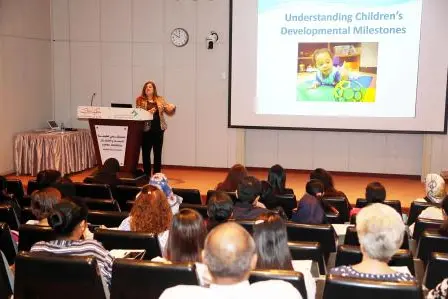
For this reason, the Dubai Health Authority (DHA) has put in place a campaign to raise awareness amongst parents about the importance of developmental monitoring and screening among children aged nine-months to six-years-old. The DHA also launched a workshop on Tuesday to train healthcare providers from private health facilities on how to conduct these developmental screenings.
This is in line with the “Quality health and rehabilitation services” pillar of the “My Community... A City for Everyone" initiative, which was launched in 2013 by His Highness Sheikh Hamdan bin Mohammed bin Rashid Al Maktoum, Crown Prince of Dubai and Chairman of The Executive Council, with the aim of transforming Dubai into a friendly city for people of determination by the year 2020.
Dr Fatima Sultan Al Olama, Consultant and Head of Childcare at DHA explained that developmental monitoring entails observing children’s growth to make sure that they meet the typical developmental milestones in playing, learning, speaking, behaving, and moving.
“Parents should track their child’s developmental milestone and check off the ones their children have achieved [Milestone checklist available in fact box below]. For example, at six- months, a baby should be able to roll back and forth and sit up without support. At 12 months, a baby should be able to crawl, babble mama or dada and walk with or without support,” she said.
Dr Al Olama emphasised that a missed milestone could be a sign of a problem, so the child should be referred to a doctor or a specialist for developmental screening.
Furthermore, Dr Al Olama said the DHA will soon be adding a developmental screening tool, that can be accessed by parents through DHA’s Tifli App.
“The developmental screening tool includes a brief questionnaire that’s asks questions about a child’s development, including language, movement, thinking, behaviour, and emotions. The tool is currently used in all primary health care centres run by the DHA for children aged nine-months to six years.”
She said that monitoring and screening is important because lack of early intervention contributes to the fact that one in three children have significant school disabilities or difficulties.
Preterm babies or children with an existing long-lasting health problem are at a higher risk of developmental problems that might require additional screening.
She said that most child delays are not discovered early, in fact, studies have found that only 20 per cent of these children are identified and receive help before school begins and as a result, these children must wait to get the help they need to do well in social and educational settings.
She added that studies have also found that 11 per cent of children are at high risk of disability and need referrals for further evaluation while 43 per cent of children are at low risk of disability and only need routine monitoring and follow-up.
Dr Al Olama said that the most common developmental or behavioural disabilities that these screenings can discover are autism, learning disorders, attention-deficit/hyperactivity disorders and language delays.
She said that raising awareness on this issue is important as a Dubai based study found that while most the women surveyed keep an eye on their child’s growth, a notable percentage is unaware of developmental screening tools.
The study found that 13 per cent said they do not use a screening tool and 14 per cent are unaware of the availability of screening tools that can detect developmental delays.
“In addition to the Dubai developmental Screening Tool, the DHA currently provides a number of early detection services that can prevent future developmental delays such as pre-martial tests, early detection test of genetic and metabolic diseases of new-borns, pregnancy examinations and follow-up as well as early detection tests of jaundice, hearing and visual disabilities and autism,” she said.
FACT BOX
Child Developmental Milestones Checklist
- By six months
- Rolls both ways
- Sits without support
- Responds to own name
- Explores toys with hands and mouth
- Looks for partially hidden objects
- Imitates sounds that you make
- Transfers objects from one hand to the other
- Makes happy and sad noises
- By 12 months
- Scoots or crawls
- Walks with or without support
- Babbles and says “Mama” and “Dada”
- Responds to simple requests
- Pokes and points with index finger
- Uses thumb and index finger to pick up small items
- Has strong preference for primary caregivers
- Imitates gestures like a wave or a kiss
- By 18 months
- Climbs onto and down furniture assisted
- Points to pictures in a book
- Stacks items such as blocks
- Knows three body parts
- Uses several words including “no” and “mine”
- Plays with toys by their function
- Tries to activate a toy
- Does things for attention and looks for a reaction
- By 24 months
- Kicks a ball and can walk on tiptoes
- Begins to run
- Uses simple sentences
- Follows simple directions
- Sorts items by colour, shape or size
- Is learning to share and take turns
- Scribbles and may begin to copy vertical lines and circles
- Recites repeated phrases and well-known books
About the Dubai Health Authority:
The Dubai Health Authority (DHA) was created, in June 2007, by Law 13 issued by His Highness Sheikh Mohammed bin Rashid Al Maktoum, Vice President and Prime Minister of the UAE, Ruler of Dubai, with an expanded vision to include strategic oversight for the complete health sector in Dubai and enhance private sector engagement. His Highness Sheikh Hamdan Bin Rashid Al Maktoum, Deputy Ruler of Dubai and UAE Minister of Finance is the President of the Dubai Health Authority and His Excellency Humaid Al Qatami, Director-General of the Dubai Health Authority.
The DHA’s aim in Dubai is to provide an accessible, effective and integrated healthcare system, protect public health and improve the quality of life within the Emirate. This is a direct translation of the objectives of the Dubai Strategic Plan 2015 launched by His Highness Sheikh Mohammed bin Rashid Al Maktoum. Keeping the strategic plan in mind, the DHA’s mission is to ensure access to health services, maintain and improve the quality of these services, improve the health status of nationals, residents and visitors and oversee a dynamic, efficient and innovative health sector.
In addition to overseeing the health sector for the Emirate of Dubai, the DHA also focuses on providing services through DHA healthcare facilities including hospitals (Latifa, Dubai, Rashid and Hatta), specialty centres (e.g. the Dubai Diabetes Center) and DHA primary health centres spread throughout the Emirate of Dubai.
The main pillars of service delivery at DHA health facilities are quality, efficiency, patients and staff. It is our aim to maintain and improve the quality and efficiency of DHA health services. An important aspect of the service delivery strategy is to focus on patients, their needs and satisfaction as well as attract, retain, nurture and support outstanding staff.
Prior to the establishment of the DHA, the Department of Health and Medical Services (DOHMS), which was established in 1973, was the functioning authority that almost exclusively focused on health service delivery.
© Press Release 2018Disclaimer: The contents of this press release was provided from an external third party provider. This website is not responsible for, and does not control, such external content. This content is provided on an “as is” and “as available” basis and has not been edited in any way. Neither this website nor our affiliates guarantee the accuracy of or endorse the views or opinions expressed in this press release.
The press release is provided for informational purposes only. The content does not provide tax, legal or investment advice or opinion regarding the suitability, value or profitability of any particular security, portfolio or investment strategy. Neither this website nor our affiliates shall be liable for any errors or inaccuracies in the content, or for any actions taken by you in reliance thereon. You expressly agree that your use of the information within this article is at your sole risk.
To the fullest extent permitted by applicable law, this website, its parent company, its subsidiaries, its affiliates and the respective shareholders, directors, officers, employees, agents, advertisers, content providers and licensors will not be liable (jointly or severally) to you for any direct, indirect, consequential, special, incidental, punitive or exemplary damages, including without limitation, lost profits, lost savings and lost revenues, whether in negligence, tort, contract or any other theory of liability, even if the parties have been advised of the possibility or could have foreseen any such damages.