PHOTO
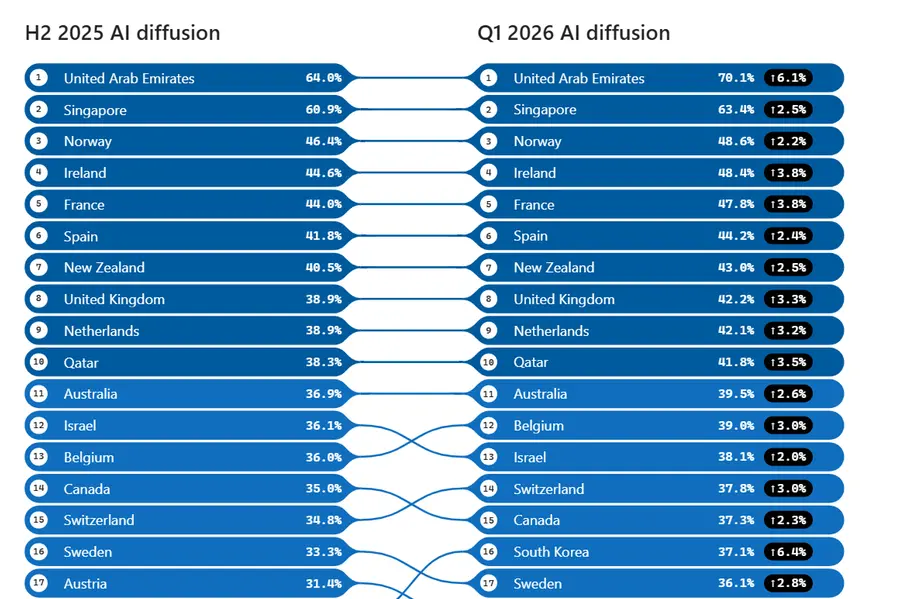
United Arab Emirates: The United Arab Emirates’ continued progress in AI adoption reflects sustained, long-term investment in digital infrastructure, skills, and governance. New findings from Microsoft’s AI Diffusion Report for Q1 2026 indicate that AI usage has become increasingly embedded in how people across the country work and learn, supported by foundations designed for resilience, operational continuity, and responsible growth. AI adoption in the UAE has risen steadily, increasing from 59.4% to 64% and now reaching 70.1% in the latest findings.
The report, published by the Microsoft AI Economy Institute using aggregated and anonymised telemetry across more than 100 markets, places AI adoption in the UAE at 70.1% of the working-age population, making it the first economy in the world to cross the 70% mark. This positions the country among the most advanced globally and reflects a rate of uptake that continues to outpace the global average, which stands at 17.8%, underlining the impact of consistent national focus on digital capability and ecosystem development.
The data reflects usage during the first quarter of 2026, a period in which the UAE’s adoption rate continued to grow, a reflection of the durability of economies with deeply embedded digital foundations.
Amr Kamel, General Manager, Microsoft UAE, said: “Growth at this scale reflects deliberate, long-term investment in the right foundations, even through more challenging periods. This milestone belongs to the UAE, to its government, its institutions, its businesses, and the people who have made AI part of how they work and learn. The priority now is what comes next: enabling organisations to operate with confidence, sustain continuity, and build forward responsibly. Microsoft’s role is to support that journey as a long-term partner to the UAE.”
Microsoft has operated in the UAE for more than three decades, supporting public and private sector organisations through successive cycles of digital transformation. Its infrastructure in the country, two cloud regions in Abu Dhabi and Dubai, supported by multiple redundancy zones was designed with operational continuity as a baseline requirement. The company’s sovereign cloud collaboration with G42 and Core42 extends that infrastructure to support public sector and regulated industries with in-country data governance.
As part of a $15.2 billion commitment to the UAE spanning AI infrastructure, skills, and innovation, Microsoft continues to invest in the capabilities that support long-term national competitiveness. This includes a target to skill one million learners in AI by 2027, expanded through Microsoft Elevate UAE to reach more than 250,000 students and educators and more than 55,000 government employees. Microsoft and its partners are projected to contribute $74.4 billion to the UAE economy and support more than 152,000 jobs in the years ahead.
Globally, the Q1 2026 report points to a widening gap between the Global North and Global South, with adoption growing more than twice as fast in higher-income regions. The report highlights persistent challenges in connectivity, digital infrastructure, and local-language AI capability as the primary barriers to equitable diffusion and identifies deliberate, long-term investment as the most effective response.
Find the full report here.
About Microsoft
Microsoft (Nasdaq “MSFT” @microsoft) creates platforms and tools powered by AI to deliver innovative solutions that meet the evolving needs of our customers. The technology company is committed to making AI available broadly and doing so responsibly, with a mission to empower every person and every organization on the planet to achieve more.
For more information (Press only):
Magdalena Stepien, Microsoft UAE
E : Magdalena.Stepien@microsoft.com
Kriti Kulshreshtha, Assembly Middle East
E: Kriti.Kulshreshtha@assemblyinc.com