PHOTO
TOKYO — ispace, inc. (ispace) (TOKYO: 9348), a global lunar exploration company, today announced that it will commence a new service, providing a lunar transportation service that will launch aboard SpaceX’s Starship spacecraft. This will be in addition to ispace’s existing lunar transportation services utilizing its ULTRA lunar landers. As the world returns its attention to the Moon and enters a new era of lunar exploration, ispace is evolving to become a “Lunar Access Integrator,” capable of providing unified services for the “integration, transportation and operation” of lunar payloads.
In preparation for the new business offering, ispace has secured 500 kilograms of payload capacity on Starship, scheduled for launch as early as 2030. ispace is offering global customers with relatively small payload delivery needs, weighing 500 kilograms or less, a comprehensive service to integrate, transport and operate their payloads on the Moon.
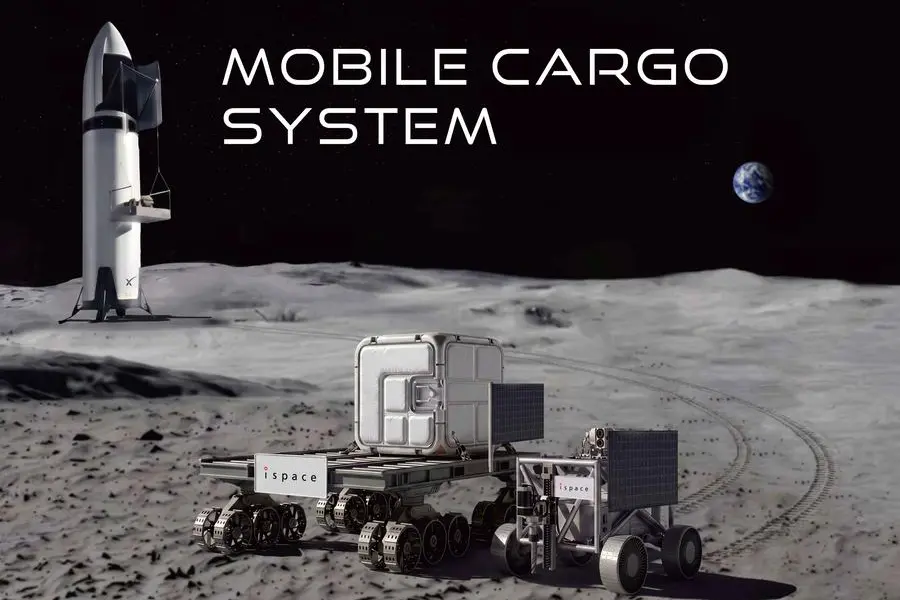
As part of the integration process, ispace will assess each customer’s payload requirements and implement the quality control necessary for lunar transportation. ispace will then integrate multiple payloads into the dedicated “Mobile Cargo System” in development by the company and provide services, including interface coordination with Starship as part of the system. Upon landing on the Moon, ispace aims to provide operational support through the “Mobile Cargo System” to ensure the smooth deployment of payloads onto the lunar surface, their movement across the lunar surface, and access to other infrastructure.
Through the service and capturing the spirit of its motto “We Go Beyond,” ispace will go beyond transporting payloads to the Moon, evolving its business model into a “Lunar Access Integrator.” The company will connect Earth and the lunar surface end-to-end and offer a comprehensive package that includes the “integration, transportation and operation” of customer payloads. As the mission cadence and demand increases, ispace will proactively explore the utilization of the “Mobile Cargo System” to accommodate multiple units, expand capacity to handle ton-class customer payloads exceeding 500 kg, and enable lunar surface transportation over longer distances from lunar landing sites.
Since becoming the first Japanese space start-up to sign a contract for a Falcon 9 launch in 2018, ispace has now signed a total of three launches to date. ispace’s HAKUTO-R Mission 1 and Mission 2 launched aboard Falcon 9 rockets in 2022 and 2025.
With key business and manufacturing hubs in Japan, the U.S., and Europe, ispace recently established an entity in the Kingdom of Saudi Arabia and has formed a global customer acquisition team spanning multiple continents, separating it from competitors as a unique global company with reach around the world. The launch provides an opportunity for customers with payloads under 500kg to work with ispace and SpaceX for access to the lunar surface.
The emergence of rockets with the capability of transporting large-scale payloads to the Moon is expected to accelerate deployment of lunar infrastructure, including power, communications, construction, data, and mobility. The establishment of this core infrastructure on the lunar surface will reduce barriers hindering subsequent infrastructure projects, leading to a rapid expansion in the transport of relatively small lunar payloads for purposes such as technology validation, exploration, and business development.
ispace is currently developing and preparing for three lunar landing missions in 2028, 2029, and 2030, respectively, using the ispace-developed ULTRA Lander. Today’s announcement involves an expansion of the company’s business portfolio beyond the ULTRA Lander to include lunar transport services utilizing ispace’s “Mobile Cargo System” aboard SpaceX’s Starship. This will enable the company to broadly address the expected global growth in demand for lunar payloads.
While transport via Starship and the “Mobile Cargo System” enables high-capacity shipments and relatively low cost, transport via the ULTRA Lander enables high-value-added, tailored solutions to specific customer requirements, such as timing, location, environment, and other characteristics. By combining ULTRA’s customized transport with Starship’s high-capacity transport to offer the optimal solution for each customer, ispace aims to stimulate latent demand for small lunar payloads and drive an accelerated increase in that demand.
Statement of Takeshi Hakamada, Founder & CEO of ispace, inc.
“We are very pleased to be able to offer the new Lunar Access Integration service utilizing Starship’s payload space through our collaboration with SpaceX. High-capacity, relatively low cost lunar transport, such as that provided by Starship, is essential to realizing the sustainable lunar economy that ispace aims to create,” said Takeshi Hakamda, Founder & CEO of ispace. “As a ‘Lunar Access Integrator,’ ispace aims to combine high-value-added lunar transport using its own landers with high-capacity transport opportunities utilizing Starship, serving as a gateway for customers around the world to access the Moon and carry out their missions.”
Statement of Stephanie Bednarek, Vice President of Commercial Sales, SpaceX “Having previously flown multiple ispace missions to the Moon aboard Falcon 9, we’re excited to expand this relationship to Starship. Their integration services provide a valuable pathway for smaller payloads to secure a ride to the Moon today, and we look forward to supporting ispace and their customers as they help expand access the lunar surface.”
About ispace, inc. (https://ispace-inc.com)
ispace, a global lunar resource development company with the vision, “Expand our planet. Expand our future.”, specializes in designing and building lunar landers and rovers. ispace aims to extend the sphere of human life into space and create a sustainable world by providing high frequency, low-cost transportation services to the Moon. The company has business entities in
Japan, Luxembourg, and the United States with more than 300 employees worldwide.