PHOTO
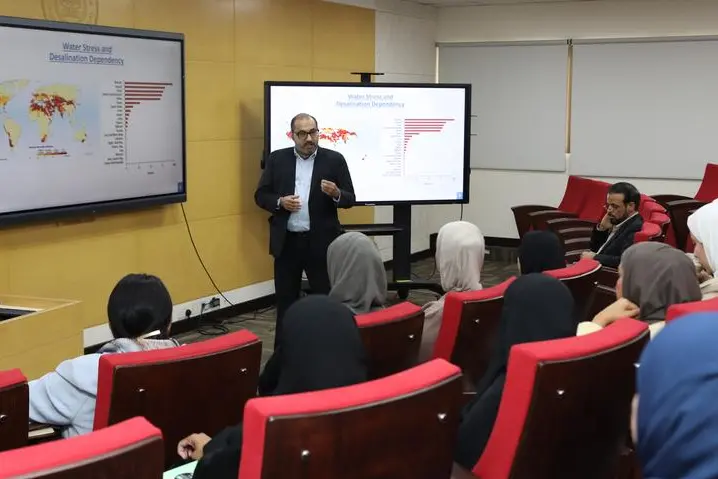
Manama – The Shaikh Khalifa bin Hamad Al Thani Chair in Geographic Information Systems and the Shaikh Isa bin Salman Al Khalifa Academic Chair in Technology Management, hosted by the College of Education and Administrative and Technical Sciences at the Arabian Gulf University (AGU), welcomed a number of engineers from the Electricity and Water Authority of the Kingdom of Bahrain to deliver an extensive scientific seminar on the national experience in water desalination. The seminar was held as part of the postgraduate course “Selection and Deployment of Technologies”, within the framework of cooperation between the University and national institutions and government ministries in Bahrain and the GCC.
During the seminar, Eng. Khaled Mansour Ahmed Hashem, Head of the Abu Jarjoor Reverse Osmosis Desalination Plant, and Eng. Fadhel Salman, Operations Officer at the plant, delivered a comprehensive presentation on the selection of appropriate desalination technologies. They highlighted Bahrain’s experience in this field, with a particular focus on the Abu Jarjoor Plant as an advanced model of reverse osmosis technology.
The presentation addressed the growing reliance on desalination as a primary source for meeting increasing water demand in the Kingdom, while also reviewing the history of the desalination industry and its development over the past 70 years. The speakers provided students with an integrated overview of water sources and the distribution of desalination plants, linking these factors to population changes and development needs, and emphasising the importance of the water sector in supporting the stability and sustainability of water supplies.
Furthermore, the presentation also examined the key technologies used globally and locally, explaining the differences between them in terms of efficiency and energy consumption, as well as the drivers behind the selection and adoption of specific tech options in line with operational and production requirements. In addition, the speakers outlined the main stages of work in desalination plants, from seawater intake and treatment through to the production of potable water. The seminar concluded with a discussion of the key challenges associated with desalination, including energy efficiency, the reduction of operational costs, and environmental considerations related to brine discharge, as well as future development opportunities, including the integration of renewable energy into plant operations to enhance efficiency and ensure the sustainability of this vital sector.