PHOTO
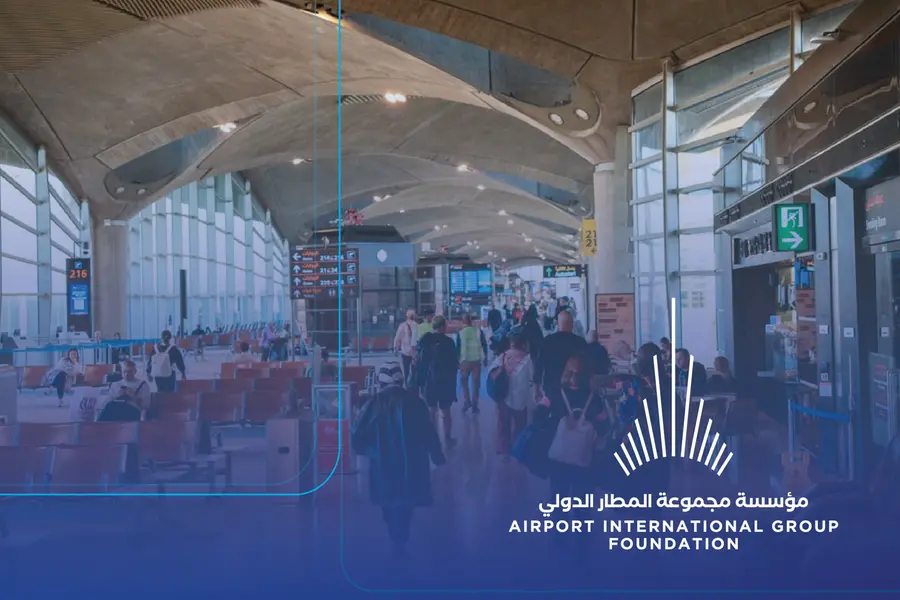
Amman, Jordan: Airport International Group (AIG), the Jordanian operator of Queen Alia International Airport (QAIA), has reported its Corporate Social Responsibility (CSR) and sustainability achievements for 2025 and the first half of 2026. This period was defined by measurable impact across environmental performance, community empowerment and institutional governance. AIG’s results underscore how sustainability has evolved into a core driver of operational resilience and long-term value creation at Jordan’s gateway to the world.
In 2025, QAIA maintained its distinction as the first and only airport in the MENA region to achieve Airport Carbon Accreditation (ACA) Level 4+, the highest level under Airports Council International’s carbon management framework, successfully renewing its certification for a first cycle. As part of its long-term decarbonization efforts, AIG successfully decreased its carbon emissions from Scope 1 and 2 by 11% during the year, contributing to a cumulative emissions reduction of more than 50% since 2012, from 32,643 tCO₂e to 12,130 tCO₂e.
AIG continues to translate climate commitments into operational results through expanded electric mobility initiatives and the development of an onsite solar farm, which has led to improved energy efficiency. It helped recycle 70.15 tons of waste, recycled 88% of its water and planted 20,000 trees. This progress was further reinforced by the issuance of AIG’s ESG report, prepared in alignment with the Global Reporting Initiative standards, outlining the AIG’s environmental, social, and governance performance and key achievements across the year at Queen Alia International Airport.
Commenting on the achievements, Nicolas Deviller, CEO of Airport International Group, said, “At Airport International Group, sustainability is a management philosophy. The progress we achieved in 2025 and early 2026 reflects years of integrating environmental stewardship, ethical governance and social responsibility into the way Queen Alia International Airport operates. This integrated approach strengthens our operational resilience, enhances passenger confidence and positions QAIA as a benchmark for responsible airport management in the region.”
Beyond environmental leadership, AIG continued to deliver structured and measurable social impact through its philanthropic arm, Airport International Group Foundation (AIGF). In 2025, the Foundation graduated its sixth cohort from the Hirfati Training Center, equipping 72 young men and women from Al Jizah and surrounding communities with practical, market-relevant vocational skills. AIGF recently launched its seventh cohort and signed a partnership agreement with Pioneers of Development and Training to further expand its reach. These efforts have resulted in 694 graduates since Hirfati’s launch in 2019, reflecting a cumulative investment in livelihoods that extends beyond training to measurable economic participation.
Conducting an independent Impact Assessment Report covering 2023–2025 further strengthened accountability, ensuring that community programs remain evidence-based and outcome-driven. This structured and scalable model earned AIGF both the Sustainability Innovation Award and a High Commendation for Social Responsibility Initiative of the Year in 2025, while it maintained its Elite AAA ESG Rating of 93/100.
In reference to the impact of AIGF, Omar M. Masri, Chairman of Airport International Group Foundation, said, “Our commitment goes beyond delivering training programs. Through Hirfati, we equip young people with skills that translate into employment, entrepreneurship and long-term income generation. We firmly believe that structured, evidence-based CSR can create scalable solutions that strengthen both communities and the national economy.”
In line with its procurement strategy, AIG recently strengthened its local supply chain through a partnership with Hygex Jordan. Following an agreement signed in February 2025, AIG sourced 30 tons of de-icing chemicals through this local supplier, reflecting AIG’s commitment to safety and localizing its partnerships.
Internally, AIG’s commitment is reflected in its governance culture and inclusive workplace practices. Over the past year, more than 80% of AIG staff at all levels actively participated in CSR initiatives serving the environment and the community. Furthermore, AIG’s dedication to diversity remains also a key pillar in its strategy. Women today represent 17% of AIG’s workforce with 38% females from new hires until mid-2026, 24% of managerial, operations, engineering, and shared services roles and 18% of Board of Director membership, supported by structured initiatives designed to expand female leadership and participation. In 2025, AIG joined UN Women, aligning its policies with international standards on gender equality and inclusive employment. At the institutional level, the QAIA became the first airport in the region to receive the ISO 50001 certification for Energy Management System, while sustaining four ISO certifications (ISO 9001; ISO 14001; ISO 45001; and ISO 10002), reinforcing a governance framework that integrates environmental management, occupational health and safety, quality assurance and information security into day-to-day operations.
As a national gateway and a driver of economic growth, QAIA reflects AIG’s commitment to embedding local economic development at the heart of its operations. In the first quarter of 2026, QAIA earned a 4.98 satisfaction score in the Airport Service Quality (ASQ) rankings, placing fourth in the Middle East. The Group continues to channel economic value into the national economy by sourcing 81% of its local suppliers, demonstrating that operational excellence, service quality and sustainability performance are mutually reinforcing objectives.
It is worth noting that AIG is a Jordanian company with extensive experience in airport rehabilitation, operation, and management. Since 2007, AIG has overseen the expansion and operation of QAIA under a public-private partnership with the Government of Jordan, delivering world-class services, stimulating tourism and economic growth, and implementing sustainable practices that reduce the airport’s environmental footprint.