PHOTO
PHULENAGAR/MUMBAI, India - In the western Indian village of Phulenagar, Samadhan Sonawane set up a drip irrigation system on his small onion farm using digital currency issued directly from the central bank.
The funds come from a pilot programme that is part of India's efforts to boost its e-rupee, a central bank digital currency (CBDC), and tighten its $80 billion welfare payment system, which has historically suffered from corruption and inefficiency.
While India's early efforts are modest compared with those of China, where more than 200 million people use the e-yuan, the world's most populous nation could in theory become its biggest CBDC issuer if the system gains traction.
For now, Indian authorities are working to establish use cases in the farm and subsidised food distribution sectors, where welfare often struggles to make it to the right recipients.
"Where we are right now is looking for some kind of killer use case that differentiates CBDC ... I think that's what India's trying to do, to find those kinds of killer applications," said John Kiff, an independent digital currency adviser who formerly worked with the IMF and Bank of Canada.
The pilot, run jointly by the World Bank, the Reserve Bank of India (RBI), the Maharashtra government and Punjab National Bank, is one of around 10 experiments under way across India to test whether the e-rupee can be used to deliver welfare payments more efficiently, two people familiar with the initiatives said.
China and India are the only countries with programmable CBDCs at scale, analysts say. India's pilot scheme has an estimated 10 million users.
Globally, 49 countries are currently running CBDC pilots while only a handful have done a full launch, according to the Atlantic Council's CBDC tracker.
India kicked off the e-rupee in late 2022, pitching it as the future of payments while warning that privately issued cryptocurrencies pose risks to financial stability, but adoption has been limited.
Transactions using the e-rupee have totalled about $3.6 billion since its launch, a fraction of the more than $300 billion processed monthly on India's popular Unified Payments Interface (UPI). Officials and analysts see welfare payments as a potential way to give the CBDC a clearer purpose.
The sources declined to be identified as they are not authorised to speak to media. India's federal government and the central bank did not respond to emails seeking comment.
Details about India's plans to expand welfare payments via CBDC have not been previously reported.
ADOPTION VIA WELFARE
The CBDC system of direct transfer appeals to Sonawane as he does not have to pay for the equipment upfront or wait weeks or months for a government refund.
The drip irrigation system costs about 103,000 rupees ($1,235), more than twice the roughly 50,000 rupees he earns in a five-month growing season.
Under the pilot, the government transfers the subsidy directly into a digital wallet in e-rupees covering 80% of the total costs. The funds are programmed to be spent at approved vendors.
In Sonawane's home district, nearly 1,400 farmers have applied to receive irrigation subsidies via the e-rupee, officials said.
"The programmable aspect of CBDC ensures funds cannot be misused while also removing the need for farmers to make an upfront payment," said Vijay Kolekar, an economist at a Maharashtra government agency overseeing the project.
The experiment is also testing whether the CBDC can enable a more "equitable and inclusive subsidy delivery system", he said. Vendors, typically from socially dominant groups, are reluctant to offer credit to farmers lower in the social hierarchy.
The mechanism has also boosted sales.
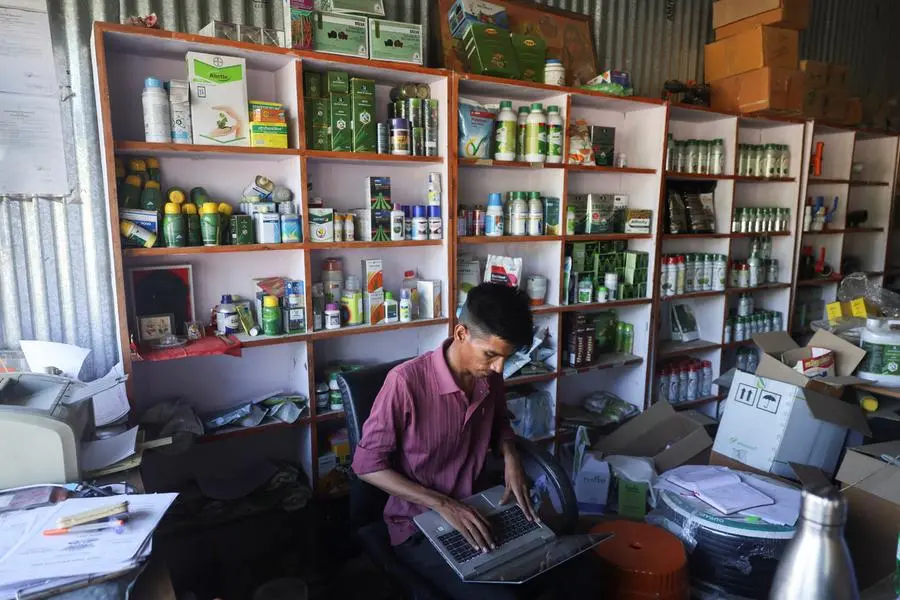
Vaibhav Vhalgade, who owns a farm equipment store about 20 km (12.4 miles) from Sonawane's farm, said he usually makes about 200 sales of such equipment every season between February and August. This year he has received around 50 applications through CBDC till April alone.
PROMISE AND PITFALLS
Similar trials are taking place elsewhere.
In Prime Minister Narendra Modi's home state of Gujarat, about 15,000 beneficiaries have been enrolled in a pilot that uses the digital rupee to distribute subsidised food through government ration shops, said Mona Khandhar, a senior state official.
The aim is to eventually cover all 7.5 million families eligible for subsidised food in Gujarat by June, she said.
"It's a win-win," Khandhar said, pointing to better tracking and efficiency in running a large welfare programme.
The central bank intends to use separate CBDC versions, with welfare payments offering higher transparency while retail ones carry greater privacy protections, the first source quoted earlier said.
However, critics warn that restrictions on how money can be spent may come at a cost and run counter to the argument that CBDCs are similar to cash.
"Trying to enact this level of control over economic activity is very challenging," said Neha Narula, director of the Digital Currency Initiative at the MIT Media Lab.
Narula said heavily programmed money - with conditions on when, where and for what purpose it can be spent - could deter people from adopting a CBDC or saving in it.
"This is a really dangerous road to go down," she said.
($1 = 93.8037 Indian rupees)
(Reporting by Jaspreet Kalra and Ashwin Manikandan in Mumbai; Editing by Ira Dugal and Jacqueline Wong)