PHOTO
(The opinions expressed here are those of the author, a columnist for Reuters.)
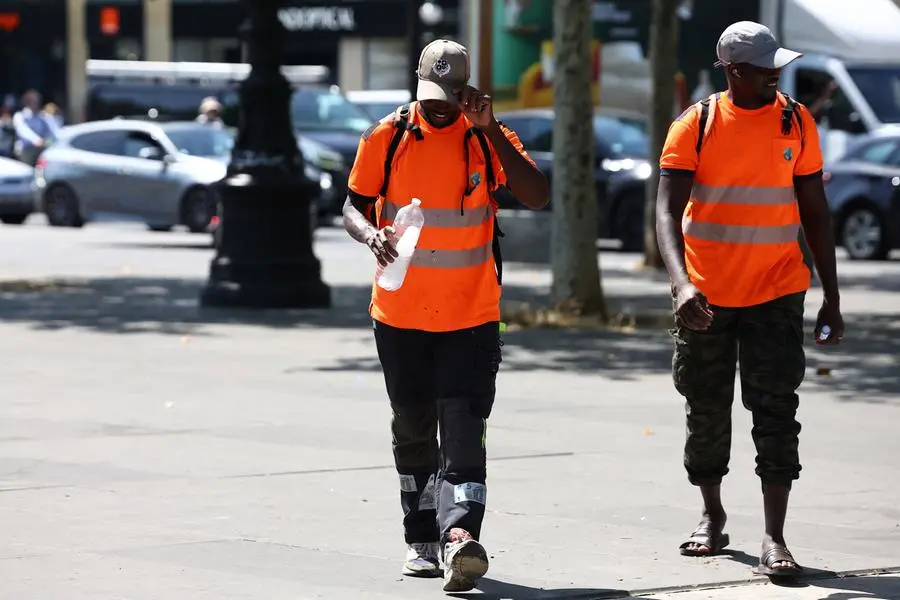
LITTLETON, Colorado - Europe's latest heatwave delivered an uncomfortable reminder that the continent's climate challenge doesn't stop at cutting emissions. As temperatures surged past 40 degrees Celsius (104 degrees Fahrenheit) in parts of western Europe, roads buckled, rail tracks warped, traffic lights malfunctioned and transport operators imposed speed limits or cancelled services altogether.
According to the U.N. Economic Commission for Europe (UNECE), transport infrastructure across the region is increasingly exposed to pavement deterioration, rail deformation and thermal stress as heat extremes become more frequent.
For years, Europe's infrastructure spending narrative has been dominated by decarbonisation, with investors focused on wind turbines, solar panels, electric vehicles and batteries.
But a different infrastructure story is beginning to emerge as it becomes clear that Europe was largely built for a climate that no longer exists.
The next major spending cycle may therefore be less about generating clean energy and more about ensuring that trains still run, roads remain intact and electricity networks function during increasingly intense summer heatwaves.
THE ROADS TRADE
The European Environment Agency has identified protection of infrastructure from heat-related risks as one of the continent's urgent adaptation priorities.
Road surfaces provide perhaps the clearest illustration of the problem.
Conventional asphalt binders soften under sustained heat, leading to rutting, cracking and deformation. Much of Northern Europe's transport infrastructure was designed around temperature ranges that are becoming steadily less relevant as heat records fall.
That points toward increased demand for polymer-modified bitumen and other high-performance paving materials already widely used in hotter climates.
One potential beneficiary is TotalEnergies, whose Styrelf range of polymer-modified binders is marketed specifically for resistance to rutting, thermal cracking and heavy climatic stress.
The products are already used in demanding applications ranging from highways to airport runways and racing circuits.
Shell could also be a winner. The company remains one of the world's largest bitumen suppliers and has expanded its range of advanced binders designed to extend pavement life and withstand tougher operating conditions.
The investment opportunity does not necessarily lie in developing breakthrough technologies. It may simply involve selling Northern Europe the kinds of road materials that have long been standard in Southern Europe and the Middle East.
THE RAIL RESILIENCE BOOM
Railways present a bigger challenge.
Europe's low-carbon transport ambitions rely heavily on shifting passengers and freight onto rail. Unfortunately, rail systems are highly sensitive to temperature extremes because steel expands under heat.
Recent heatwaves have triggered service disruptions across multiple countries as operators grappled with rail deformation, melting sealants, signalling failures and speed restrictions.
UNECE has warned such disruptions are likely to become increasingly common without adaptation measures.
That creates opportunities for specialist rail infrastructure suppliers.
German group Vossloh supplies rail fastening systems and concrete sleepers designed for different climate zones and operating conditions worldwide.
Concrete sleepers and more robust fastening systems help maintain track stability during periods of thermal expansion.
Pandrol, whose fastening systems are used on rail networks around the world, is similarly positioned to benefit from efforts to improve track resilience and reduce maintenance demands under increasingly volatile climate conditions.
Austria's voestalpine Railway Systems also stands to gain from greater spending on upgraded rail components, turnouts and fastening technologies.
In effect, Europe's climate adaptation strategy for transport may require rebuilding significant sections of its existing rail network to standards once associated with much hotter regions.
THE UNSUNG MATERIALS STORY
Investors looking for adaptation winners should also keep an eye on cement, specialty chemicals and construction materials.
Heat stress affects bridges, tunnels and other civil structures through thermal expansion and accelerated wear.
Companies such as Heidelberg Materials, Holcim and Sika occupy potentially attractive positions in this theme because they supply advanced concretes, specialty additives, sealants, reinforcement systems and other products that can extend asset life under harsher conditions.
The adaptation trade may ultimately be a materials story as much as an engineering one.
Just as the energy transition created demand for lithium, copper and rare earths, climate adaptation could create sustained demand for polymer additives, high-performance concrete, advanced steel products and specialised construction chemicals.
DON'T FORGET THE GRID
The power sector represents another layer to the story.
Transport systems increasingly depend on electricity. Railways, signalling equipment, charging infrastructure and urban transit networks all require power networks capable of operating under extreme temperatures.
That should support demand for high-performance cables, upgraded conductors and more resilient transmission systems.
Prysmian and Nexans are already major suppliers to European grid-expansion projects, while Nordic cable producer NKT is positioned to benefit from network reinforcement and underground cabling programmes. Recent initiatives by French grid operator RTE to lay 45,000 km (28,000 miles) of transmission and distribution lines by 2030 underscore the scale of investment already being directed toward transmission infrastructure.
THE NEXT INFRASTRUCTURE SUPER-CYCLE?
The adaptation market remains overshadowed by decarbonisation, a focus that could prove shortsighted.
Every euro spent on electrifying transport becomes less valuable if rail services fail during heatwaves. Every investment in clean power loses some of its value if transmission systems can't cope with extreme weather.
Europe's policymakers have spent the better part of two decades asking how to reduce emissions.
The more immediate question may now be how to keep society functioning in a warmer world.
The firms supplying heat-resistant asphalt, expansion joints and advanced elastomeric bearings are unlikely to command the excitement once enjoyed by solar and battery stocks.
But when temperatures reach 40C and beyond, they may turn out to be every bit as important.
The opinions expressed here are those of the author, a columnist for Reuters. Enjoying this column? Check out Reuters Open Interest (ROI), your essential new source for global financial commentary. Follow ROI on LinkedIn and X. And listen to the Morning Bid daily podcast on Apple, Spotify, or the Reuters app. Subscribe to hear Reuters journalists discuss the biggest news in markets and finance 7 days a week.
(Reporting by Gavin Maguire; Editing by XX)