PHOTO
(The opinions expressed here are those of the author, a columnist for Reuters.)
WASHINGTON - "AI or die." That was International Monetary Fund Managing Director Kristalina Georgieva last week, telling a panel at the IMF/World Bank spring meetings in Washington how she views the challenges businesses, industries, and economies around the world face given the transformative powers of artificial intelligence.
Her comments also apply to the stock market.
U.S. Big Tech suffered a substantial wobble and repricing in the first quarter, but has roared back in the last three weeks, with market conviction in the AI productivity boom seemingly stronger than ever.
Investors will get a sense of whether this optimism is justified this week, with Tesla, the first of the "Magnificent Seven" megacaps to report, releasing first-quarter results on Wednesday. IBM and Intel also report this week.
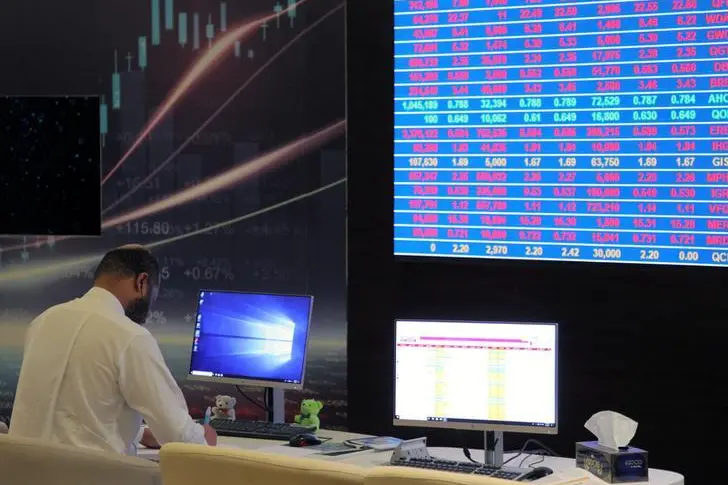
Markets are clearly expecting more good news. U.S. stocks have shrugged off the Iran war and the energy supply shock to hit new all-time highs. The Nasdaq on Friday clocked its 13th daily gain, its longest winning streak since 1992, rising nearly 20% in the process. Should the rally extend through Monday, it will be the best run since June 1987. The S&P 500 is also up 13% in the last three weeks.
The rebound has been highly unbalanced, however, driven by only a handful of Big Tech firms. Indeed, less than 10% of the S&P 500 stocks are trading at 52-week highs, according to Liz Ann Sonders at Charles Schwab.
The S&P 500 tech sector is now worth nearly 35% of the overall index's market cap, closing in on October's record 36%. The tech and communications services sectors' combined market cap is now less than a percentage point off October's record 46% market share.
Concentration risk is suddenly back on the table.
Any downward shift in sky-high AI sentiment could have an outsized impact on the wider market. And with global energy prices up the most in five years, there are worries that the hyper-bullish earnings outlook for Big Tech – now a highly energy-intensive sector – could sour.
POWER UP
While economists at BNP Paribas reckon the AI boost will "comfortably" overshadow all negative shocks over the next several years, in the near term - this year and next - negative shocks are likely to carry more weight.
"If current (AI) capex pledges are met in full, this could significantly boost power prices, diminishing the positive productivity effect from AI deployment," they wrote last week.
These capex pledges are huge - some $635 billion this year from hyperscalers Microsoft, Amazon, Alphabet and Meta alone, and over $800 billion in total, according to Morgan Stanley.
The numbers on the energy demand side are also eye-popping.
In November, Morgan Stanley energy analysts estimated total U.S. data center power demand through 2028 at 69 gigawatts, warning of a potential 44 GW shortfall. They now see that demand reaching 80 GW, with the potential shortfall rising to 55 GW. For context, 10 gigawatts could power 10 medium-sized nuclear power plants.
With AI-driven demand for energy going up and supply constrained, the prices Big Tech must bear will undoubtedly be higher than expected. This could eat into the huge profits baked into market expectations for hyperscalers.
Or, as Melissa Otto, head of research at S&P Global Visible Alpha, told Reuters last month, it could even hinder their capex plans altogether.
"I think if the capex numbers get pulled back, if in fact energy prices are not reflected in earnings, that could be a catalyst" for an equity market pullback, Otto said.
However, the energy price spike may ultimately be a short-term concern that is quickly forgotten as the AI juggernaut rolls on. It's also possible that rising geopolitical tensions could actually benefit Big Tech, as the fracturing of the world order will likely only heat up the AI arms race.
Moreover, if JPMorgan's Nikolaos Panigirtzoglou is right that investors retain a large short position in the benchmark tech 'QQQ' exchange-traded fund (ETF), there is even room for the AI trade to accelerate further in the short term.
"AI or die" may very well be investors' motto in the coming years, and for good reason. But if energy prices stay higher for longer, this revolution – and the stock market – may not advance as quickly as expected.
(The opinions expressed here are those of Jamie McGeever, a columnist for Reuters)
Save the date: On April 23 at 1300 GMT/9 a.m. EDT, ROI columnists Mike Dolan and Jamie McGeever will join LSEG for a webinar discussion, "ROI Markets Unpacked: Rethinking safe havens in uncertain times". Click here to sign up.
Enjoying this column? Check out Reuters Open Interest (ROI), your essential new source for global financial commentary. Follow ROI on LinkedIn, and X.
And listen to the Morning Bid daily podcast on Apple, Spotify, or the Reuters app. Subscribe to hear Reuters journalists discuss the biggest news in markets and finance seven days a week.
(By Jamie McGeever; Editing by Marguerita Choy)