PHOTO
LONDON - AI fervour kept world stocks at record highs on Thursday as investors looked past rising borrowing costs, a high-stakes summit between U.S. President Donald Trump and China's Xi Jinping, and a live political crisis in Britain.
The pan-European STOXX 600 rose 0.5% and, with Wall Street futures pointing 0.3% higher, MSCI's global stocks index extended its rebound from Iran war lows to 15%.
Much of the focus was on Beijing where Xi told Trump that trade talks were making progress. There was a warning about Taiwan too, but traders were banking on tariff and AI deals to keep the rally running.
Europe's other big story was Britain's political crisis, where Prime Minister Keir Starmer faced a potential leadership challenge after heavy losses in regional elections last week.
Health minister Wes Streeting - seen as a possible successor - said he was resigning and had "lost confidence" in Starmer's leadership, urging him to step aside.
The uncertainty kept the UK's 10-year borrowing cost above 5%, having hit its highest since the 2008 financial crisis this week as markets braced for a likely bruising leadership battle.
Sterling, down almost 1% since Monday, was a fraction lower at $1.3505, although data showing Britain's economy unexpectedly grew in March offered some support.
"We must presume there is going to be a leadership challenge," Franklin Templeton's Global Investment Strategist Michael Browne said.
That would feed into a debate over how much room a new UK leader would have to pursue more aggressive economic policies given the strains on public finances, he added.
"On the surface it doesn't look like there is much."
DOLLAR GETS A LIFT FROM INFLATION DATA
Wall Street futures pointed to further record highs later, with nearly $6 trillion chipmaker Nvidia seen rising almost 2% after Reuters reported the U.S. has cleared about 10 Chinese firms to buy its second-most powerful AI chip, the H200.
The dollar held recent gains as investors bet the Federal Reserve's next move would be a rate hike after a run of hotter-than-anticipated inflation data.
U.S. producer prices on Wednesday posted their biggest rise since early 2022, a day after data showed annual consumer inflation accelerating at its fastest pace in three years.
With the economy and labour market still strong, traders are starting to price in a potential Fed hike in the first half of 2027, although most economists still see a cut as the more likely next move.
The two-year U.S. Treasury yield hovered near a 1-1/2-month high at 3.9708% in Europe, while the benchmark 10-year yield stood at 4.468%.
Germany's 10-year Bund yield was close to its recent multi-year highs at 3.082% and the euro bought $1.1716 amid expectations for a European Central Bank rate hike next month.
The yen fetched 157.93 per dollar, keeping traders wary of fresh intervention by Tokyo after a recent flurry of sharp moves.
AI FLYING
In Asia, China's blue-chip stocks eased about 0.8% after hitting their highest since late 2021 at the start of the session, while the yuan rose to a three-year high against the dollar.
Charu Chanana, chief investment strategist at Saxo, said markets were supported by the absence of fresh tensions from the Xi-Trump meeting. "So far, that seems to be enough," Chanana said.
Franklin Templeton's Browne said he was hopeful for some "significant movement" on U.S.-China trade policy.
"It is going to be about technology and the development of tech - and all that will do is further fuel the AI bubble," he said.
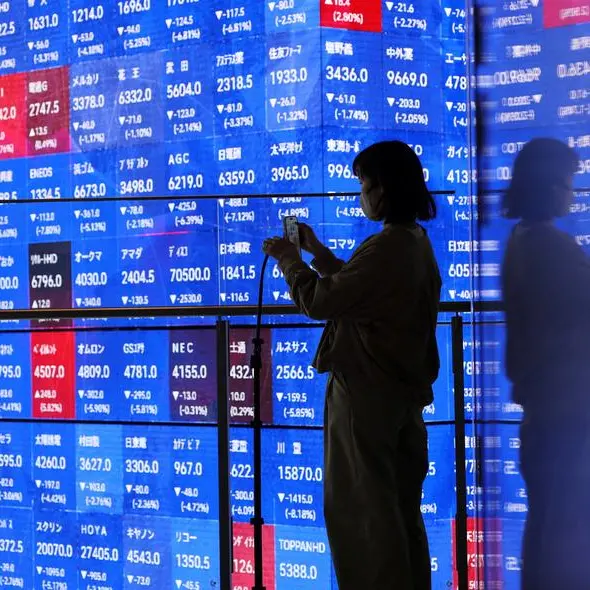
That dynamic was playing out almost everywhere. Japan's Nikkei hit a new all-time peak in Tokyo as data showed AI-linked demand was helping lift earnings for Japanese firms.
In South Korea, another of Asia's AI darlings - SK Hynix - was on the verge of joining the elite group of firms with a $1 trillion market cap having seen its stock surge over 200% this year.
Analysts, though, caution that elevated oil prices and the impasse in Middle Eastern peace talks could bring inflationary worries back into view.
Brent crude futures were at $106.50 a barrel in London, while U.S. West Texas Intermediate futures fetched $101.33 per barrel. Both are up roughly 50% since the Iran war erupted in late February.
"Markets are trying to run two playbooks at once: AI and earnings say buy growth, but geopolitics and energy prices are quietly re-writing the inflation trajectory in the background," said Saxo's Chanana.