PHOTO
This is an important year for Pakistan. In 2018, the world’s will hold several key elections, voting in a new government and leadership. Elections are first due for the Senate in March and then for the National Assembly and the legislatures of all the country’s four provinces by August.
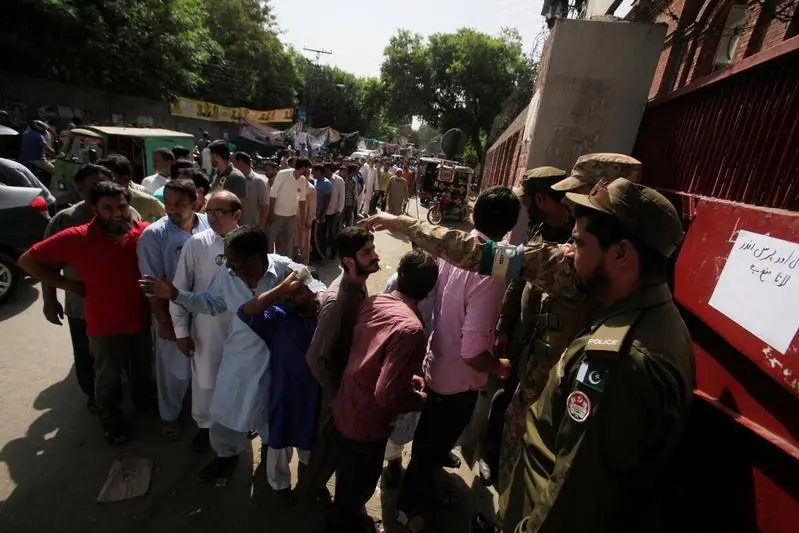
More than 100 million voters are expected to help elect 1,122 national and provincial parliamentarians, including 52 senators, 342 members of the National Assembly and 728 members of the provincial assemblies. This is one of the largest electoral exercises in the world: Pakistan is the world’s fifth-largest democracy after India, the United States, Indonesia and Brazil in terms of population, and the second-largest Muslim democracy after Indonesia.
But this political transition for Pakistan will not come easy, as the scale of the electoral exercise is not the only challenge. Coming on the heels of one of the most turbulent political periods in Pakistan’s history, a great deal of national anxiety persists around the elections and their exact dates.
Constitutionally, Senate elections are bound to be held every three years, and polls for the national and provincial assemblies every five years, but polarization around the political objectives of the key power contenders are threatening to derail Pakistan’s democratic project.
Divisiveness and delays around electoral reforms aimed at improving the processes to make them fairer and freer have put election deadlines under threat. As have a startling pre-election campaign focused on removing the incumbent party from power by a disparate but paradoxically united opposition, which seems in a hurry to conduct accountability not through the ballot but through street protests.
With less than 50 days to go to the Senate elections, which must be held by March 5 at the latest, there are dark mutterings about preventing them from happening. A lot is at stake for the contenders. For Nawaz Sharif’s ruling Pakistan Muslim League-N (PML-N), the process of electing half of the 104 members of the upper house of Pakistan’s bicameral parliament (52 senators are elected for six-year terms every three years) is key to securing a majority in the house two decades after it last did so.
This would help it elect its own chairman and therefore control the legislative agenda in the Senate for the next three years, even if it does not return to power after the summer general elections.
For the opposition, including Bilawal Bhutto’s Pakistan People’s Party (PPP) and Imran Khan’s Pakistan Tehrik-e-Insaf (PTI), a gnawing worry is that Sharif secures a big enough majority to legislate in both houses before the end of the current parliamentary term in May to restrict the period of his legislative disqualification by the Supreme Court.
This will technically allow him to get elected to the office of president of Pakistan, complete with immunity against prosecution on any count, and lead his party into the general elections on a sounder footing than it is now.
To prevent this, recent political developments hint at the possibility of the dissolution of the Khyber Pakhtunkhwa Assembly ruled by Khan’s PTI and the Sindh Assembly governed by Bhutto’s PPP ahead of the Senate elections. Considering that the provincial assemblies, along with the National Assembly, constitute the electoral college for the Senate, this would create a constitutional crisis and kill the plans of Sharif and his party to muster major political advantage ahead of the national elections.
This month, the PML-N government was mysteriously ousted in Balochistan by its own party legislators, who revolted to allow one of the group’s bitterest opponents to come to power.
At another key public show of force in Lahore, the hometown of Sharif, bitter political opponents Khan and Asif Ali Zardari recently joined hands to promise public pressure aimed at dethroning the PML-N from its home base of Punjab. Rumors have grown of the PPP and PTI mulling dissolving their legislatures in Khyber Pakhtunkhwa and Sindh, as well as getting their legislators to resign from the National Assembly in order to create a constitutional crisis that would prevent the Senate elections and instead force early elections for the national and provincial assemblies, to the disadvantage of PML-N.
Whether this will happen or not will become clear in the next five weeks, after which it will become irrelevant as Senate elections will go ahead and the political status quo could change in favor of Sharif and his PML-N.
If the Senate elections happen on time, the possibility of Sharif staging a sensational comeback in the August elections will make him a strong contender to lead Pakistan for a record fourth time. If the Senate elections do not happen and the other elections (which must be held within 90 days of the dissolution of the assemblies) are held before August, the main contenders for the leadership of Pakistan will be Shehbaz Sharif of PML-N, Khan and Bhutto.
Who among them will actually be crowned as the new prime minister will depend on which of their parties secures 172 seats — whether alone or in alliance with others — in the National Assembly. Whatever the outcome, Pakistan will have passed a key milestone, having successfully held three successive elections on time for the first time.
• Adnan Rehmat is a Pakistan-based journalist, researcher and analyst with interests in politics, media, development and science.
Copyright: Arab News © 2018 All rights reserved. Provided by SyndiGate Media Inc. (Syndigate.info).