PHOTO
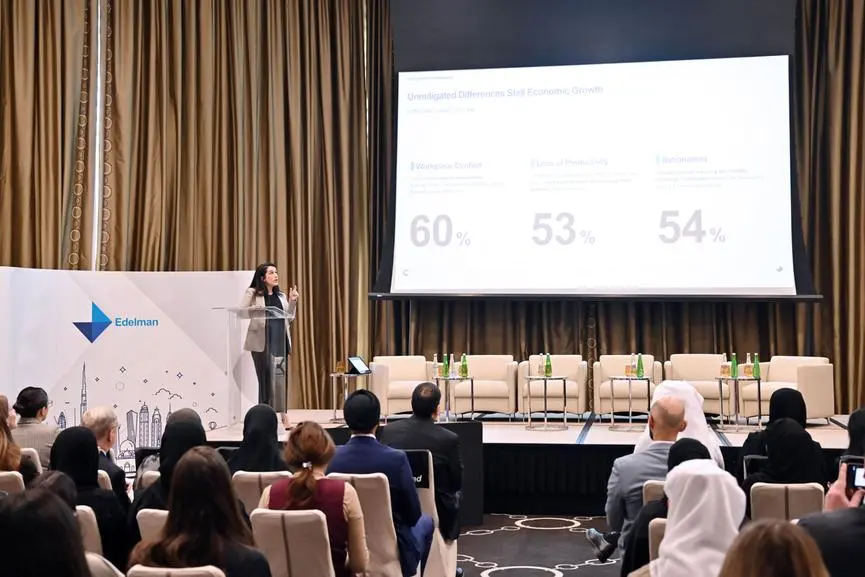
The 2026 Edelman Trust Barometer showed that while societies around the world are increasingly turning inward, the United Arab Emirates continues to demonstrate the strength of its society, rooted in trust in institutions, employers, and leadership, with trust levels in the UAE remaining strong even among the most cautious groups.
The index indicated that the trend towards insularity is not limited to trust patterns alone, but also reshapes people’s outlook on the future. Globally, optimism has declined sharply, with less than one-third of respondents (32 percent) believing that the next generation will be better off than today.
In contrast, the UAE displays a more resilient and optimistic outlook, with nearly two-thirds of the population (63 percent) remaining optimistic about the future of the next generation.
Nidaa Lone, Head of Abu Dhabi at Edelman Middle East, said that the UAE continues to demonstrate the strength of its society, derived from trust in institutions, employers, and leadership, noting that trust levels within UAE society remain strong even among more cautious groups.
In a highly diverse society, she added, this is of particular importance as it provides a solid foundation for leadership based not only on avoiding differences, but on engaging constructively with them, in line with the country’s future-oriented outlook.
Employers in the UAE hold a strong position that enables them to act as trust brokers amid the global shift towards insularity. “My employer” ranked first at 70 percent among employees in the UAE, tied with government at 70 percent among the general population, as the most effective institutions in bridging divides and facilitating trust-building between groups lacking mutual trust.
Employees identified a set of clear and consistent actions that support this role, with nine out of ten confirming that employers can build trust by fostering a shared identity and culture, bringing together teams comprising colleagues from different values and backgrounds, and providing training in constructive dialogue.
This comes within a context of sustained institutional trust in the UAE, where the local environment has not witnessed widespread rejection of institutions despite rising global caution toward differences.
The media maintains high levels of trust, while institutional leaders continue to retain credibility. Overall trust levels remain high, with employers trusted by 88 percent of employees, while 86 percent of the population trust government, 84 percent trust the business sector, 77 percent trust non-governmental organisations, and 74 percent trust the media.
Based on these findings, the index recorded rising public expectations of leadership in the UAE, with people looking to chief executive officers to lead trust-building efforts within institutions and society. While 83 percent of respondents believe CEOs are obligated to play an active role in bridging divides between different groups, 62 percent believe CEOs are currently succeeding in doing so.
The public believes that effectively strengthening trust requires leaders to engage constructively with critics and sceptics (85 percent), signalling openness to dialogue rather than retreating from differences, consult people from diverse backgrounds when making decisions (84 percent) to reinforce inclusion and practical experience in leadership choices, and model trust-building behaviours from the top, as CEOs set the tone for how organisations engage with differences.
These findings convey a clear message to leaders: maintaining trust is no longer automatic or general, but has become increasingly tied to personal experience.
In this context, sustaining trust will depend on the ability of employers to bridge gaps, strengthen cohesion, and build trust across the components of a diverse society.