PHOTO
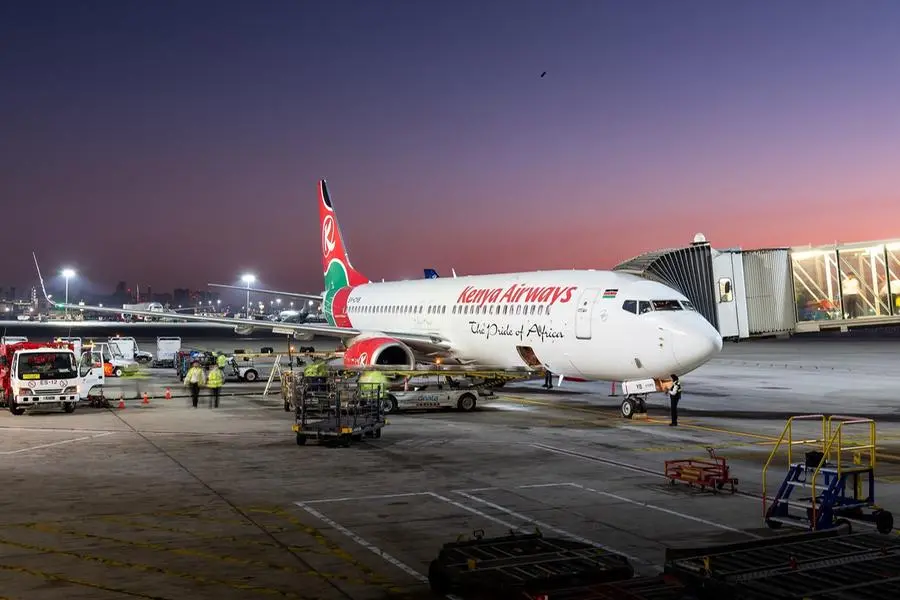
East African aviation majors Ethiopian Airlines (ET) and Kenya Airways (KQ) are poised to gain from the ongoing Middle East conflict, while smaller carriers RwandAir and Air Tanzania risk losing revenue from key destinations in the region.
Aviation analysts say the widespread disruption of Middle East airspace, a critical gateway linking Europe and Asia, could redirect some passengers through alternative hubs such as Nairobi and Addis Ababa, boosting demand for KQ and ET and helping offset losses from cancelled Middle East flights.
RwandAir, Uganda Airlines and Air Tanzania, on the other hand, risk losing revenue from cancelled flights to the Middle East, particularly Dubai, one of their most lucrative routes.
“In the short term, ET and KQ are actually benefiting slightly as passengers heading from Europe to Asia are being rerouted via Addis Ababa and Nairobi, as Middle Eastern hubs are closed,” argued Sean Mendis, a former executive in an African airline and an aviation commentator.
Jomo Kenyatta International Airport (JKIA) has this week recorded a surge in arrivals as transiting passengers reroute through Nairobi. Other major airports across Africa, including in Ethiopia, Egypt and South Africa, have also reported a sudden influx in passenger numbers in the wake of the Middle East conflict. KQ and ET are expected to benefit from this surge.
The temporary influx is expected to cushion the two airlines from the impact of airspace disruptions in the Middle East for as long as the hostilities last.“The labour and trader traffic will rebound as soon as active hostilities end,” said Mr Mendis.
It also flies to Tel Aviv in Israel, Sharjah in the UAE, Muscat in Oman, Doha in Qatar, Bahrain, Kuwait, Dammam, Jeddah, Jizan, Medina and Riyadh in Saudi Arabia, among others.
KQ only flies to Dubai twice daily using a Boeing 737 aircraft with a capacity of about 160 passengers. Despite the expected surge in demand, KQ has not announced additional flights on any of its routes, but its load factor – the proportion of seats filled – is projected to improve significantly.
ET, on the other hand, has already begun redeploying its freed capacity. On Thursday, for instance, it wet-leased a Boeing 787 Dreamliner to Uganda Airlines, which has had its entire wide-body fleet grounded for maintenance.
The Kampala-based carrier had temporarily halted its London and Mumbai routes due to the grounding of its long-haul fleet, while its Dubai flights dropped in frequency to three times a week from four.
Nonetheless, the closure of Middle East airspace is still expected to hit it as Dubai is one of the few long-haul routes it currently serves.
Air Tanzania flies five times weekly to Dubai, also one of its few long-haul routes, and is expected to take a tangible hit from the conflict, especially because it cannot currently access many countries in Europe due to a ban by the region’s aviation regulator.
RwandAir flies to Doha six times weekly and five times weekly to Dubai. The codeshare arrangement means that RwandAir ferries passengers from Kigali to Doha for onward connections on Qatar Airways, which is currently not flying.
All the airlines have confirmed suspension of flights to and from parts of the Middle East, but none has publicly disclosed the expected impact on their overall passenger traffic and revenues for the year.
© Copyright 2026 Nation Media Group. All Rights Reserved. Provided by SyndiGate Media Inc. (Syndigate.info).