PHOTO
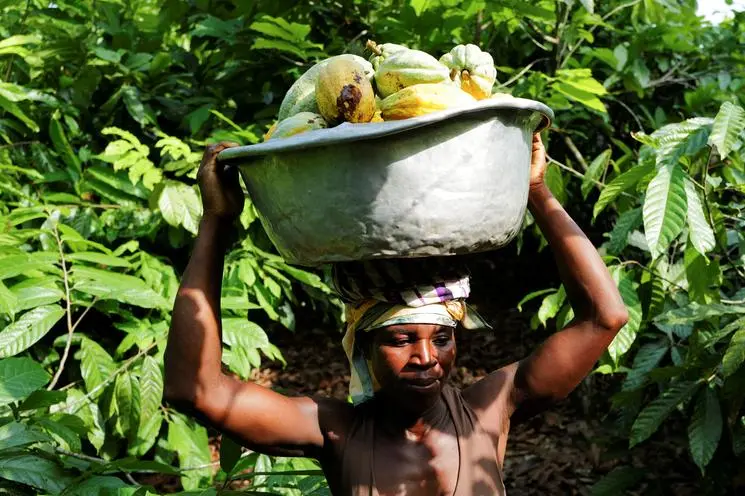
Joseph Bermah Dautey, a Ghanaian cocoa farmer, delivered six bags of beans to be sold months ago, but is still waiting for payment from the country's regulator, forcing the 65-year-old to limit his meals to one a day.
He is among thousands of farmers in Ghana, the world's second biggest cocoa producer, struggling to find money to buy food, pay for their children's school fees and invest in basic farm maintenance as thousands of tons of unsold beans have piled up.
The situation is comparable in Ivory Coast, the biggest producer, as global cocoa demand has fallen sharply, leading global prices to halve over the course of a year to two-year lows of around $4,000 a metric ton.
Before that, a poor crop had led to a price spike on international markets.
Dautey, who previously worked as a teacher, told Reuters he was unable to pay for his older daughter's tuition and that his younger daughter keeps calling him asking for money.
To maintain a 25-acre farm in Assin Foso, a major cocoa-growing district, he spent 3,600 cedis ($328.77) using borrowed funds and still owes 2,000 cedis.
"For about three weeks now, I eat once a day, things are very difficult for me," Dautey said. "It has affected my life so much that I cannot even describe it."
Another farmer, Jacob Agbeko Tetteh, told Reuters his children could not return to university because he has also not been paid for six bags of cocoa he delivered. He lacks funds to replace ageing cocoa trees, whose yield has declined.
INTERNATIONAL TRADERS STOP BUYING
Ghana's farmgate price, set annually by market regulator Cocobod, is 58,000 cedis a ton or nearly $5,300, meaning international traders face losses on Ghanaian cocoa purchases. Their purchases have dwindled as a result, leaving farmers unpaid.
The regulator said last week it has about 50,000 metric tons of unsold cocoa at ports, adding that it is in talks with farmers and the Finance Ministry to try to resolve the situation.
Farmers told Reuters they have significant unsold stocks of beans at home but no access to buyers after the district officers of the Licensed Buying Companies, the only companies authorised to buy from the farmers, closed their shops.
Cocoa can be stored for only 6-12 months before losing quality in hot, humid countries.
MISMATCH BETWEEN INTERNATIONAL PRICES AND FARMGATE PRICES
The licensed buyers urged the regulator Cocobod last week to secure funding urgently to pay for approximately 300,000 tons of cocoa.
A coalition of Ghanaian cocoa farmers said it was willing to accept lower prices for future deliveries if the government agrees to sign a memorandum of understanding linking farmgate rates to international market prices going forward.
However, the Ghana Cooperative Cocoa Farmers and Marketing Association, which represents about 395,000 members, said the government must first pay what it owes for beans already delivered at the official price.
"What they have already bought and not paid for, they should find a way to pay that immediately," Theophilus Tamakloe, the association’s national vice president, told Reuters.
"After that, they can meet with us to discuss a possible reduction of the farmgate price."
Tetteh said he would accept a government price reduction if it enables the regulator to purchase remaining stocks and pay for beans already delivered.
"It's business, so if prices go up on the international market, farmgate prices should also go up. If they come down, the farmgate price must come down too," said the farmer who is still drying fresh cocoa with nowhere to sell it.
($1 = 10.9500 Ghanaian cedi)
by Emmanuel Bruce; Editing by Anait Miridzhanian and Barbara Lewis)