PHOTO
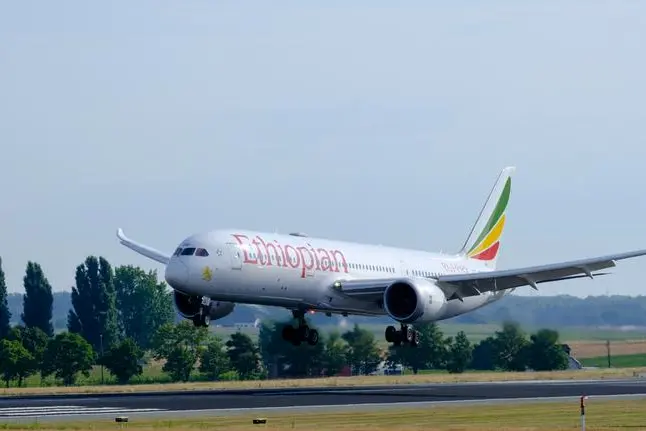
Africa’s largest carrier, Ethiopian Airlines, this week marked 80 years of operations, offering a case study in institutional resilience and long-term strategy in an industry often defined by volatility.
Global celebrations, including those at outstations, were flagged off on April 8 at a ceremony held at the Ethiopian Skylight Hotel in Addis Ababa, presided over by the airline’s chief executive Mesfin Tasew alongside government dignitaries.“This is a proud moment for Ethiopian Airlines and the entire African aviation industry,” Mesfin said during the event. “We are honoured to reach the 80 years mark serving our continent and the rest of the world. Keeping our Pan-African identity, we have bridged gaps, linked nations, pnd connected economies for eight decades. Our achievements are built by hard work, commitment, and partnerships. This is not a milestone just for the management and staff, it is also a remarkable moment for our stakeholders, partners, and our esteemed customers.”Founded in the aftermath of World War II, the airline’s first scheduled flight on April 8, 1946, connected Addis Ababa to Cairo at a time when much of Africa remained largely disconnected from global aviation networks. From those modest beginnings, the carrier has grown into Africa’s largest aviation group, serving more than 150 destinations across five continents.
Over the decades, Ethiopian Airlines has navigated political upheaval, economic shocks and conflict, both domestically and across the continent.
Resilience testFor Tewodros Desta, the director for transformation at Ethiopian Airlines, the carrier’s endurance reflects more than operational agility.“Its story is a testament to resilience, discipline, and the enduring belief that African institutions can compete and lead on the global stage,” he wrote in a recent commentary marking the anniversary.
That resilience was tested again during the Covid-19 pandemic, when global aviation ground to a near halt. While many carriers suspended operations or required state bailouts, Ethiopian Airlines pivoted rapidly, converting passenger aircraft into cargo planes and expanding its freight operations.
The strategy enabled it to transport medical supplies, vaccines and humanitarian cargo across Africa and beyond at a time when global supply chains were severely constrained.“Resilience is not merely the ability to survive disruption; it is the ability to rise stronger because of it,” Tewodros noted.
Economic roleBeyond its operational performance, the airline has become a central pillar of Ethiopia’s economy.
Through its cargo and passenger networks, it facilitates exports of coffee, flowers and other agricultural products, while also serving as a gateway for investment and tourism.
According to the International Air Transport Association, aviation supports more than 500,000 jobs in Ethiopia and contributes an estimated $2 billion annually to the economy when tourism and related sectors are included.
From its hub at Addis Ababa Bole International Airport, Ethiopian Airlines has built the continent’s most extensive intra-African network, positioning itself as a critical connector between African cities and global markets.
This connectivity has been underpinned by sustained investment in modern aircraft and infrastructure. The airline operates one of the youngest fleets in the industry, including the Boeing 787 Dreamliner and the Airbus A350, reflecting a strategy focused on efficiency and long-term competitiveness.
On January 10, 2026, Ethiopian launched construction of a new hub in Bishoftu with capacity for 110 million passengers annually. Phase One is expected to be completed in 2030. The mega hub is aimed at reinforcing Addis Ababa’s position as a key gateway linking Africa, Europe, Asia and the Middle East.
Desta argues that this governance model has been central to its success, noting that “public ownership combined with professional management” has enabled the airline to sustain growth where others have faltered.
Ethiopian’s trajectory stands as one of the clearest examples of how African institutions, when effectively managed, can compete globally and shape their own growth path.
As it enters its ninth decade, the airline is continuing to invest in fleet expansion, cargo logistics, training and digital systems, positioning itself for further growth in a rapidly evolving aviation landscape.
© Copyright 2026 Nation Media Group. All Rights Reserved. Provided by SyndiGate Media Inc. (Syndigate.info).