PHOTO
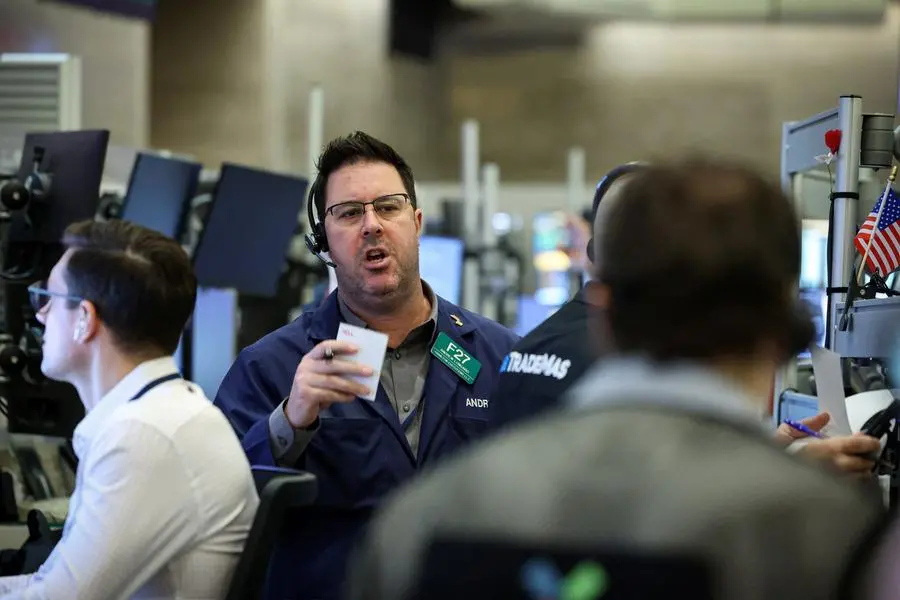
U.S. stock index futures tumbled more than 1% on Monday as oil prices soared, exacerbating inflation fears as hostilities in the Middle East entered their tenth day.
Geopolitical tensions deepened after Iran named Mojtaba Khamenei as the successor to his father, Ali Khamenei, as supreme leader - a move seen as a clear signal that hardliners remain firmly in control in Tehran.
Crude prices jumped more than 25%, climbing to just under $120 a barrel but pared gains after a report said that the Group of Seven (G7) finance ministers and the International Energy Agency will discuss a joint emergency oil reserves release, and Saudi Aramco offered prompt crude supply through a series of rare tenders.
A drawn-out conflict in the Middle East also comes on the back of last week's data that reflected a weakening jobs market, while broader economic activity surged, stoking stagflation worries.
"Stock markets have raced to catch up to all the news, but we are now looking at a vastly increased chance of a U.S. and global recession as inflation surges," said Chris Beauchamp, chief market analyst at IG.
"While a coordinated release of oil reserves provides temporary relief, it is a limited response, and is dwarfed by the loss of oil output from the Hormuz closure and the shutdown of production in the region."
Travel stocks that had borne the brunt of the selloff last week were also the most hit on Monday.
Alaska Air and United Airlines along with cruise stocks such as Carnival and Norwegian Cruise dropped about 4% each in premarket trading.
Big banks, seen as the backbone of any economy, also took a hit with JPMorgan Chase, Citigroup and Bank of America down over 2% each.
Higher energy prices lifted shares of Diamondback and APA that climbed over 3% each, while Occidental added 2%.
At 4:42 a.m. ET, Dow E-minis were down 758 points, or 1.60%, S&P 500 E-minis were down 94.5 points, or 1.40%. Nasdaq 100 E-minis were down 385 points, or 1.56%.
The Cboe Volatility Index, Wall Street's most-watched gauge of investor anxiety, jumped 5.16 points to 34.62, its highest since April 2025.
Prices of traditional safe-havens such as precious metals also came under pressure as investors rushed to the U.S. dollar <=USD. Shares of miners such as Endeavour Silver tumbled 6% and Barrick Mining lost 3%.
Bucking the trend, defense companies such as RTX climbed 1% and AeroVironment added 2.3%.
The spike in energy costs is likely to complicate the Federal Reserve's interest rate outlook at a time when the focus has been more on shoring up the labor market.
Policymakers have broadly voiced the need to wait and gauge the repercussions on the economy before deciding on monetary policy. However, the yield on the two-year Treasury note , reflecting interest rate expectations, briefly touched its highest since late November.
Futures tracking the rate-sensitive Russell 2000 index dropped 2.5% and has marked a 10% drop from all-time highs. A 10% fall is commonly known as correction territory for indexes.
Friday's soft jobs report boosted expectations for a 25-basis-point interest rate cut in June. However, now traders have pushed those odds to potentially September or October, according to LSEG-compiled data.
Last week, the Dow Jones Industrial Average fell 0.95%, marking its steepest weekly percentage decline since early April 2025. The S&P 500 dropped 1.33%, logging its worst week since mid-October, while the Russell 2000 posted its biggest weekly loss since early August.
Markets face a crucial week packed with high-stakes economic releases. Job opening numbers, personal consumption expenditures data - the Fed's preferred inflation gauge - and a second estimate of quarterly GDP are due this week.
(Reporting by Johann M Cherian, Pranav Kashyap and Shashwat Chauhan in Bengaluru; Editing by Mrigank Dhaniwala and Maju Samuel)