PHOTO
LONDON - U.S. stock futures rose, the dollar wavered and oil prices fell below $100 on Wednesday after President Donald Trump said he would indefinitely extend the Iran ceasefire.
That said, optimism about an end to the war that has shaken the global economy remained muted as the Strait of Hormuz remained mostly closed and there was no sign of a resumption in U.S.-Iran talks.
Trump's announcement appeared to be unilateral, and it was not immediately clear whether Iran, or U.S. ally Israel, would agree to extend the ceasefire, which began two weeks ago. Iran had rejected a second round of negotiations before Trump's announcement.
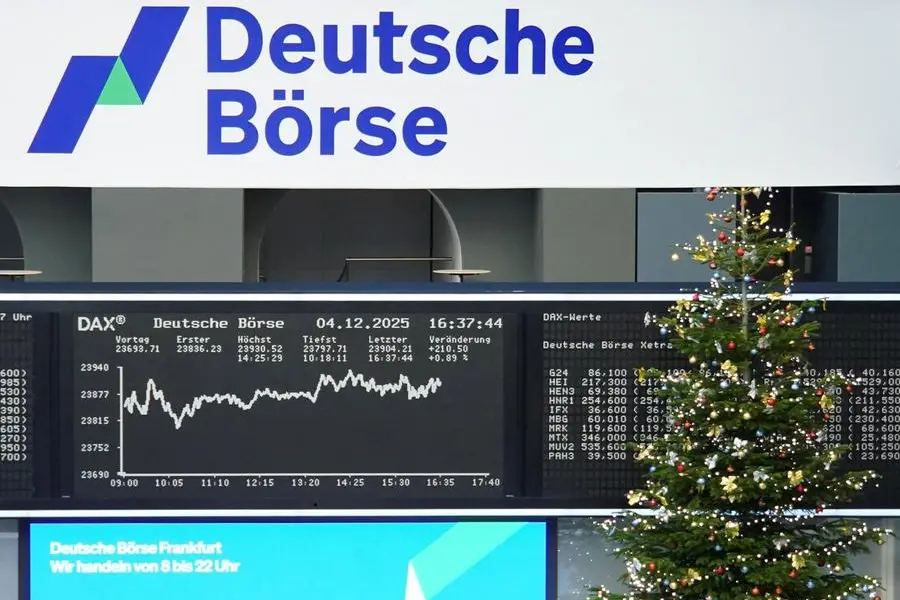
S&P futures rose 0.6% while Nasdaq futures gained 0.7%. Europe's benchmark STOXX index edged up 0.1% in early trade, while MSCI's broadest index of Asia-Pacific shares outside Japan dropped 0.5% after hitting a seven-week top on Tuesday.
Thomas Mathews, head of markets for Asia-Pacific at Capital Economics, said the earlier ceasefire was widely seen as indefinite so it was not surprising the latest announcement had not moved markets much.
"Obviously, any news on the re-opening of the Strait is a good candidate for the next big market flashpoint," Mathews added.
HORMUZ REMAINS KEY
Although the war caused a sharp selloff in March, equity markets across the globe have swiftly rebounded this month to pre-war levels as the prospect of a peace deal and the ceasefire spurred a risk-on rally.
That has also left the U.S. dollar, which benefited from safe haven demand in March, on the back foot, giving up most of its war-induced gains.
"It appears markets were right to assume peak war uncertainty is behind us," said Matt Simpson, a senior market analyst at StoneX. "Risk seems likely to remain buoyant and dips viewed favourably by equity bulls. The closure of the Strait of Hormuz is already priced in."
The dollar index, which measures the U.S. currency against six peers, was last at 98.27. Although it is hovering near its highest in a week, it is down 1.5% in April after rising about 2.3% in March.
Trump said he would continue the U.S. Navy's blockade of Iran's ports and shores.
Oil prices dipped, with Brent crude futures down 32 cents or 0.3% at $98.16 a barrel after nearly touching $100 earlier in the session.
While oil prices have come down from their March peaks they are still well above pre-war levels, worrying investors that elevated energy prices could quicken inflation and keep global rates higher for longer.
WARSH SENATE APPEARANCE
Investors parsed comments from Federal Reserve chief nominee Kevin Warsh as he tried to assure U.S. senators considering his confirmation to lead the central bank that he would act independently of the White House.
Warsh said he had made no promises to Trump about cutting rates and called for a new approach to controlling inflation and a communications overhaul that could discourage his colleagues from saying too much about the direction of monetary policy.
Separately, data on Tuesday showed U.S. retail sales rose more than expected in March as the war with Iran boosted gasoline prices and led to a record surge in receipts at service stations, while tax refunds underpinned spending elsewhere.
(Reporting by Lawrence White in London and Ankur Banerjee in Singapore; Editing by Jacqueline Wong, Kim Coghill and Edwina Gibbs)