PHOTO
SINGAPORE - Asian stocks drifted on the last trading day of a year that has seen investors brush off much of the tariff-related uncertainty and embrace AI chip stocks, while the dollar's dismal year has left the euro and sterling standing tall.
Precious metals have grabbed much of the spotlight toward the end of the year, with silver's astonishing rally taking its yearly gains to more than 160% although the metal was 1% lower on Wednesday as traders booked profits.
Gold firmed a bit and is on track for a 66% surge in 2025 as the three-year rally shows no signs of stopping.
Japanese markets are closed for the rest of the week, and with most markets closed on Thursday for the New Year's Day holiday, volumes are likely to be thin and moves muted.
MSCI's broadest index of Asia-Pacific shares outside Japan was 0.17% lower on Wednesday as investors weighed the minutes of the Federal Reserve's December meeting that underscored deep divisions among policymakers about U.S. rates.
The index is poised to clock a 27% increase for the year, its sharpest rise since 2017, mainly on a strong rally in chipmakers amid the boom in artificial intelligence-related stocks.
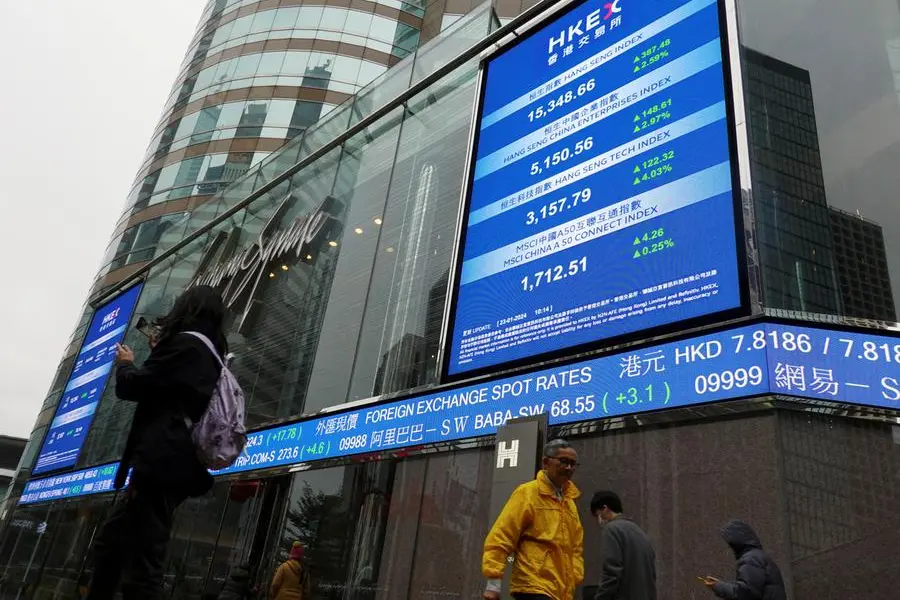
China's blue-chip index inched higher, on course for an 18% increase for the year while Hong Kong's Hang Seng slipped 0.7% but was looking to clock a 28% gain for 2025 as investors shrugged off trade war worries.
South Korea's Kospi is the best performing major stock market in the world, rising 76% in the year, with a lot of those gains coming from SK Hynix and Samsung.
"Notwithstanding a few little shocks, the year has been terrific for investment returns," said Kyle Rodda, senior financial analyst at Capital.com.
"The gains have been a little concentrated obviously but the combination of the AI boom and accommodative monetary and fiscal settings have driven risk assets higher and around record levels."
Markets have weathered a year of tariff wars, the longest government shutdown in U.S. history, roiling geopolitical strife as well as threats to central bank independence and yet eked out strong gains across the globe.
"Heading into 2026, AI is still the anchor theme, but in a different phase: less hype, more adoption and return on investment scrutiny," said Charu Chanana, chief investment strategist at Saxo in Singapore.
"The biggest risks are an unwinding of crowded positioning in both AI and precious metals," Chanana said.
"Add to that a market that’s too confident about a smooth rate path, and the real economic impacts of tariffs that weren’t fully evident in 2025 starting to show up in 2026, repricing inflation expectations and profit margins quickly."
Investor focus next year will also be on the Fed's rate path after the central bank earlier this month projected just one rate cut, while traders are pricing in at least two more cuts.
The minutes of the December meeting underscored the challenge facing the policymakers and markets. "Most participants" ultimately supported a cut earlier this month with "some" arguing that it was an appropriate forward-looking strategy "that would help stabilize the labor market" after a recent slowdown in job creation. Cash Treasuries were untraded due to the holiday in Japan, while Treasury futures were little moved. Yields on 10-year notes stood at 4.1258% on Monday, having dropped 45 basis points this year.
In currencies, the dollar held its ground on Wednesday but was headed for a 9.4% decline for the year, its biggest drop since 2017, leaving the euro and sterling with strong yearly gains.
Oil prices slipped more than 10% in 2025, with Brent heading for its longest stretch of annual losses ever, as supply outpaced demand in a year marked by wars, higher tariffs and OPEC+ output and sanctions on Russia, Iran and Venezuela.
(Reporting by Ankur Banerjee in Singapore; Editing by Lincoln Feast.)