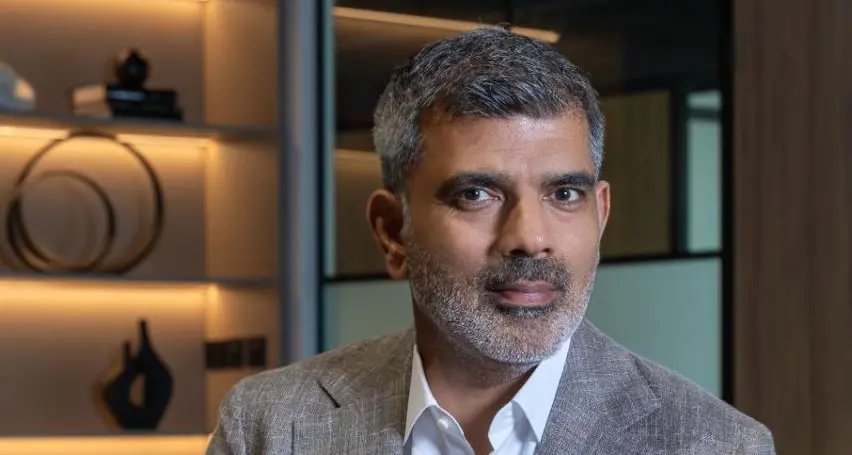
Serving a country on its telecom needs for more than three decades is no small job. Etisalat has done this single-handedly until two years ago, when the second telecom operator entered the market. But the interesting aspect is that Etislalat has continued to grow at the same pace, or maybe even faster despite the presence of a second operator. If anyone asks Etisalat's chief executive officer, Mohammed Khalfan Al Qamzi, what aspect he would consider as of the highest priority for the success of a venture, he would say without a pause that it is the 'quality of service'. Being an engineer by profession, Al Qamzi is so bent on the quality aspect that he believes excessive competition could ultimately tell upon the quality of service. The question whether Etisalat needs a leader who strongly believes in quality or one who encourages competition is left to the readers to answer.
Al Qamzi during an interview with The Business Weekly's CL Jose said value addition is the name of the game now when more players seek to enter the same market which used to be served by limited players.
"We are all set to revolutionise the fixed lines in the country. We will show you that people use fixed lines from homes and offices more often than before," he said. Al Qamzi has ambitious growth plans for the company, the only one corporate house from the UAE to have crossed the Dh7 billion-mark in profitability.
Etisalat which is the largest listed company in the UAE on many counts has crossed the Dh7 billion-mark in net profit during 2007. Do you think the profit for the current year could cross Dh8 billion-mark?
Why settle on Dh8 billion and why not Dh9 billion? About five to seven years ago, we used to dream about Dh500 million and Dh700 million. Now our dream is to grow by Dh1 billion and Dh2 billion every year.
So with competition from new player you are not scared about the profit growth?
Why should we?
Do you think UAE has space for one more operator?
It all depends on the market and market situations. This is a thing which the regulator has to decide after studying the market. Question is not just whether more operators can function in a market, rather one has to see whether the quality of services would affect with the entry of a new operator into the market. This is an industry which needs to grow a lot. An operator will be willing to invest in a market for the improvement of the market if the growth prospects are there.
But if an operator is just keen on making money right from the inception, who is going to invest in that market?
There are markets where five or six operators co-exist. They are unlikely to think of the quality improvement in the market as ideally no one would risk their money in a market which is highly competitive on pricing.
Doesn't the customer stand to benefit from competition?
He may benefit on the price front, but who will be able to guarantee quality in such a market. But Etislalat believes in quality and this cannot happen without an investment process.
Etisalat has been growing ever since its inception. Does it mean that the entry of Du has not affected you at all?
As you said, we have always been growing. It is true that Du has grown its number of mobile subscribers substantially and so has our number been, during this period.
But the growth of fixed line is stuck at less than one million, I guess. Why are you not focusing on that?
It is not true. We are doing a lot of innovations to the fixed line. Etisalat has completed the IP network for all UAE. These moves will enable us to offer you lots of future services through the fixed lines at home and offices. Our strategy for new developments is the full deployment of Fibre To The Home (FTTH) which will enable us to offer advance services such as Smart Home where the main feature is Triple Play services offering Voice, Broadband, and TV on single IP connection. In March, we witnessed Al Raha Gardens being connected to Etisalat's FTTH network. We will revolutionise the use of fixed lines in the UAE and you will see the number of fixed lines soaring in this country.
Do you think that there is space for one more operator in the UAE?
It is the question of whether you look for limited number of players who are willing to invest and improve the quality of services, or more players who will be merely bent on making profits without much bothering about the quality of service the customers get. It is up to you to choose.
You have so many subsidiaries, operating under Etisalat. Will you be looking at establishing a holding company to look after all these operations?
Yes, we are in the process of setting up a holding company. We will divide the international operations into three Africa and Middle East, Asia, and UAE operations and they will form different subsidiaries.
What are your plans for India?
India is too large a market. But we have already established a software company in the south Indian city of Bangalore.
You have gone for a $3 billion loan during 2006. What is the status of that deal?
We have not drawn down the whole money, but a very small portion from that. It is a facility which we still enjoy with banks. I think Etisalat is going to renew that facility.
You have surplus funds and you have a long standing in several markets. Will you be diversifying into more areas?
We are always exploring avenues to diversify into. But we will confine our diversification dreams to telecom-related areas only. Indian venture in software is a venture which will make telecom-related software. We ourselves need a lot of software as we have decided to bring in a lot of innovations in telephony.
Domestic calls are not being charged now. We heard that international operators are taking objection to this. Will you do away with free calls?
We have not thought of such a thing so far. This is the first time we heard about someone else said to be complaining against our 'free call system'.
The penetration in mobile phone has already crossed 150 per cent. How do you propose to grow on this?
Any intelligent operator would think how the Arpu can further be increased. This can be done. We have to look at value-added services in order to raise Arpu. We will have to offer several services on mobile including transfer of money or paying utilities bills. We have to explore ways to bring in more high Arpu customers to mobile or at least maintain the same Arpu.
How cooperative are Etisalat and Du?
We have our customers and they have theirs. But we can cooperate on many areas such as site sharing. We have offered them site sharing facilities from which they have taken some now. We have given several links to them. We have given them roaming facilities in western region and northern emirates.
It is a long time since you offered a cut on the basic rates. Why is this so?
We are offering you a lot of discounts now-a-days. We are offering you different packages, time-specific and country-specific, where the customers stand to gain a lot more than before. But this doesn't mean that we will never come out with straight cuts. Everything depends on market and the market is constantly under study.
What are your investment plans?
We are going through an optimization process. We are serving more than 400 switches; we have 78 gateways in the UAE to serve our customers.
How many countries you currently operate in?
In addition to being the UAE's telecom provider, Etisalat has now expanded to manage and operate telecom companies in Saudi Arabia, Egypt, Sudan, Pakistan, Tanzania, Benin, Burkina Faso, Gabon, Niger, Togo, Republic of Central Africa, Ivory Coast, Nigeria and Afghanistan.
How many countries do you plan to enter within the next two to three years?
We don't decide on numbers beforehand. We see whether a market has scope for market penetration and if so, we may decide to go there. Alternatively, we also weigh the Arpu (average revenue per user) of the market and future prospects of growth in the country, etc before deciding to enter a new market.
What about Etisalat Local coverage and roaming agreements?
Etisalat has offered the best services through its network coverage that covers the entire country. In addition, Etisalat customers can stay connected even while abroad with Etisalat's roaming agreements with more than 444 operators in more than 180 countries.
What about Etisalat's strategic goal for the next three years?
Reputed for over 31 years for delivering technological excellence, innovation and reliability, Etisalat is on track to be a top-10 global Telco by 2010 pioneering technology for tomorrow's customers.
How do you view your quarter-one performance?
During the first quarter, net profit reached Dh2.122 billion, an increase of Dh285 million compared with 2006 performance which had Dh1.837 billion in profit.
Etisalat's consolidated revenues were recorded at Dh6.060 billion, an increase of Dh1.251 billion or 26 per cent over 2007 figures. Etisalat reported 6.63 million mobile subscribers, an increase of 4 per cent from December 31, 2007. Telephone and internet lines in service at March end 2008 were 1.33 million and 940,000 respectively.
© The Business Weekly 2008