Technology zones are known around the world as Science Parks, Technology Parks, Research Parks, Technopolis, or Innovation Centers. The term technology zone usually denotes a focus on technology, innovation, and tenant companies' involvement in knowledge-based activities.
The International Association of Science Parks defines a science park as:
- a property-based initiative, which has formal and operational links with universities or other higher educational institution, or major centers of research;
- designed to encourage the formation and growth of knowledgebased industries, or high valueadded firms, normally resident on site; and
- has a steady management team actively engaged in fostering the transfer of technology and business business skills to tenant organizations.
Technology zones are designed to facilitate the production and commercialization of advanced technologies by forging synergies among research centers, education institutions, and technologybased companies.
Tenants of technology zones are mostly small companies pursuing an ambitious growth strategy based on the development and commercialization of new technology. Large and multinational companies are usually attracted to these zones as anchor tenants. To facilitate the successful commercialization of new technology in the market place, the technology zone provides:
- cooperation in R&D with scientific research institutes and laboratories;
- financial consulting and assistance in obtaining venture capital;
- professional, technical, administrative and legal assistance;
- information and telecommunications services; and
- supportive business infrastructure.
SOIETZ
In 2001, legislation was passed to set up the Saudi Organization for Industrial Estates and Technology Zones (SOIETZ).
Its function is to undertake, as an independent public agency, the regulation and promotion of industrial estates and technology zones in the Kingdom of Saudi Arabia (KSA) on both public and private industrial lands, and to encourage the private sector to become involved in the development, operation, and maintenance of industrial estates and technology zones.
The SOIETZ is the new planning and regulatory authority for specified industrial estates and technology zones in KSA. According to the SOIETZ legislation: " The main purpose of SOIETZ is planning of specified Industrial Estates in the Kingdom and encouraging the establishment, management, maintenance, operation and supervision of these Estates." "Specified Industrial Estates" refer to the existing stock of Governmentowned industrial estates (and technology zones), which previously fells under the remit of the Ministry of Industry, together with private land, which has been authorized by SOIETZ as an industrial estate or technology zone.
Functions of SOIETZ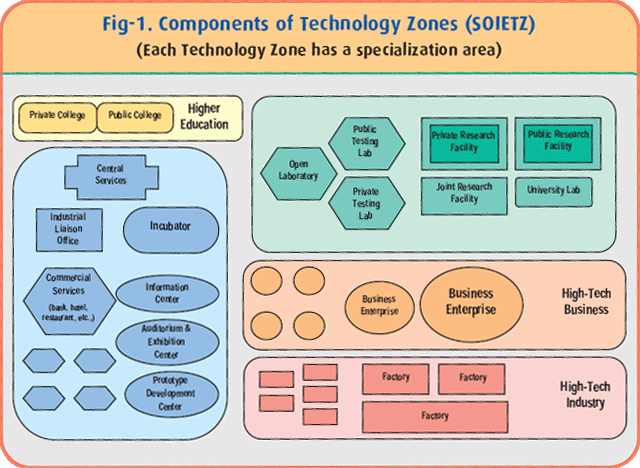
- Acquisition of land for development into industrial estates;
- Maintenance of new and existing industrial estates;
- Issuing of licenses to developers for the development of specified industrial estates on public and privately owned land;
- Issuing of licenses to operators of specified industrial estates on public and privately owned land;
- Development of a strategy to finance new projects through disposal of existing assets or other means;
- Actively engage the private sector in investigating and developing SOIETZ lands into Industrial Estates;
- Creation of new technology zones.
Technology zones in KSA will take the form of high technology industrial parks, which shall cluster together production-research-development-commerce- consultation-education-training to create a cohesive knowledge based environment.
a. Permissible Activities in Technology Zones
The following activities will be allowed in each technology zone:
- Manufacturing and assembly hightechnology products in targeted technological fields.
- Scientific research, technological development (R&D), laboratories, and prototypes development.
- Commerce and businesses that deal with high-technology products and services in targeted technological field (based on research, development, innovation, or patent outputs).
- Consultations: technical, business, and legal.
- Education and training: technical, professional, and administrative.
- Technology Incubators.
- Supporting commercial services such as, restaurants, banks, mail, hotels, and others.
Mass production factories, warehouses, or temporary buildings will not be allowed in technology zones. For a graphical description of what constitutes a technology zone, it is possible to describe it by the components that comprise it. Figure-1, shows a model for components of a typical technology zone.
b. Tenants Performance Criteria in Technology Zones
The following criterion determines tenants' acceptance or rejection from the technology zones:
1. Tenants should provide hightechnology, and high value added products and services linked with research, development, and innovation.
2. Tenants should be engaged in activities related to the technological specialization of the zone (except those that provide consultation and commercial services).
3. Industrial and business tenants should fulfill at least the minimum R&D activity (funding or conducting) from its total operations.
c. Specialization of Technology Zones
Technology zones are classified by their technological/industrial specialization. Emphases are given to the specialization field of the tenants so that it matches the overall specialization of the technology zone. This specialization promotes the clustering of related enterprises in one area.
Furthermore, specialization helps reduce the cost of construction, infrastructure, and services that are needed by the tenants. Clustering affect is proven to enhance technology transfer, cooperation, and integration between tenants in the technology zone. Examples of specialization fields of technology zones around the world include:
Biotechnology, New Materials, Information and Communications technologies, Environment.
d. Infrastructure Specifications of Technology Zones
Each technology zone shall have its own infrastructure specifications (according to its specialization). Nevertheless, there are general specifications set by SOIETZ such as nearness of the land to a city, development guidelines, building codes, environmental impact, and services needed.
S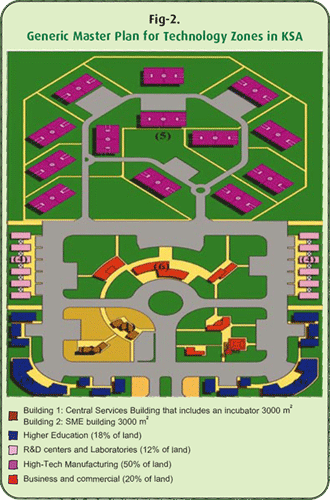 OIETZ' Plans
SOIETZ will work on zoning appropriate lands in KSA for technology zones, as well as setting up regulatory environment and framework required to develop and manage these zones.
SOIETZ's short-term plan is to establish three technology zones in 2005 (period does not include physical construction). The three technology zones will be located in Riyadh, Jeddah, and Dammam.
It is expected that other Technology Zones will be established in different regions in the Kingdom during the period 2005-2008. Each technology zone will have at least one of the following specialization areas which are strategic to Saudi's economy and national security:
- Energy
- Environment.
- Water desalination.
- Life Sciences and Biotechnology.
- Information, Communications, and electronics.
- Advanced Petrochemicals
- New Materials.
- Knowledge intensive products and services for pilgrimage.
- Knowledge intensive agriculture and production of dates.
SOIETZ' Program for Technology Zones in KSA
SOIETZ' program is to establish technology zones and incubators in different cities in the Kingdom of Saudi Arabia to serve the aforementioned strategic fields besides other fields that may be realized in the future.
Theoretically, it is preferred to construct technology zone for each targeted strategic field but it will be possible to consolidate some of the complementing fields in one zone. Thereof, seven projects are currently formed for SOIETZ as part of its program for technology zones:
Project-1. Energy and Environment Technology Zone.
Project-2. Water Desalination Technology Zone.
Project-3. Life Sciences and Biotechnology Zone.
Project-4. Information and Communications Technology Zone.
Project-5. Advanced Petrochemicals and New Material Technology Zone.
Project-6. Pilgrimage (Hajj) and Omrah Technology Zone (for knowledge intensive products and services relating to Hajj and Omrah).
Project-7. Dates Technology Zone (for knowledge intensive agriculture and production of Dates).
Development Steps of Technology Zones
Technology zones under SOIETZ regulations will be developed and operated with private sector participation. The development technique of a technology zone can be summarized in the following steps:
Step 1:- SOIETZ shall study and identify a suitable land to be a technology zone, and shall secure its legal status (either government or private lands).
Step 2:- SOIETZ shall officially invite competitors to bid for the development of a technology zone through a BOT request for proposal (except if an official agreement has been entered into between the owner of the land and a developer). SOIETZ shall provide the investors with the required technical information including, location and size of land, development guidelines, building codes, and terms and conditions of the license.
Step 3:- The competing developing entities shall submit their technical proposals that include: development plans, and detailed engineering drawing for lands, buildings, and infrastructure in the technology zone. An approved engineering office shall review the technical proposal. In addition, development entities shall submit a financial proposal that includes: development costs, yields, and rental charges of the different sites in the zone.
Step 4:- SOIETZ shall select the best competitor and shall approve his technical and financial proposal. SOIETZ shall grant him a license, to develop and operate a technology zone. The licensed developer shall be given a two years period to start actual construction work. SOIETZ shall sign a development contract with the developer if the specified land belongs to SOIETZ in lieu for 20% to be obtained by SOIETZ from the total revenue gained by the developer or operator in such case. A supervision contract shall be entered into between SOIETZ and the owner if the land belongs to a private entity. Under this supervision contract, SOIETZ shall supervise the licensed developer and operator as well as the management the technology zone for annual charges paid by the owner to SOIETZ.
Step 5:- During the two years grace period, the approved developer shall market sites in the first phase of the master plan to targeted customers in order to solicit early commitments to rent specific sites.
Step 6:- After the minimum rent commitments is achieved for first phase of development, the approved developer shall start construction of the first phase of the technology zone.
Step 7:- SOIETZ is to supervise the performance of the developer, operator, and tenants of the technology zone according to its Statute, Executive by-law, and the license terms and conditions. When the first phase is fully occupied by tenants, the approved developer shall construct the second phase of development of the technology zone.
Finance
In Saudi Arabia, financing technology zones could come from various sources:
1- Saudi Industrial Development Fund offers 50% loan for the developer of a technology zone who is licensed by SOIETZ.
2- Local Banks
3- Foreign Investors interested in technology zone development projects (SOIETZ has a list of international entities which expressed their interest in developing a technology zone in Saudi Arabia).
SOIETZ will work diligently with all the parties involved, and provide all the information needed for the successful development and operation of technology zones. The organization will also work with many other government bodies in order to make Saudi technology zones successful economic endeavors.
SOIETZ?s Plan for Technology Zones
SOIETZ has developed a plan for the establishment of technology zones in Saudi Arabia. The concept is designed to facilitate the creation of Technology Clusters in areas strategic to Saudi's national economy and security.
1- SOIETZ will secure good lands in industrial or urban areas (wherever possible) so that developers will have an incentive to develop it. SOIETZ will also do the master plans of the technology zone.
2- SOIETZ will then offer the land to developers as a BOT in a bidding process (if land is owned by SOIETZ).
3- The investors would then conduct feasibility studies, and then develop detailed technical and financial plans for developing and operating the technology zone according to SOIETZ's Development Guidelines.
4- The land should be developed into various subzones (see Figure-1). Furthermore, development could be done in phases. Rental space will be restricted to 60% of total area. The rest of the area is for roads, open areas, and landscaping.
5- The winning bidder is then approved and licensed by SOIETZ to develop and operate the land according the master plan and the financial plan approved by SOIETZ.
6- SOIETZ will help the developer in marketing and managing the zone.
7- SOIETZ will allow the developer to develop 100% of the commercial sub-zone during the first phase of development since it has the highest potential to generate income.
8- The developer is obligated to develop two central buildings
9- The developer is also obligated to develop lands that constitute the Industrial, Research, and Education subzones (development of land in these zones does not necessarily mean buildings).
10- The Developer/operator will rent developed lands and building in all the technology zone according to the rental charges in the financial plan approved by SOIETZ.
11- The developer will forward 20% of his total income to SOIETZ (if the land belongs to SOIETZ).
Estimated Income and Costs
Estimates from Rental IncomeIt is estimated that total rental income from a 200,000 m2 technology zone could amount to SR 2,944,000.Estimated Income from Services It is expected the developer/operator of the technology zone will receive income from various services he will offer to tenants. The income includes: Income from water and sewage charges, Income from maintenance charges, Income from advertisements in commercial sub-zone, Income from renting auditorium and training facilities, Income from exhibitions.
It is estimated that the income from these services will amount to SR 500,000 to SR 1,000,000 per year.

Eng. Abdullah A. Al Saif, Director General - SOIETZ
© Saudi Commerce and Economic Review 2005