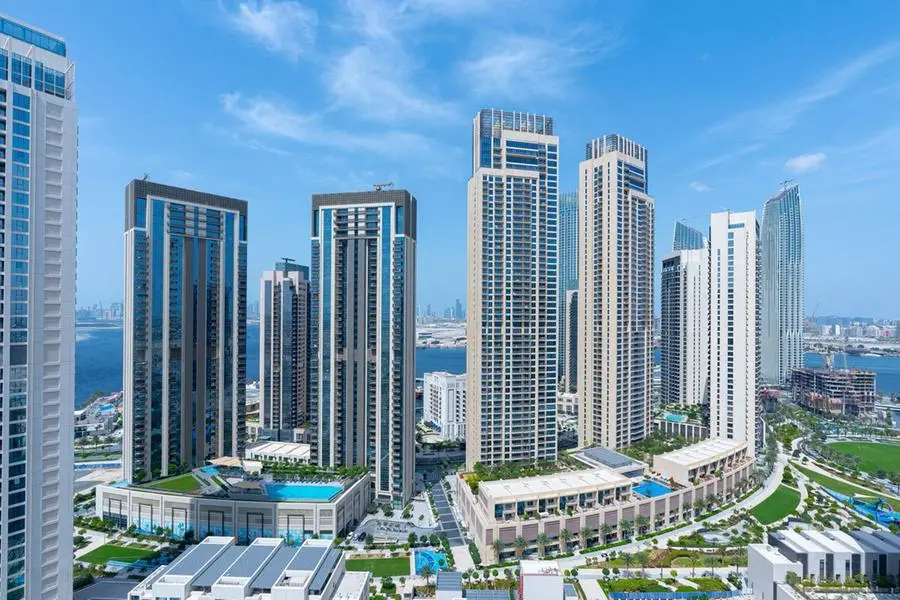
Guests at the luxurious Park Hyatt Dubai hotel are being kept cool thanks to a unique water recycling project, which treats Treated Sewage Effluent (TSE) for use in the hotel's HVAC (heating, ventilating, and air conditioning) system. Thanks to this project, the hotel has saved 154,880 cubic metres of potable water to date or enough water to fill as many as 62 Olympic-sized swimming pools. (The average volume of an Olympic-sized swimming pool is 2,500 cubic metres). The overall system processes 148,300 cubic metres/year of TSE for the resort which is used to supply its HVAC towers that help cool the property's 225 luxury rooms and suites.
Dow Water & Process Solutions, through Original Equipment Manufacturer (OEM) Veolia Water Solutions & Technologies, supplied the ultrafiltration (UF) and reverse osmosis (RO) components that process the TSE at the hotel.
"At Dow, sustainability is at the heart of everything we do and it is always gratifying to see our solutions being used to drive change," said Dr Ilham Kadri, Commercial Director, Dow Water & Process Solutions, Europe, Middle East and Africa (EMEA). "Water is a precious resource in the Middle East and it's important to recognise that wastewater will evolve into the next big source of water along with desalination."
"The success of this project demonstrates the viability of water reuse and recycling solutions in a region where water scarcity leads the agenda," said Emmanuel Gayan, CEO, Veolia Water Solutions & Technologies Middle East. "The system is an excellent example of how we collaborate with Dow in the value chain to integrate technologies and deliver effective solutions that are not only sustainable but also cost effective with a fast return on investment. I truly believe that this model can and should be replicated in order to help conserve water and improve efficiencies."
The TSE is pre-treated using DOW UF membrane technology and is further purified using FILMTEC RO membrane technology. The process results in high quality water that is low in Total Dissolved Solids (TDS) and not only has an impact on the resort's environmental footprint but also on the efficiency and cost of the HVAC towers operation.
Apart from helping the hotel reduce its consumption of potable water, the system has also contributed to improving the efficiency of the cooling system. As Sanjeev Unni, Technical Manager, Middle East & Africa, Dow Water & Process Solutions, pointed out, cooling water cycles depend on turbidity and TDS in the water. In the case of normal potable water, where the TDS is around 120-150 ppm, both TDS and turbidity will go up after six to seven cycles. So the water is blown down with fresh water. In the case of TSE, the combined UF-RO system actually reduces TDS to levels lower than that in potable water.
Unni elaborated: "The TSE comes with a low TDS of around 1,000-1,200 ppm. The UF stage removes all the biological activity and TDS, while the RO stage reduces TDS to around 20 to 30 ppm. If you use this water for the cooling blow down, you can actually increase the cycles."
The combined UF-RO system can help addresses the scaling and bio-fouling problems encountered in wastewater reuse applications.
"Good pre-treatment is the key. With proper anti-scalants, you will get softened water from the RO system," said Unni.
Dr Ilham Kadri believes that the region will only see more and more of such projects in the future. She said: "We take water from the sea, remove the salt, use it, recuperate the wastewater and then put the water back into the sea, which is a real waste of money and energy. We believe that wastewater will become the fastest growing market in the region. It is an easy resource to access and less energy intense compared to seawater desalination."
Another landmark water re-use project that Dow is associated with in the UAE involves the country's leading dairy producer. Al Ain Diary is using a similar combined UF- RO system to reuse 300,000 litres of TSE/day, which is then sprayed through an automated cooling system designed to keep the herd cool and comfortable during the summer season, thereby maintaining optimal dairy production levels.
© H2O 2012