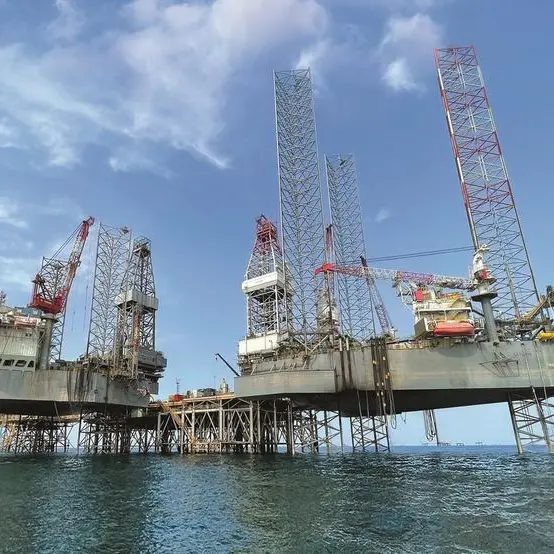
Nigeria's oil thieves are pilfering the profits of some of the world's largest oil companies.
Royal Dutch Shell estimates that the country is losing USD 12 billion annually due to oil theft and sabotage.
"We have seen a marked escalation in security problems and theft in Nigeria in 2013," Paul Voser, chief executive officer at Shell told analysts. "Oil theft and sabotage in Nigeria are resulting in substantial revenue loss for the Nigerian government and widespread environmental damage."
Shell saw a second quarter 2013 shortfall of around 100,000 barrels of oil equivalent per day, 150,000 tons of LNG, and at least USD 250 million of lost earnings due to problems in its Nigerian operations. As a result, the company has initiated a "strategic review" of its operations in the country.
"Shell and our partners are all working with the government of Nigeria, as well as foreign governments, on solutions to what seem to be an endemic issue; we will play our part, but we can't solve this on our own."
Italian oil company Eni also blamed production cuts on problems in its Nigerian operations, noting that "performance was affected by force majeure events in Nigeria".
In June, Chevron Corp. said it plans to sell five of its Nigerian leases. The company is selling 40% stake in three leases and another two in the Niger Delta.
Meanwhile, ConocoPhillips Corp. is in the process of selling its entire Nigerian business to a local company for USD 1.8 billion.
Nigeria is a member of OPEC and Africa's largest producer of oil, but has suffered setbacks in recent years due to unrest in the Niger Delta region.
The Shell joint venture has had numerous shut-ins on major oil pipelines and the gas pipelines that feed the Nigerian Liquefied Natural Gas (NLNG) plant.
In addition, Shell has complained about tax disputes between its Nigeria LNG joint venture and the Nigerian Maritime Administration and Safety Agency, which resulted in a blockade on exports from NLNG for 23 days, ending on July 14.
HIT BY SHALE
The spate of problems in the sector has led to a fall in production from 2.1 million barrels per day (bpd) in 2011 to around 1.8 million bpd by June 2013. The country's total production capacity stands at 3 million bpd.
"Oil production in Nigeria reached its peak of 2.63 million bpd in 2005, but began to decline significantly as violence from militant groups surged, forcing many companies to withdraw staff and shut in production," says the Energy Information Administration, the statistical arm of the US Department of Energy.
"The lack of transparency of oil revenues, tensions over revenue distribution and environmental damages from oil spills, coupled with local ethnic and religious tensions, have created a fragile situation in the oil-rich Niger Delta basin. As a result, crude oil production plummeted by more than 25% by 2009, four years after reaching its peak."
To add to its woes, the United States, which was a major importer of Nigerian light sweet crude, is increasingly displacing its imports with home-grown domestic shale production.
"Nigerian crude as a share of total United States imports has fallen to 5% in the first half of 2012, down from 10 and 11% in the first half of 2011 and 2010, respectively," according to the EIA.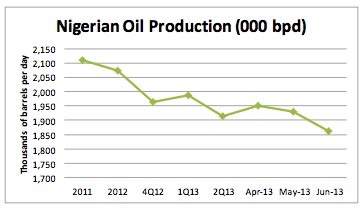
DREADED OIL CURSE
Oil revenues are crucial to the overall health of the Nigerian economy as they account for 75% of government revenues, but the departure of major oil companies could hamper future growth of the economy.
Falling oil prices are another cause for concern. Nigeria' s Bonny Light blend was selling at USD 115.97 per barrel last year, but has since eased back to USD 105.83 in May this year, according to OPEC data.
The International Monetary Fund (IMF) is warning that a significant fall in the oil price could undermine the country's fiscal consolidation, produce faster domestic debt accumulation, increase credit risk, and place a heavier burden on monetary policy.
"Meanwhile, terrorist activity continues in the north, adversely affecting economic activity (particularly in agriculture and commerce), the IMF said in a report on the country in late May. "A further deterioration in security would raise business costs in an already high cost environment and depress confidence, thereby harming growth and further financial system development."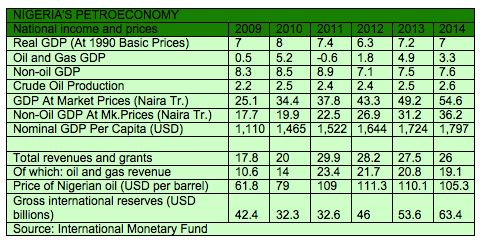
The stalled Petroleum Industry Bill, which is expected overhaul the country's energy sector, has also kept some oil companies on the sidelines. Critics complain the new bill is skewed in favor of the Nigerian government and grant additional powers to the Minister of Natural Resources.
"The powers vested in the minister are not different from (those in) ... other countries in which best practices are followed," minister Diezani Alison-Madueke told lawmakers in June as she urged them to pass the law. "The powers complained of are even less than what my counterparts in advanced oil producing countries enjoy."
Nigeria has been the continent's leading oil power, but it is no longer the only game in town. Rising energy powers such as Ghana, Angola, Kenya and Mozambique are also diverting investment dollars to their economies, promising better deals and less cumbersome rules.
The country will be well advised to pass the petroleum law and manage the insurgency in the Delta region to ensure that oil majors continue to keep Nigeria as a major strategic asset in their portfolio.
© alifarabia.com 2013