A step that needs more support to revive the market
The National Bank of Egypt launched an initiative that could, according to experts, save the deeply weakened Real Estate sector in the aftermath of the Egyptian revolution. Corruption files disclosure and state land reclamation, in addition to the state's delay in paying contractors their due, were estimated by the Chairman of the Egyptian Federation for Construction and Building Contractors, engineer Hassan Abdul Aziz, to total 15 billion Egyptian pounds (EGP).
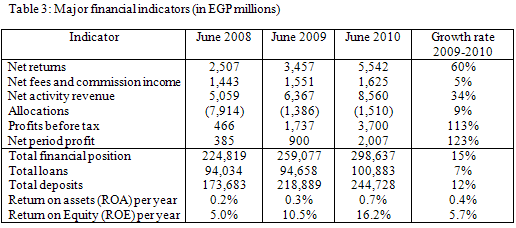
The National Bank's financial statements reveal that it ranked first in terms of loans, deposits and cash. According to June 2009 figures, the Bank's deposits volume amounted to EGP219 billion, compared to about EGP51 billion at the Commercial International Bank, EGP39 billion at National Société Générale Bank and EGP25 billion at the Bank of Alexandria. Its loans volume reached EGP95 billion, compared to EGP29 billion at the Commercial International Bank, EGP27 billion at National Société Générale Bank and EGP17 billion at the Bank of Alexandria. June 2010 figures reveal that the National Bank's deposits volume increased by 12% and reached EGP245 billion, compared to EGP219 billion during the previous financial year. Total loans amounted to EGP101 billion, compared with almost EGP95 billion from the previous year, while total Bank deposits increased by 10% and reached EGP892 billion during the same period; deposits reached EGP810 billion in the previous financial year.
Banker magazine rated the National Bank of Egypt as first among Egypt's banks; the Bank achieved progress on the international level within the top 1,000 banks and was rated 371 in 2011 - rising 70 places since its 2009 ranking. The Bank was also ranked the ninth best bank in Africa. The Bloomberg Institute recently announced that the Bank ranked first, ahead of all international and regional banks, with regards to joint loans management, guarantee and marketing in the Middle East/North Africa region; between January 1 and June 30, 2011 the bank managed, guaranteed and marketed a joint loans volume of USD2.61 billion and therefore achieved the biggest market share (29.4%) of loans management and guarantee. The National Bank also achieved the biggest market share (19%) of joint loans marketing in the region.
Despite real estate mortgage reforms, including the establishment of a Financial Supervisory Authority as well as various mortgage companies, the problem of delayed contractor payments remained pending without any solution. All current indicators confirm the Government's inability to pay the contractors. Egypt's economy is witnessing unprecedented circumstances and a large budget deficit that has exceeded EGP130 billion; numerous demonstrations and strikes demanding better wages have been organized. On the one hand, the Bank's initiative was a rescue remedy for Egypt's real estate business, it injected more cash into it and led it to recovery. The banks benefited, on the other hand, from their cash placement as the private sector is expectantly awaiting the political change in Egypt, in light of the absence of new horizons at a time when some companies use only 50% of their maximum production capacity.
The National Bank's initiative was discussed at the highest levels during a large meeting chaired by Prime Minister Dr. Issam Sharif and attended by the Deputy Prime Minister and Minister of Finance Dr. Hazem Beblawi, the Minister of Electricity Dr. Hassan Younes, the Minister of Planning and International Cooperation Dr. Fayza Abou Naja, the Minister of Housing, Utilities and Urban Development Dr. Fathy El Baradei, the Minister of Manpower Dr. Ahmad Hassan El Borai, the Minister of Transport Dr. Ali Zine El Abidine, the Chairman of the National Bank of Egypt Tarek Omar and a delegation from the Egyptian Federation for Construction and Building Contractors.
Results
Dr. Mohsen Abdel Hadi, owner of contracting companies and founder of the Arab Federation for Construction and Building Contractors, said it was decided at this meeting that the contractors will soon be paid what they are owed in cooperation with the National Bank; an emergency committee was formed that will validate the amounts owed with various ministries, authorities and organisms and submit them to the Bank. The National Bank has agreed to provide all credit facilities to the members of the Egyptian Federation for Construction and Building Contractors and to facilitate letters of guarantee. The Ministry of International Cooperation agreed to provide a EGP550 million grant to the Construction and Building sector that would benefit from access to grants, loans and international agreements in order to increase the size of projects designed to use the contracting companies' technical and human capacities while striving to open new business areas to Egyptian contractors operating abroad, namely in Africa and Arab countries. The Government agreed to a 6-month deadline extension for implementing projects that were assigned before January 25, 2011. It also agreed to hold a meeting with the Deputy Prime Minister and Minister of Finance and the Tax Authority officers to finalize what was agreed upon in terms of taxation rules, compelling concerned parties to abide by the tenders and bids related law, non-direct business assignment, achievement of equity and equal opportunities to all contractors.
Abdel Hadi described the National Bank's initiative as a positive step towards stimulating and reviving the real estate business, which slowed during the previous period and was among the reasons behind the payment delay of the Governmental agencies' debts, especially to contractors. Abdel Hadi revealed that the National Bank will pay about EGP5 billion of the Egyptian Government dues to contractors and will allow a 2-month period for these funds to be repaid without interest. However, if the concerned parties fail to repay their debts to the Bank during these two months, a prevailing market interest rate will be applied in accordance with the tenders and bids law no. 5 of 2005 that amended law no. 89 of 1998 and stipulated that if governmental agencies fail to pay their dues to a contractor in a 2-month period, the prevailing bank system interest rate is applied. However, the Egyptian Government did not apply this text before, and the contractor is not able to collect the interest since, they use will contracts and are not entitled to any delay fines - unlike banks, which can claim such fines via an agreement with the Government.
Dr. Hadi added that banks will benefit from this arrangement because payment by governmental agencies is always delayed for at least a year, and from their available cash funding in the banking system in light of the general slow economic activity, an operation that will lead to higher funds cost in the bank during that period, pointing out that the initiative will reflect itself to Egypt's economic growth in general, especially that the contracting business is controlled by the governmental public business sector with about 22 companies. The Government's debt volume to the private sector is about EGP6 billion and to the public business sector EGP5 billion, with an overall debt of EGP11 billion, which means that the National Bank will have to pay half of these debts.
The initiative will revive the real estate business, which will in turn reactivate various other sectors and manpower employment to reduce unemployment, according to the Chairman of the National Bank, Tarek Omar, who revealed that EGP5 billion will be injected according to buying securitization system and collected from Government agencies with the guarantee of the Ministry of Finance. He added that:
We offered the Egyptian Government to pay the different governmental agencies' debts to the contractors. The initiative started with EGP5 billion, an initiative with which other banks will participate in order to help the Government in such critical circumstances to revive the Egyptian economy and achieve growth rates of up to 5%, knowing that such rates cannot be reached unless the construction and building sector has recovered, the contractors' funds paid by Egypt's governmental agencies and production is revived in all economic sectors.
Next week
The Vice Chairman of the National Bank, Sharif Alawi, revealed that payment to contractors will be made according to a complete system, an operation that is expected to end by next week, to which the National Bank will contribute EGP2 billion. The Banque Misr will contribute EGP500 million, and other banks will participate in the debts payment to contractors during the upcoming period. The National Bank is able to pay these funds by itself, but will allow other willing banks to participate in the payment process. Alawi explained that the National Bank, in its capacity as a publicly owned bank, has a responsibility towards Egypt's society and economy and should intervene in matters that would contribute to Egypt's economic reactivation and growth rates. He pointed out that economic recovery will eventually extend to all operating banks in Egypt; slow economic activity leads to a decline in banks' revenues, especially banks that have been affected by the slow economic activity in the aftermath of the revolution. Alawi added that real estate business recovery will not be limited to the payment of some of the funds due to contractors, since the bank is striving via an integrated system to reactivate the real estate operating companies by granting them credit facilities and helping them overcome current circumstances; he explained that the bank proceeded to renew credit facilities for more than EGP3 billion for a number of real estate operating companies in Egypt.
According to the Chairman of one of Egypt's largest construction companies (Arab Contractors), engineer Ibrahim Mahlab, the Contracting business is the driving force of economy, growth and employment. Mahlab stressed that the EGP5 billion aims to reactivate Egypt's economy in the most critical circumstances ever experienced by the economy and to revive many other sectors; the construction sector is a driving economic force and influences many sectors in addition to employment.
He added that the Government owes EGP2.5 billion to the Arab Contractors Company alone and explained that the most important challenges facing the real estate business are the payment delay to contractors, project postponement, and a decrease in business volume in Egypt's current circumstances. This situation can only be reversed - according to Mahlab - when the Government implements large national projects; this will activate the real estate business and achieve economic and political goals, as well as establish a partnership between banks operating in Egypt and the construction companies in the field of real estate investment and debt payment by the Government to the construction business.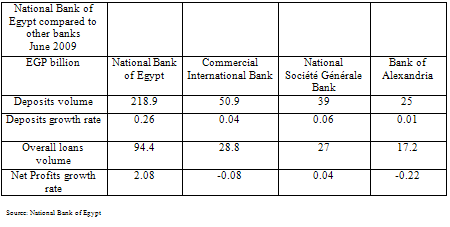
Chart 1: Total deposits in the National Bank of Egypt
Achieve 104% of target
Enhance market share to reach 27.4% compared with 27% last year
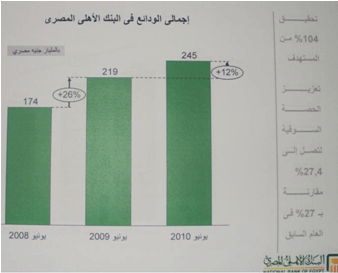
Chart 2: Total deposits in the Egyptian market
Achieve 104% of target
Enhance market share to reach 27.4% compared with 27% last year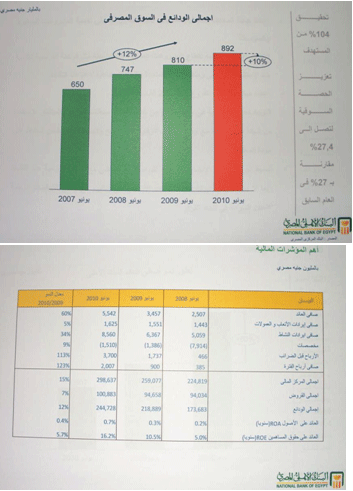
© Zawya 2011