03 December 2008
The Gulf Cooperation Council (GCC) currency union planned for 2010 is unlikely to affect the government bond ratings of its six member states, a recent study said.
The disadvantages of a currency union are less applicable as the GCC states have already fixed exchange rate pegs, said Moody's in a report sent to Emirates Business.
The primary disadvantages associated with membership of a currency union, like a ceding control over monetary and exchange rate policies, are less immediately relevant for GCC members given their currency pegs.
"The formation of a currency union presents an opportunity for the GCC to move to a more flexible exchange rate regime in an orderly fashion," explained Tristan Cooper, a Moody's vice-president, senior analyst and author of the report. Some benefits of having a currency union too are muted in case of GCC, he said.
Most economic studies indicate that currency unions tend to encourage and facilitate trade between member states, chiefly through the removal of exchange rate volatility and transaction costs within the currency area. However, in the case of GCC, the stimulus to trade from the adoption of a common currency would likely be more limited than has been the case with other currency unions, said Moody's.
"Firstly, there is already very little exchange rate risk within the GCC because all six member states have longstanding pegged exchange rates - Kuwait's to a dollar-heavy currency basket and the others straight to the dollar. Hence, traders within the GCC already enjoy a stable exchange rate environment," said Tristan.
Secondly, there is less potential for trade within the GCC than in other currency unions because of lesser economic diversification. All six economies are heavily concentrated in hydrocarbons, he added.
According to Moody's the disadvantage of a loss of independent monetary policy that could apply to currency unions is less relevant in GCC as member states' monetary policies are closely related to that of the US given their exchange rate pegs.
Also as the GCC currencies are already pegged, the disadvantage of loss of exchange rate policy is also restricted. However, over the long term, this issue may become relevant to smaller, less wealthy members as they need to adjust their currencies to facilitate economic diversification.
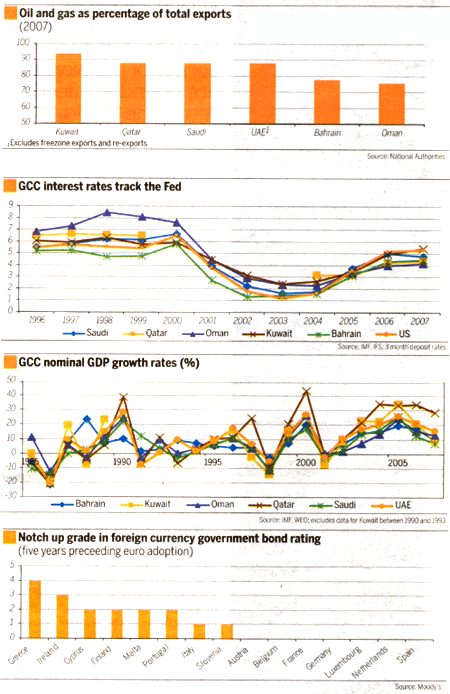
Given their similar economic structures, with hydrocarbons dominating fiscal revenues and export receipts, the economic performances of individual GCC states are highly correlated.
"With the exception of Kuwait's performance around 1990, nominal GDP growth rates for all six GCC countries have tracked each other. This speaks well to the concept of currency union because it is less likely that a one-size-fits-all monetary policy will create difficulties for individual member states as their economic cycles diverge from mean."
The degree to which it is being accompanied by material institutional reform is a major factor in determining the pros and cons of a currency union, added Moody's.
In case of the EU the mandatory adoption of the "Acquis Communautaire", the establishment of the highly regarded European Central Bank and Euro state and their enforcement of the stringent ERM II Eurozone entry process have led to significant improvements in the institutional frameworks and policy predictability of members. This can be seen in the improvement of government effectiveness indicators for most countries that have recently joined or are in the process of joining he Euro, said Moody's.
The GCC Supreme Court in 2006 endorsed a set of macro economic performance criteria and are aimed at fostering economic policy convergence. The way these criteria would be assessed prior to entry and how they would be enforced once countries are members of the union is yet to be seen.
The Gulf Cooperation Council (GCC) currency union planned for 2010 is unlikely to affect the government bond ratings of its six member states, a recent study said.
The disadvantages of a currency union are less applicable as the GCC states have already fixed exchange rate pegs, said Moody's in a report sent to Emirates Business.
The primary disadvantages associated with membership of a currency union, like a ceding control over monetary and exchange rate policies, are less immediately relevant for GCC members given their currency pegs.
"The formation of a currency union presents an opportunity for the GCC to move to a more flexible exchange rate regime in an orderly fashion," explained Tristan Cooper, a Moody's vice-president, senior analyst and author of the report. Some benefits of having a currency union too are muted in case of GCC, he said.
Most economic studies indicate that currency unions tend to encourage and facilitate trade between member states, chiefly through the removal of exchange rate volatility and transaction costs within the currency area. However, in the case of GCC, the stimulus to trade from the adoption of a common currency would likely be more limited than has been the case with other currency unions, said Moody's.
"Firstly, there is already very little exchange rate risk within the GCC because all six member states have longstanding pegged exchange rates - Kuwait's to a dollar-heavy currency basket and the others straight to the dollar. Hence, traders within the GCC already enjoy a stable exchange rate environment," said Tristan.
Secondly, there is less potential for trade within the GCC than in other currency unions because of lesser economic diversification. All six economies are heavily concentrated in hydrocarbons, he added.
According to Moody's the disadvantage of a loss of independent monetary policy that could apply to currency unions is less relevant in GCC as member states' monetary policies are closely related to that of the US given their exchange rate pegs.
Also as the GCC currencies are already pegged, the disadvantage of loss of exchange rate policy is also restricted. However, over the long term, this issue may become relevant to smaller, less wealthy members as they need to adjust their currencies to facilitate economic diversification.
Given their similar economic structures, with hydrocarbons dominating fiscal revenues and export receipts, the economic performances of individual GCC states are highly correlated.
"With the exception of Kuwait's performance around 1990, nominal GDP growth rates for all six GCC countries have tracked each other. This speaks well to the concept of currency union because it is less likely that a one-size-fits-all monetary policy will create difficulties for individual member states as their economic cycles diverge from mean."
The degree to which it is being accompanied by material institutional reform is a major factor in determining the pros and cons of a currency union, added Moody's.
In case of the EU the mandatory adoption of the "Acquis Communautaire", the establishment of the highly regarded European Central Bank and Euro state and their enforcement of the stringent ERM II Eurozone entry process have led to significant improvements in the institutional frameworks and policy predictability of members. This can be seen in the improvement of government effectiveness indicators for most countries that have recently joined or are in the process of joining he Euro, said Moody's.
The GCC Supreme Court in 2006 endorsed a set of macro economic performance criteria and are aimed at fostering economic policy convergence. The way these criteria would be assessed prior to entry and how they would be enforced once countries are members of the union is yet to be seen.
By Shashank Shekhar
Emirates Business 24/7 2008