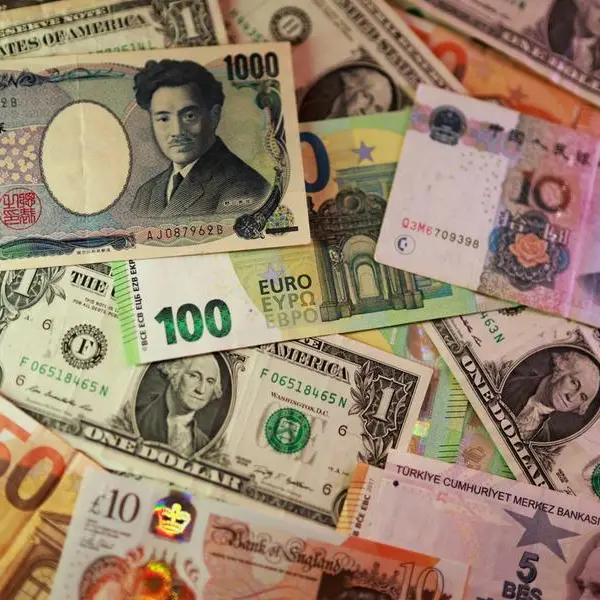
The yen was set for its strongest weekly gain in well over a year on Friday, after Japanese Prime Minister Sanae Takaichi's historic election win allayed some investor worries about the government's finances, while the euro headed for a fourth daily loss.
The yen has dominated activity in the foreign exchange market this week, particularly as its rise confounded initial expectations that a selloff in the Japanese currency could gather pace if Takaichi secured a strong mandate in last Sunday's election.
Instead, the yen has recovered most of the losses incurred ahead of the election. Volatility across the equities market this week has funnelled capital into lower-yielding currencies that investors perceive to be safe havens, like the yen and the Swiss franc.
On Friday, the yen traded on a weaker footing, leaving the dollar 0.5% higher at 153.46, but it was still headed for a gain of 2.7% for the week, its largest rise since November 2024.
Against the euro, the yen was poised for a 2.3% weekly jump, its strongest performance in a year. It was also up roughly 2.7% against the pound for the week.
"The election outcome might be seen as marking an end to the political instability that has persisted since July last year, suggesting that short-yen positions have been unwound," said Hirofumi Suzuki, chief FX strategist at SMBC.
"There may still be room for further yen appreciation."
Since the weekend election, Japanese stocks have been on a tear, while government bonds (JGBs) and the yen have steadily risen, in an apparent vote of confidence in Takaichi's plans for looser fiscal policy as the prime minister said the policy would be responsible and ruled out fresh debt to achieve it.
"We expect her administration to be a responsible steward of fiscal policy, even while deploying targeted inflation-relief and growth measures," said Drew Edwards, head of the Usonian Japan Equity team at GMO.
WAITING ON INFLATION
In the broader market, currencies were mostly rangebound ahead of the release of U.S. inflation data later on that could shape expectations for where U.S. rates are likely to go. Right now, markets show traders are pricing in two cuts in 2026, with the first one landing most likely in July.
"Unless we see big surprises in the (inflation) data, I think markets will be pretty happy with what they're currently pricing," said Carol Kong, a currency strategist at Commonwealth Bank of Australia.
"We think that the dollar could probably continue to consolidate in the near term."
The dollar was headed for a weekly loss of 0.7% against a basket of currencies, under pressure from doubts about the robustness of the underlying economy after a string of readings of the labour market, which appeared strong on the surface, but revealed elements of weakness in hiring.
The Australian dollar, the top performing major currency of 2026 so far as it soared in recent weeks on a hawkish Reserve Bank of Australia, was down 0.3% at $0.7073, but was set to rise close to 0.9% for the week.
The Swiss franc, which has been another outperformer this week, with a gain of 0.8%, was steady at 0.7695 francs.
"What the Swissie has, is it's the only currency, really, that ticks all the boxes in terms of textbook safe-haven currency. And I think we are in an environment whereby people are a little bit more scared about the dollar," Rabobank chief strategist Jane Foley said.
"Does it have a very good fiscal position? Tick. Does it have a current account (surplus) position? Tick. Does it have credible institutions? Tick. Does it have liquidity? Tick. The liquidity is the thing that, say, Norway and Sweden don't have," she said.
The Norwegian and Swedish crowns , which generally see far lower trading volumes than the Swiss franc, were among the top performing major currencies against the dollar throughout 2025, and so far this year when they have gained another 5.3% and 3%, respectively.
Elsewhere in Europe, the euro was down slightly at $1.1863, while sterling eased 0.1% to $1.3613.
(Additional reporting by Rae Wee and Jiaxing Li in Singapore; Editing by Kevin Buckland and Susan Fenton)