As the world's richest and most influential people meet in Davos, Switzerland on January 22 for their annual talk-fest at the World Economic Forum, the rest of the world has a simple message for the elite: share the wealth.
The rich are getting richer is a common refrain, but a new report puts it in stark contrast by noting that the world's 85 richest people have as much wealth as the 3.5 billion who make up the bottom half of the world's population.
Just 1% of the world's population accounts for half the world's wealth, according to a report by Oxfam, a non-governmental organization.
The wealth of the 1% richest people in the world equaled USD 110 trillion - or 65 times the total wealth of the bottom half of the world's population.
"Some economic inequality is essential to drive growth and progress, rewarding those with talent, hard earned skills, and the ambition to innovate and take entrepreneurial risks," wrote Oxfam in a report to coincide with the WEF meeting.
"However, the extreme levels of wealth concentration occurring today threaten to exclude hundreds of millions of people from realizing the benefits of their talents and hard work."
The yawning gap between the haves and the have-nots is even more striking as the world spent the last five years in a recession and deep economic malaise. But while wages stagnated (and even receded in some cases) and GDP growths faltered, 210 people became brand new billionaires, to join 1,426 billionaires to amass a combined net worth of USD 5.4 trillion.
The report echoes the World Economic Forum's own recent report which highlights income equality as the fourth biggest danger threatening global growth.
But WEF takes a more holistic view of the issue, focusing on countries left behind, rather than income disparities within each country.
"The risks perceived to be most interconnected with other risks are macroeconomic - fiscal crises, and structural unemployment and underemployment - with strong links between this macroeconomic risk nexus and social issues, such as rising income inequality and political and social instability," the WEF warned. "The failure of global governance emerges as a central risk that is connected to many different issues."
POVERTY 'INTOLERABLE'
However, it took the charismatic Pope Francis to hit home the point. In a speech delivered by a cardinal to a Davos audience, the Pope said it was "intolerable" that thousands of people continue to die every day from hunger, even though substantial quantities of food are available, and often simply wasted.
"Likewise, we cannot but be moved by the many refugees seeking minimally dignified living conditions, who not only fail to find hospitality, but often, tragically, perish in moving from one place to another. I know that these words are forceful, even dramatic, but they seek both to affirm and to challenge the ability of this assembly to make a difference. In fact, those who have demonstrated the aptitude for being innovative and for improving the lives of many people by their ingenuity and professional expertise can further contribute by putting their skills at the service of those who are still living in dire poverty."
In another striking statistic, Oxfam reported that Europe's 10 richest people exceeded the total cost of stimulus measures implemented by the European Central Bank between 2008 and 2010.
"Rising levels of inequality are also an important feature of populous middle-income countries," said Oxfam such as China, India, Pakistan, Indonesia and Nigeria.
"These countries matter because they are where most of the world's poor now live. Prior to globalization, these were low-income countries with significantly lower levels of inequality. Economic growth, however, has graduated them into middle-income status and has driven a wedge between the haves and have-nots."
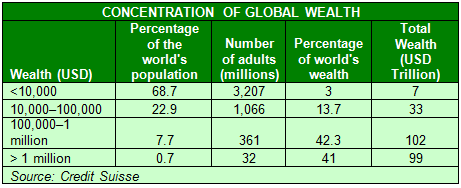
According to Swiss bank Credit Suisse, 10% of the global population holds 86% of all the assets in the world, while the poorest 70% (more than 3 billion adults) hold just 3%.
"By some measure, the riches of billionaires are now unparalleled in history."
GATES' THEORY
Bill Gates, the world's richest man by most accounts, and who now spends his time on philanthropic causes through the Bill and Melinda Gates Foundation, seems to disagree with the assertion that inequality is rising.
In his annual letter, Gates noted that the world has never had it better.
"By almost any measure, the world is better than it has ever been. People are living longer, healthier lives," he said in a letter co-written with his wife Melinda who is also the co-chair of his foundation. "Many nations that were aid recipients are now self-sufficient. You might think that such striking progress would be widely celebrated, but in fact, Melinda and I are struck by how many people think the world is getting worse."
Dispelling myths about poverty, Gates says regions like Africa are far better than they were 50 years ago.
"Income per person has in fact risen in sub-Saharan Africa over that time, and quite a bit in a few countries," Gates argues. "After plummeting during the debt crisis of the 1980s, it has climbed by two thirds since 1998, to nearly [USD 2,200] from just over [USD 1,300]. Today, more and more countries are turning toward strong sustained development, and more will follow. Seven of the 10 fastest-growing economies of the past half-decade are in Africa."
Indeed, he goes so far as to say that "by 2035, there will be almost no poor countries left in the world."
But income per capita is often a deceptive statistic.
Oxfam research shows that the top 10% of the population in each of the five populous nations have seen their wealth rise, while the bottom 40% saw their incomes decline - with the gaps widening considerably over time.
Gates example of Sub-Saharan Africa prosperity is also misleading. While investments in natural resource have transformed many African economies, inequality remains rampant, and rising per capita have done little to cut poverty reduction. In fact, there is a positive correlation between the level of resources African countries export and their levels of inequality, Oxfam said.
THREAT TO STABILITY
It is a common gripe of the have-nots: the richer are getting richer and the poor are getting poorer. But statistics show that the system is increasingly becoming rigged in favor of the very wealthy, leaving the poor with fewer and fewer resources to fight over.
Oxfam notes that the rising concentration of wealth presents a global threat to stable, inclusive societies for one simple reason: the unbalanced distribution of wealth skews institutions and erodes the social contract between citizens and the state.
"The checks and balances in place to ensure that the majority of the population are heard tend to weaken. Concentration of income and wealth actually hampers the realization of equal rights and opportunities because it makes political representation harder for disadvantaged groups, to the benefit of affluent groups. It has happened in the past and unless we pay close attention to the worrying trends outlined here, it can happen again."
© alifarabia.com 2014